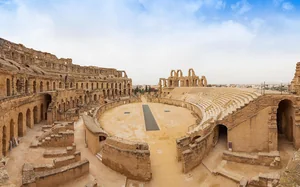
You can hear the crowd before you even see it. Not today’s crowd, mind you — but the imagined roar of twenty thousand Romans packed into an oval of stone, cheering for charioteers and gladiators. The Arles Amphitheatre stands at the heart of this sun-soaked Provençal town, a colossal relic that somehow feels alive. Its double rows of arches rise above the cafés and narrow streets, golden limestone glowing in the southern French light. And when you walk through that vaulted passage, you’re not just sightseeing. You’re time-traveling.
This is no crumbling ruin you peer at from behind a rope. It’s a working, breathing monument — one that still stages bullfights, concerts, and festivals today. The Arles Amphitheatre is famous because it refuses to be buried by history. It’s the most recognizable landmark in Provence, a symbol of how Rome’s reach extended into the heart of Gaul. For travelers, it’s a chance to stand where ancient spectators stood, to touch walls built two thousand years ago, and to look out over a patchwork of terracotta rooftops toward the Rhône. First impressions? Expect awe. Expect goosebumps. Expect to feel very small and very lucky.
You’ll also feel the weight of time. The amphitheatre wasn’t always the tidy, evocative monument you see today. It was a fortress, a neighborhood, a prison — sometimes all at once. That’s what gives it its layered, almost haunted beauty. The stones remember everything.
The story begins in the late first century AD, around 90 AD, when Roman engineers selected a hill on the northern edge of Arles (then called Arelate) for a grand entertainment venue. They built an ellipse measuring 136 meters long, with a massive facade of two arcaded tiers and a third attic tier above that. Originally, it could hold over 20,000 spectators — more than the town’s entire population at the time. The Romans didn’t do anything halfway. They included a complex system of stairways called vomitoria, designed to disgorge crowds in minutes. The central arena hosted gladiatorial combats, wild beast hunts, and public executions — brutal spectacles that kept the masses placated and entertained.
But Rome fell, and the amphitheatre’s fortunes shifted. By the fifth century, the Visigoths had turned the arena into a fortress, and later the Arabs used it as a stronghold during their brief occupation. The real transformation came in the Middle Ages. The amphitheatre became a walled town in itself, with over 200 houses, a chapel, and even a small square crammed into what was once the central fighting ground. The towers of the medieval fortification — the Tour de Roland and the Tour de la République — still peek out from the ancient walls today. It wasn’t until the nineteenth century that authorities began clearing away the urban clutter. In 1826, the French government purchased the structure and launched a massive restoration, relocating the residents and peeling back centuries of additions to reveal the Roman skeleton. A century later, in 1981, UNESCO listed it as part of the Arles Roman and Romanesque Monuments.
So what should you do when you step inside? First, take your time in the vaulted galleries. Walk the full circuit of the lower arcade, where ancient ticket-holders once shuffled to their seats. You’ll find informative panels explaining the amphitheatre’s evolution, including old photographs and engravings. But the real magic starts when you climb. Head for the upper terraces, where the view opens up like a postcard. From the south tower, you can see the entire arena below — and beyond it, the rooftops of Arles, the mighty Saint-Trophime church, and the Alpilles mountains shimmering on the horizon. This is the best photo spot in the whole city. Bring a wide-angle lens, but also just stand there for a while. Let the wind do the talking.
The arena floor itself is worth your feet. When there’s no event scheduled, you can wander across the sand where gladiators once bled. Yes, that’s sand — imported and spread just as the Romans did. You might spy the remains of the underground service corridors near the center, where animals and stage machinery were hoisted up. It takes about one to two hours to explore thoroughly, depending on how many photos you take and how long you linger on the ramparts. But honestly, you could easily spend half a day here, sitting in the shade of an arch and watching the light shift.
Tickets are reasonably priced — around 10 euros for adults, with reduced rates for students and seniors. You can also purchase a combined pass that includes other Arles monuments like the Théâtre Antique and the Cryptoporticus, which is a great deal if you’re planning to explore further. The amphitheatre is open year-round, but hours vary by season, so check in advance. Arrive early in the morning, before the tour groups and the heat, and you might have the terraces almost to yourself. Those early moments are precious — the arena sits silent, the only sound being the cooing of pigeons echoing through the stone arches.
Now, the hidden gems. Most visitors miss the two medieval towers. Climb the narrow spiral staircase of the Tour Roland to see the old defensive structure intact, complete with arrow slits and a rooftop view over the town. Also, look for the small exhibition space within the monument dedicated to the history of bullfighting in the Camargue region. It’s easy to overlook, but it gives context to the modern events still held here. And if you’re lucky enough to visit during the Fête du Costume or a performance of the Provençal bull races (courses camarguaises), you’ll experience the amphitheatre exactly as it was meant to be — alive and loud. Those events don’t happen every day, though. Check the local calendar, but don’t be disappointed if you miss them; the empty arena has its own story to tell.
One more tip: notice the patchwork of repairs. Some stones are smooth and ancient, others are rough and modern. The restorers used different materials to show what’s original and what’s new. This honest approach lets you appreciate the amphitheatre’s long journey — from a Roman playground to a medieval fortress, a residential maze, and finally a national treasure. The Arles Amphitheatre isn’t just a monument. It’s a stubborn survivor. And when you walk out through its massive arches, back into the modern bustle of Arles, you’ll know you’ve touched something eternal.
