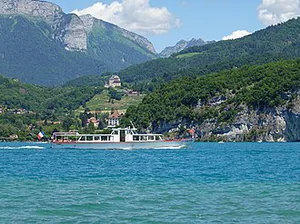
You haven’t truly seen water until you’ve stood on the shore of Lake Annecy. It’s not blue, exactly, and it’s not green either. The color shifts like liquid turquoise, a glacial cocktail of mineral silts and pure mountain snowmelt. Tucked in the crinkled foothills of the French Alps, this lake looks like something a film director would paint for an impossible dream. But it’s real. And it’s waiting.
For centuries, travelers have called it Europe’s cleanest lake, and that’s not just a cliché. The water is so clear you can see fish darting around the pebbles ten meters out. The air smells of pine and fresh alpine herbs. On any given morning, the cliffs on the far shore mirror themselves in the flat, glassy surface, while a few brave swimmers make their way across the bay. If you’re looking for a place that makes your shoulders drop and your breathing slow, this is it.
But Lake Annecy is more than a pretty postcard. It’s a living, breathing playground. Cyclists glide along its 40 kilometers of shoreline paths, paddleboarders trace lazy arcs against a backdrop of jagged peaks, and old-fashioned pedalos bob near the flower-draped quays. The town of Annecy, with its pastel houses and humpbacked bridges, crowds right up to the water’s edge. And behind it all, the mountains rise like protective giants. This is a place that demands you slow down, look up, and let the sheer beauty do its work.
The lake itself was born of ice, and its story goes back around 18,000 years. When the great Würm glacier retreated at the end of the last Ice Age, it gouged out a deep basin in the earth. Melting water filled it, leaving behind this extraordinary 2,800-hectare body of water. For thousands of years, the lake sat wild and unclaimed, home to beavers, otters, and the occasional prehistoric settler who carved dugout canoes from oak trunks.
The human story really began around the 12th century, when the Counts of Geneva chose a small riverside settlement on the lake’s northern tip as their seat of power. That settlement grew into today’s Annecy. The lake itself was not just a pretty view; it was a highway, a food source, and a natural fortress. Fishermen cast their nets, traders shipped timber and wine, and the abbeys that sprang up on the shores prospered on the lake’s abundance. By the 16th century, the town had become a refuge for Catholic bishops fleeing Calvinist Geneva, which gave Annecy its nickname, the ‘Rome of the Alps.’ But the lake remained surprisingly unchanged, mired in marsh and reed on its southern shores.
The great transformation came in the 19th century. In 1862, France’s Emperor Napoleon III himself came to open what locals still lovingly call ‘the beautiful era.’ A grand dike was built at the north end, draining the malaria-infested marshes and joining the lake to the Fier River through a canal. That single project made the shoreline habitable and drivable, and suddenly the Alps’ best-kept secret got a lot less secret. Wealthy French and English tourists started arriving on the new steamship lines and stayed in elegant villas, many of which still grace the eastern shore today. By the early 20th century, Lake Annecy had become a playground for the rich, and its traditions of sailing and water sports were born.
Today, the lake is a protected marvel. Since the 1960s, strict environmental laws have banned motor oil, limited boat noise, and connected every lakeside village to an advanced sewage-treatment system. That relentless focus on purity is exactly why the water still looks the way it did a thousand years ago. And the best part? You’re actively invited to jump right in.
So what should you actually do once you’re here? Start with the lakefront promenade, the Thiou Canal, and the Pont des Amours. This elegant arched footbridge is the classic postcard spot, especially at sunset when the lights of the town flicker on and the water turns a warm amber. Walk across it slowly. Look left at the Palais de l’Ile, a 12th-century prison in the middle of the canal, and look right at the turquoise water stretching toward the mountains. This is your first ‘wow’ moment. Bring your camera, but honestly, no photograph will ever do it justice.
A full visit deserves at least three to four hours, and a whole day if you want to truly sink into the experience. The lake itself has no entrance fee; you can dip your feet, sunbathe on the grassy shores, or picnic for free along the extensive public beaches. But if you want to get out on the water, that’s where some money comes in. You can rent a pedal boat for about 15 euros an hour, take a guided kayak tour for around 30 euros, or hop on one of the classic tourist boats that cruise the lake for a few hours. Those cruises aren’t cheap, starting around 50 euros for a full loop, but they give you an unmatched view of the Alps from the middle of the lake. For budget travelers, the ‘little train’ that circles the town is a silly but fun way to get your bearings.
One of the great hidden gems is the Roc de Chère nature reserve, a steep cliff on the eastern shore that most visitors never find. You’ll have to ask a local or follow the narrow footpath from the village of Menthon-Saint-Bernard, but once you’re up there, the reward is a panoramic view of the lake framed by pines and limestone. Up at that height, the water below you turns an even deeper shade of turquoise, and you might see swifts and eagles circling in the updrafts. Another secret? The tiny beach at the southern end, called Plage d’Angon, is far quieter than the busy town beaches and perfect for a lazy afternoon with a book.
When is the best time to go? Early June or September, hands down. The water is swimmable from May through October, but the summer crowds can turn the main beaches into a sardine tin. Come in the shoulder seasons, and you’ll find the lake calm, the locals out with their dogs, and the sunlight soft across the water. Mornings are ghostly quiet, great for a jog or a coffee along the quay. Evenings turn the lake into a mirror of orange and pink, and the distant sound of a saxophone sometimes wanders over from the old town. A visit to Lake Annecy is not just sightseeing; it’s a full immersion into a world where water and stone and sky have struck the perfect ancient bargain. Come, and leave your stress at the alpine pass.
