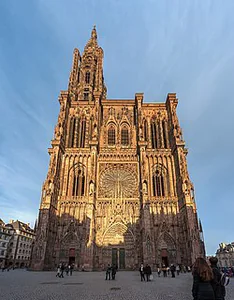
You see it long before you reach the heart of Strasbourg — a single, impossibly delicate spire piercing the sky from across the flat Alsatian plain. Then you round the corner into the Place de la Cathédrale, and she hits you: a massive facade of pinkish sandstone, carved with more statues and tracery than your eyes can possibly absorb in one glance. This is Strasbourg Cathedral, a masterpiece of Gothic architecture and one of the most awe-inspiring buildings in Europe. For over two centuries, it was the tallest structure on Earth, and while the title has long since been claimed by skyscrapers and radio towers, walking beneath that lace-like spire still feels like standing in the shadow of the impossible.
Built to honor the Virgin Mary, this cathedral doesn’t just mark the city’s skyline; it defines it. Its peculiar charm lies in the material itself — the Vosges sandstone glows warm and rosy in the morning light, shifts to a fiery orange at sunset, and turns a soft violet during the long summer twilights. Locals call it “the pink angel.” Victor Hugo poetically called it a “delicate and gigantic marvel.” And he wasn’t wrong. You’ll spend your first ten minutes here just tilting your head back, trying to take in the absurd level of detail — hundreds of tiny figures, demons, saints, animals, and geometric designs covering every inch of the stone. It’s a visual overload in the best possible way.
Now, a bit of history. The cathedral’s story begins in 1015, when Bishop Werner of Habsburg laid the foundation of a Romanesque basilica on the site of a much older church. Fire destroyed much of that structure in the 12th century, and so in 1176, the city decided to rebuild — this time in the newer, soaring style coming out of France: Gothic. The great façade we see today was started around 1277, largely under the direction of master architect Erwin von Steinbach, whose name appears in medieval records and who gave the facade its breathtakingly intricate two-dimensional design — more like a monumental screen of stone lace than a solid wall.
The real triumph came in 1439, when the single spire was completed. Most cathedrals of this ambition had two towers planned, but Strasbourg built one and made it a world record. At 142 meters, it remained the tallest building on Earth until 1874, when St. Nikolai’s Church in Hamburg finally overtook it. This single spire, with its open, interlacing tracery, looks less like a solid structure and more like a frozen musical idea. The Reformation added another layer of drama: Strasbourg became a Protestant city, and the cathedral was given to the Lutheran faith for a time, which is why you’ll see an unusually harmonious mix of religious imagery and pragmatic civic iconography inside. And it survived two world wars — hidden away behind protective layers of sandbags, but never truly damaged. The cathedral has been watching over this river-crossing city for six centuries, and it shows no signs of stopping.
Step inside, and you’ll immediately feel the great Gothic game of light and stone. The first thing to seek out is the famous Astronomical Clock — a massive, 18-meter-tall mechanism installed in the cathedral’s south transept. Built in the 19th century, but with earlier predecessors dating back to the 14th, it’s like a church within a church. At 12:30 each afternoon, the mechanical figures come alive: automaton apostles march past Christ in a slow, stately procession, while a rooster crows. It’s charming, a little eerie, and utterly unmissable. Give yourself fifteen minutes just to watch the mechanism and read the intricate dials that show the positions of the planets, the phases of the moon, and even Easter’s date for the next century.
Also inside, don’t miss the Pillar of Angels in the south transept — a tall, square pillar carved with dramatic figures representing the Last Judgment. It’s often called the “pillar of the angels” because of the twelve carved celestial beings spiraling around it, and the detail will send chills down your spine. Then look up at the stained glass. Some windows date back to the 12th and 13th centuries, and they glow with a color depth that no modern reproduction can achieve. The rose window on the western façade is a massive, radiant wheel of jewel tones, and the north and south aisles hold stunning medieval compositions of emperors, prophets, and apostles. If you’re lucky, a gentle light will fall through them in a particular way — you’ll understand why the Gothic builders called it “divine light.”
How long do you need? A thorough visit takes about 90 minutes to two hours, not counting the tower climb. Admission to the cathedral itself is completely free — you can simply wander in during opening hours, which are generous all week. Climbing the tower, however, requires a small ticket (around 8 euros), and you’ll want to plan ahead because the narrow spiral staircase can get crowded, and the views are a major draw. On a clear day, you can see all the way across the Rhine to the Black Forest. For photography, there are several great spots. From the Place de la Cathédrale directly in front, you can capture the entire facade — but go early in the morning to avoid the crowds and to see the pink stone in golden light. A less obvious angle is from the terrace of the nearby Palais Rohan — you’ll get a beautiful diagonal view with the spire against the sky. And if you can manage a short walk, the Ponts Couverts across the river offer a classic silhouette of the cathedral rising above the rooftops.
Now, the hidden gems. Most tourists rush straight for the clock and miss the subtle details that make this cathedral truly unique. Find the tiny stone dog carved at the base of one of the pillars in the south aisle — a small joke left by medieval stone masons. Seek out the Romanesque crypt, tucked beneath the choir, which predates the Gothic masterpiece above and feels like a somber, cavernous time capsule. And don’t miss the pulpit, carved in 1486, with its curious relief of a fox preaching to geese — a satirical jab at corrupt clergy that the common folk of Strasbourg would have recognized immediately. Finally, look down at the labyrinth line in the nave floor: a faint, circular maze that medieval pilgrims used to trace on their knees as a form of prayer. It’s barely visible now, but if you know where to stand — about halfway down the nave, near the choir, you’ll see the darker stones that set it apart from the rest.
Strasbourg Cathedral isn’t just a building you visit; it’s a stone book of six centuries of European history, faith, and craftsmanship. You could stand in the nave for an hour and still see new faces hiding in the carvings. You could climb that spire and feel the wind move the very stone beneath you. It’s pink, it’s intricate, it’s sometimes overwhelming — and it’s utterly unforgettable. So take your time. Let the crowds move around you. The cathedral has been waiting for you for 800 years; she’ll wait a little longer while you stare.
