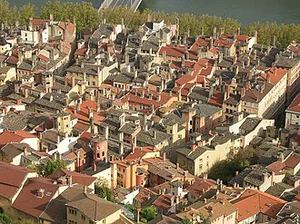
You’ll spot it from across the Saône, a honey-colored patchwork of tiled roofs and russet facades climbing toward the hill of Fourvière. But Vieux Lyon—the city’s old town—doesn’t need a grand reveal. It whispers. Its charm hides in narrow passageways called traboules, in hidden courtyards where laundry crisscrosses like festive bunting, and in the scent of garlic and red wine drifting from a bouchon at lunchtime. This isn’t a museum-piece quarter, though UNESCO crowned it a World Heritage site in 1998. People live here. Their bikes lean against Renaissance arches; their cats nap on medieval stone thresholds. You’re not just visiting a landmark. You’re stepping into a pulse that has beaten since Roman times.
What makes Vieux Lyon so extraordinary? It’s one of the largest intact Renaissance neighborhoods in Europe—roughly 500 hectares of it. Forget Paris for a moment. Here, you can wander for hours without hearing a car horn. The city’s modern heart presses against its old soul, but somehow the ancient part refuses to yield. You get that rare double-take feeling: one moment you’re walking past a hip café serving oat-milk lattes; the next, you’re under a vaulted passage that smells of damp stone and 500 years of stories. It’s an contradiction that feels utterly natural.
History runs through Vieux Lyon like the Saône itself. The site began as the Roman town of Lugdunum, founded in 43 BC. Those Romans chose wisely—the hills gave protection, the rivers gave trade. But the Vieux Lyon you see today is mostly a heartbeat from the 15th and 16th centuries. That’s when Lyon became Europe’s silk capital, and Italian merchants—especially Florentines fleeing political chaos—arrived with deep pockets and even deeper aesthetic ambitions. They built townhouses with soaring courtyards, galleries, spiral staircases, and grotesque stone masks peeking from walls. These weren’t just homes; they were business cards. Wealthy silk merchants commissioned Italian artists and architects, which is why you’ll spot flamboyant Italianate ornament abruptly colliding with French Gothic. The result? A style unique to Lyon.
The traboules—secret passageways threading between streets—are the old town’s signature. They began as practical shortcuts for workers carrying silk through rain and riverside muck. Later, during World War II, they became escape routes for the Resistance, allowing people to vanish from the Gestapo in seconds. Walking through one now, you’ll feel the hush. The only sounds are your footsteps and the occasional drip from a hidden fountain. Some are open; some are private, marked discreetly with a sign. But in Vieux Lyon, those that are accessible are so frequent you’ll quickly lose your sense of geography. That’s the fun of it. Get lost. You’ll stumble into a courtyard that looks like an abandoned film set—and maybe that’s exactly what it is, because Ridley Scott filmed part of “The Hunger” here.
Now, let’s talk about what not to miss. Start at Place Saint-Jean, the old town’s living room. On the south side, Cathédrale Saint-Jean waits, its Gothic facade a mix of grace and grit. Inside, don’t just glance at the famous astronomical clock—an intricate 14th-century machine that still boasts automata and a rather smug rooster. Give yourself a good ten minutes just to watch it fold out its wings at noon. If you’re feeling curious about the city’s past, the Gadagne Museum, a gorgeous Renaissance mansion, tells Lyon’s story through quirky objects and tasteful interactive displays. But for pure fun, the Museum of Miniature and Cinema is unforgettable. It’s housed in a stunning baroque building and holds over a hundred hyper-detailed miniature scenes—some so realistic you’ll expect them to breathe. Allow an extra hour; you’ll need it.
How much time do you actually need? Honestly, you could rush Vieux Lyon in a morning, but that would be like drinking a vintage wine in one gulp. Give it at least four to six hours. Start early, when sunlight slices through the alleys and bakers are pulling fresh pralines out of the oven. Then let the day stretch. This is a snack-and-wander place, not a checklist place. Most attractions inside the quarter charge modest fees—the cathedral is free, as are the public traboules. The museums range from €7 to €10, and they’re worth every centime. But the true currency here is time. The longer you linger, the richer you’ll feel.
For photo spots, skip the obvious selfie-by-the-cathedral shot—which is lovely, but everyone has it. Instead, turn left onto Rue de la Bombarde and find the little Passage de la Baleine. Its name means “whale” and, sure enough, a carved whale spouts from the facade. Then aim for Place de la Baleine, a tiny square that feels like a stage set. Best moment? Late afternoon, when the light turns everything the color of apricot jam. Another gem: the traboule at 54 Rue Saint-Jean. Enter it, and you’ll find a courtyard of pure serenity, complete with a well and a staircase that seems to twist upward forever. Climb to the top floor and look back down into the well—that’s a shot most visitors miss.
Speaking of hidden gems, here’s a lesser-known secret: the Tour Rose—a tiled turret that looks like it belongs in an Italian hill town. It’s not really accessible to the public, but you can see it brilliantly from the courtyard at 16 Rue du Bœuf. You’ll have to peer over a gate, but that’s fine. Part of the allure is the sneaking. Another under-the-radar experience is the traboule at the end of Rue Saint-Paul, which opens onto the medieval Saint-Paul district. It’s quieter than the tourist thrum, and you might catch a flash of the wooden houses that make this corner feel almost like a fairy tale.
Now, for the practicalities that make a place sing. Inside Vieux Lyon, you’re never far from a quiet bench or a hidden fountain to rest your feet. But do yourself a favor: stop at a bouchon—the traditional Lyonnais eatery—for a long, lazy lunch. These cork-walled bistros serve serious food: andouillette, quenelles, and the famous praline tart for dessert. You’ll need a reservation at most of them. And while the main streets get crowded by midday, the rear courtyards often stay blissfully empty. So don’t be afraid to wander past the souvenir shops. The real old weirdly wonderful is always one passageway away.
A final thought: Vieux Lyon doesn’t announce itself. It seduces. You might come for the Renaissance architecture and the secret passageways, but you’ll stay for the feeling of being inside a history book that’s still being written. Whether you’re trailing your fingers along a 16th-century wall, chasing the shadow of a gargoyle, or just sipping an espresso as a bicycle echoes down an alley, this place gets into your bones. It’s no wonder those Florentine merchants never left. You won’t want to, either.
