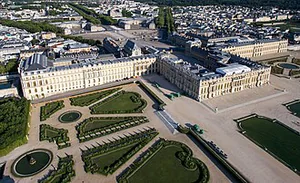
Imagine standing in a room where every ceiling swirls with painted gods and every corner glints with gold. That’s the Hall of Mirrors at Versailles, and it’s just one fleeting moment in a palace designed to make ordinary mortals feel like royalty. The Palace of Versailles, a UNESCO World Heritage site on the western edge of Paris, isn’t just an old building. It’s a statement. It’s French absolutism frozen in marble, a theatrical stage for kings, courtiers, and centuries of history.
For most visitors, the first glimpse arrives through the gilded Porte Royale, the golden gate that flashes in the sunlight and sets the tone for everything inside. You’ll wander through state apartments draped in velvet, past chandeliers the size of small cars, and out onto terraces that overlook a garden sculpted into geometric perfection. It’s overwhelming, in the best way. And before you even check your phone, you’ll understand why so many world leaders and celebrities still make a pilgrimage here.
This is not a museum you can rush. It’s a world built to be savored—and once you learn the story behind it, every silk wall and carved doorway starts to whisper.
Versailles began as something far humbler: a modest hunting lodge for Louis XIII. In 1623, he came here to escape Paris and chase deer through the wooded countryside. His son, Louis XIV—the Sun King—saw far bigger potential. Between 1661 and his death in 1715, he transformed the lodge into the grandest palace in Europe. Architects Louis Le Vau and Jules Hardouin-Mansart expanded the structure, while painter Charles Le Brun filled ceilings with allegorical scenes, and garden designer André Le Nôtre laid out the vast, symmetrical grounds. In 1682, Louis XIV moved his court and government here permanently, pulling thousands of nobles into a golden web of etiquette and routine. By keeping them close, he kept them busy. And by keeping them busy, he kept them from causing trouble.
The palace saw revolution coming in 1789. King Louis XVI and Marie Antoinette were forced back to Paris by an angry crowd, and Versailles never again served as the royal seat. For a time, the palace stood nearly abandoned, looted and stripped of its furniture. Napoleon didn’t bother with it. Later French kings restored some rooms, but it wasn’t until 1837 that Louis-Philippe turned the palace into a museum dedicated to all the glories of France. During World War I, the Hall of Mirrors even gained another chapter in history: the Treaty of Versailles was signed there in 1919, closing out the war and reshaping the map of Europe. Today, thanks to decades of meticulous restoration, Versailles shines as one of France’s most powerful symbols—a place where art, politics, and sheer human ego collide.
Once you’re inside, start with the King’s State Apartments. Go early and you can trace the daily rituals of Louis XIV, from the enormous bed in the King’s Chamber to the salons named after planets and mythological gods. The Hall of Mirrors is the undeniable highlight—73 meters long, 357 mirrors facing arched windows that pour in natural light. Give yourself a few quiet minutes just to look at the ceiling. Then move on to the Queen’s Apartments, where Marie Antoinette slept, and don’t miss the Opera Royal, a marvel of wooden architecture built for royal weddings and performances.
As for time, the honest answer is that you need more than you think. At minimum, plan for half a day—four to five hours—just for the palace and gardens. If you want to explore the Grand Trianon, Petit Trianon, and Marie Antoinette’s estate, turn that into a full day. Versailles is enormous, so wear comfortable shoes. Your feet will thank you by the time you reach the Grand Canal.
Tickets are straightforward. A passport ticket gives you access to the palace, the Trianon estates, the gardens, and the Coach Gallery. Timed entry is essential in peak season, especially for the palace itself. You’ll pass through security lines, so build in a little buffer time. Grab an audio guide or the official app—it brings the rooms to life with royal anecdotes and historical detail. On a budget? The gardens are free on most days, though the palace always requires a paid timed ticket. Also check the official opening days carefully; the palace is closed on Mondays, and parts of the estate shut down during winter for maintenance.
Let’s talk photos. The Hall of Mirrors is best shot early in the morning when crowds are thin—position yourself near the central windows for a symmetrical reflection shot. The golden gates outside provide a stunning foreground for a wide-angle view. For a different angle, walk to the top of the palace steps and look out over the Parterre du Nord; the rows of manicured greenery stretch out like a page of calligraphy. And here’s a little secret: the courtyard behind the Royal Chapel is usually much quieter, with beautiful limestone arches and a perfect view of the spire.
Don’t forget the hidden gems. Most visitors rush through the state apartments and miss the small, private rooms tucked away upstairs—the King’s private cabinet and library are intimate spaces that feel a world apart from the glittering state rooms. In the gardens, wander away from the main paths and you’ll find groves that offer peaceful, shaded escapes. The Bosquet de l’Encelade is a quiet favorite, complete with a striking statue and gentle fountains. Marie Antoinette’s Hamlet, a rustic village with thatched cottages and a working dairy, feels like a strange, charming fantasy world. You’ll be shocked at how quickly the crowds vanish once you step into these lesser-known corners. That’s when Versailles truly becomes personal—when you’ve left the royal crowds behind and started discovering secrets of your own.
