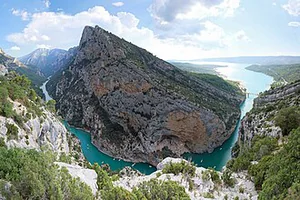
There’s a place in the south of France where the water looks painted. Not a real color, you’d think—not a river you can trust. The Verdon River pours through the Verdon Gorge in shades of electric turquoise, so vivid that postcards seem tame. One second you’re standing on a limestone cliff, dizzy above a silent crease in the earth. The next, you’re staring down at a thread of glowing jade winding a thousand meters below. It doesn’t feel like a river. It feels like the setting for a legend.
This is Verdon Gorge, Europe’s own Grand Canyon, tucked into the wild heart of Provence. It stretches for about 25 kilometers through the limestone plateau of Haute-Provence, with cliffs that plunge up to 700 meters to the riverbed below. But unlike Arizona’s monochrome masterpiece, this canyon is a riot of color—ochre rock, midnight-green pines, and that impossible river. It’s not just a place to look at, though. You can hike its trails, paddle its rapids, swim in its pools, and even sleep beside its rim. The gorge rewards the curious with a thousand different views, each one more dramatic than the last.
For decades, travelers have called it one of the most beautiful gorges in Europe. That’s no exaggeration. But the scale doesn’t hit you from a photo. You need to feel the sheer humidity rise from the river on a summer morning, to hear the echoes of your footsteps on the Sentier Blanc-Martel, to stand on a ledge and watch golden eagles spiral above the abyss. That’s when Verdon Gorge stops being a picture and becomes a world.
History runs through this canyon like the river itself—slowly, patiently, then suddenly fierce. Geologists say the Verdon has been slicing through the limestone plateau for about 250 million years, though the canyon you see today formed mostly in the last few million. As the land rose, the river kept its course, cutting downward into a maze of gullies, caves, and hairpin bends. The result is one of the deepest river gorges in Europe, and a stroke of pure geological luck.
The name ‘Verdon’ comes from the Latin ‘viridis,’ meaning green, a nod to the river’s distinctive emerald complexion. People have lived in these hills since prehistoric times, leaving traces in caves and rock shelters. The Romans built roads through the region, and by the Middle Ages, the gorge had become a natural barrier between warring lords. For centuries, local shepherds used precarious paths along the cliffs, and the area remained wild, remote, and almost mythical.
It wasn’t until 1905 that the outside world truly discovered the gorge. That year, the legendary French speleologist Édouard-Alfred Martel led one of the first recorded descents of the Verdon through its entire canyon. He traveled by boat and on foot, battling rapids, sheer drops, and dead-end chasms. His expedition proved the gorge wasn’t just a vertical maze—it was one of France’s greatest natural wonders. Within decades, engineers carved the now-famous Route des Crêtes along the southern rim, and viewpoints like Point Sublime opened the abyss to ordinary visitors.
The second turning point came in the 1970s, when the construction of the Sainte-Croix dam backed up the river to create the vast Lake Sainte-Croix. The dam, completed in 1974, supplies hydroelectric power and flood control, but it also changed the gorge’s personality. The lower section now empties into a shimmering blue lake that feels beautifully surreal, edged by jagged cliffs. It’s a man-made addition, yes, but the result has become almost as beloved as the gorge itself. And it’s the reason you can rent a kayak, paddle into the canyon’s mouth, and feel like a character in an adventure film.
Today, Verdon Gorge gives you a full menu of ways to experience it. The classic starting move is the scenic drive along the Route des Crêtes, a winding road that hugs the southern rim. You’ll pass pullouts with guardrails, each revealing a new tilt of the canyon. If you stop at Point Sublime, you’ll see why it earned that name—a dramatic overlook at the ‘Grand Canyon du Verdon.’ Deeper into the gorge, the Balcon de la Mescla offers a less crowded, spine-tingling view of the river’s sharp hairpin turn. Photographers, bring a wide lens and your patience; the light shifts every few minutes.
For hikers, the sentier (trail) that belongs at the top of your list is the Sentier Blanc-Martel. It’s about 13 kilometers of switchbacks, staircases, and narrow ledges etched into the cliff, usually taking five to six hours. You descend into the canyon, cross the river twice, and climb the far side, with the turquoise water always below your footsteps. It’s demanding but utterly unforgettable. For something shorter, the easy walk to the Point Sublime viewpoint is a quick taste of the grandeur. And if you’re here between May and September, don’t skip a kayak or canoe trip on the river itself. No permit is required for paddling, but you’ll see why those turquoise waters are legendary as you glide through mirrored gorges.
Time is your most precious resource here. To do justice to the gorge, give it a full day—at least. With a single day, you can drive the Route des Crêtes, take a short hike, and dip into the river at one of the swimming spots near Lake Sainte-Croix. If you’re serious about the Blanc-Martel trail, plan a full day just for that, with early start. And if you want the true immersive experience, give Verdon Gorge two or three days. You’ll want time to linger, to watch the sunset set the cliffs on fire, and to wake up to the hum of bees in the scrubland.
Most of the gorge is freely accessible. There is no single ticket gate, no turnstile to buy your way through the magic. You will, however, pay for parking at many of the popular viewpoints—often a few euros per car. The Sentier Blanc-Martel is also free to walk, though the access roads can charge small parking fees in high season. For kayaking and other water activities, you’ll be paying local outfitters, so it’s best to check ahead during peak months. Honestly, the gorge itself is a bargain, especially when you consider that the most breathtaking views in France are largely open to the sky.
As for the best photo spots, you can’t go wrong with Point Sublime at golden hour, or the now-famous view from the bridge at Galatas, northeast of Moustiers-Sainte-Marie. That’s the postcard angle where the turquoise water fans out into the lake. But here’s a lesser-known tip: walk to the Balcon de la Mescla, especially late in the day, when the crowds have thinned. You’ll stand directly above the violent corridor where the river rushes through a narrow slit of rock, and for a moment, you’ll hear nothing but the wind and the icy blue water. It feels secret. It feels like the gorge only belongs to you.
Hidden gems go beyond viewpoints, too. Tucked near the eastern entrance of the gorge is the Chapel of Saint-Croix, a tiny stone church from the 12th century, sitting alone in the woods above the lake. And if you want to escape the heat, follow the small footpath to the cool, shadowy mouth of the Baume de l’Ôusse, a cavern carved into the gorge wall. These are the quiet corners where you’ll find the true heartbeat of the Verdon—away from the coaches, the selfie sticks, and the hum of engines. The real magic is never on the map. You just have to wander.
Verdon Gorge is not a place to tick off a list. It’s a place to slow down, look up, and remember that nature still knows how to make you feel small. Whether you arrive for the postcard views, the heart-pumping hikes, or the simple joy of swimming in that impossible blue, you’ll leave with something deeper than a souvenir. You’ll leave with the sound of wind in the gorge, and the color of a river that can’t possibly be real. It is. It’s right there, waiting for you.
