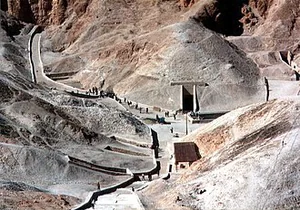
The Valley of the Kings sits on the west bank of the Nile, a silent, sun-baked canyon that looks less like a royal burial ground and more like a forgotten alien landscape. Golden limestone cliffs rise in jagged folds, and the heat shimmers off the rocks, making you squint even under a wide-brimmed hat. But beneath this barren surface lies one of the most extraordinary legacies of the ancient world: a labyrinth of tombs carved 3,000 years ago. This isn’t a single monument — it’s a city of the dead, home to pharaohs like Tutankhamun, Ramesses the Great, and Seti I.
For centuries, the valley remained in darkness, untouched by time. In 1922, Howard Carter’s discovery of Tutankhamun’s intact tomb sent a shockwave around the globe. The golden mask, the chariots, the alabaster perfume jars — they all emerged from this arid gorge, fresh as if sealed just days ago. Today, you can walk the same rugged paths, descend into the same cool chambers, and stand before wall paintings that still shimmer with original blues and reds. Few places on Earth feel so intimately connected to the ancient past.
The story of the Valley of the Kings begins around 1539 BC, during Egypt’s New Kingdom. Earlier pharaohs built pyramids, but those massive monuments invited grave robbers. So the rulers of the 18th, 19th, and 20th dynasties chose a hidden, naturally pyramid-shaped peak called el-Qurn — the horn — to guard their final resting places. The first king buried here was likely Thutmose I, on the orders of his vizier and architect, Ineni. Together, they carved a deep, secret shaft in the rock, closing it with rubble. The plan was brilliant and morbidly practical: a hidden necropolis where the bodies of Egypt’s most powerful men could sleep in peace.
Over the next five hundred years, more than sixty tombs were dug into the valley’s limestone. Workers, left-bank villagers, scribes, and artists lived nearby in a purpose-built settlement called Deir el-Medina. They toiled by lamplight, chiseling out corridors that stretched as deep as 100 meters, painting scenes from the Book of the Dead, and storing the king’s entire afterlife wardrobe. But secrecy didn’t ensure safety. Tomb robbery was rampant even in antiquity, and most royal mummies were moved to hidden caches by priests. By the time the last king, Ramesses XI, was buried around 1077 BC, the valley had been thoroughly looted. Still, its purpose and scale remain staggering — a forgotten engineering achievement that predates Rome and rivals the pyramids in ambition.
When you enter the valley today, the first thing that strikes you is how open and natural it feels. Small signage marks the tombs, and a sleek tourist train ferries visitors between the entrance and the main sites. You’ll want a decent flashlight, because the interior corridors are lit with dim bulbs — and the best way to see the artistry is to point your beam directly at the reliefs. Most visitors start with the tomb of Ramesses VI, which is a spectacle of celestial ceilings and star-filled vaults. Then head to Ramesses III’s tomb, the longest in the valley at over 125 meters, with its vivid scenes of daily life mixed with religious rituals. And you can’t miss the tomb of Seti I, a masterpiece of art with finely carved and painted reliefs — though it’s often closed for conservation, so check the board at the ticket office.
The most famous tomb, Tutankhamun’s, is smaller and less visually impressive than the others, but it packs an emotional punch. You’ll descend a steep staircase, pass through the burial chamber, and see the restored stone sarcophagus that once held the boy king. His actual mummy now rests in a climate-controlled glass box nearby — a controversial but captivating sight. Allow a full three to four hours to explore comfortably. You’ll be walking a lot, bending down in narrow passages, and climbing steep wooden stairs, so wear sturdy shoes and expect to sweat. The valley has no shade, so take water and some sunblock.
Ticket-wise, you’ll pay a general admission fee to enter the valley, plus extra for each tomb you want to see. The standard pass lets you visit three tombs of your choice from the open selection. Tutankhamun’s tomb and the tomb of Seti I require separate, more expensive tickets — and they’re worth it if your budget allows. Buy your tickets at the main entrance and don’t lose the stubs, because guardians at each tomb will check them. Photography inside the tombs is now prohibited in most areas, but that rule gets relaxed from time to time. Ask your guide or the tomb warden — sometimes a small tip can earn you the chance to snap a shot. But honestly, the real souvenir is in the memory of standing before colors that have outlived empires.
For the best photo spots, skip the crowded tomb entrances and head to the western branch of the valley. It’s quieter, and the dramatic cliffs towering over the dirt path give you postcard-worthy views. The tomb of Ay, an obscure pharaoh, lies there — and its walls hold the famous “fishing and fowling” scene that’s far more elegant than those in the main tombs. Also, look for the small, unfinished tomb of Ramesses VIII. It’s not much to see visually, but its empty corridors speak to a king whose reign was so brief that his final home was never completed. These lesser-known corners feel like a private archaeology discovery.
One hidden gem that often gets overlooked is the tomb of Thutmose III. It’s tucked high in a narrow cleft on the valley’s far end. The climb is a bit steep, but the reward is a remote, beautifully decorated chamber with walls painted in a distinctive stick-figure style that looks almost like modern art. Inside, the ancient Egyptians wrote out the full Amduat, a religious text depicting the sun god’s journey through the underworld. It’s haunting, intimate, and rarely crowded. If you have the stamina, make this your final stop — and when you emerge back into the blinding sun, take a moment to listen to the silence. The Valley of the Kings, for all its fame, still feels like a secret that history has only half-revealed.
