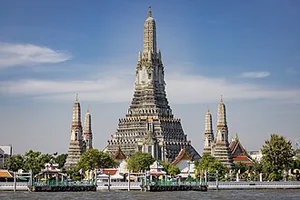
On the west bank of the Chao Phraya River, a tower of broken porcelain shards catches the first light of day. That’s Wat Arun, Bangkok’s most photogenic temple. Its official name is Wat Arunratchawararam Ratchawaramahawihan, but everyone just calls it Wat Arun, the Temple of Dawn. The moment you see it—whether from a river boat or a rooftop across the water—you’re looking at a structure that’s less brick and mortar, more a dazzling mosaic of color and light.
It’s famous for its 70-meter-high central prang, a Khmer-style tower encrusted with tiny pieces of colored glass and Chinese porcelain. When the sun rises behind it, the whole thing sparkles like a jeweled crown. It’s no wonder the temple is featured on the back of the Thai 10-baht coin. For anyone visiting Bangkok, Wat Arun is not just a sight; it’s an experience—a place where religion, art, and riverside life collide in the most beautiful way.
The temple’s story begins long before Bangkok was the sprawling city it is today. It was built during the Ayutthaya period, probably in the 1600s, and was originally known as Wat Makok, named after the olive trees that grew there. According to local legend, King Taksin discovered the temple after fleeing the fall of Ayutthaya in 1767. He supposedly promised to build a grand temple there, and when he established his new capital in Thonburi, he kept that promise. He gave it a new name: Wat Chaeng, and made it his royal temple. Later, a Buddha relic was enshrined within its walls, cementing its importance.
The real transformation came in the 19th century during the reign of King Rama II. He rebuilt and expanded the temple, renaming it Wat Arunratchawararam, and his successor, King Rama III, added the final decorative touches. That’s when the central prang, the iconic tower that dominates the skyline, was completed and clad in the famous porcelain mosaic. These weren’t special tiles, by the way—they were pieces of broken Chinese porcelain, collected from ships that sank in the river and from old tableware. It was a brilliant, budget-friendly way to cover the brick structure with something that would shimmer in the sun. The prang is designed to represent Mount Meru, the mythical center of the universe in Buddhist cosmology. Four smaller prangs surround it, each one aligned with a different direction.
Once you’re inside, the first thing you’ll want to do is take a look at the central prang up close. The sheer detail is staggering. Hundreds of tiny ceramic flowers, demons, and angels adorn every inch of the tower’s face. You can actually climb the steep stairs to the first terrace, and if you’re up for the challenge, go higher. The steps are narrow and the ascent is a workout, but the reward is a panoramic view of the river, the Grand Palace, and the city beyond. Just hold on tight to the railing. It’s a respectful climb, so wear appropriate clothing—shoulders and knees covered—and remove your shoes when entering the sanctuary halls.
Give yourself at least an hour and a half to really soak it in. You could rush through in 45 minutes, but that would be a shame. Start by walking clockwise around the base of the prang. You’ll notice the two enormous guardian figures at the entrance—giant demons with fierce expressions and multi-colored bodies. They’re there to protect the temple, and they make for fantastic photo subjects. Next, head to the ordination hall, known as the bot. Inside, you’ll find a serene Buddha image, and the walls are covered with beautiful murals that depict scenes from the life of Buddha. One of the lesser-known treasures is the large footprint of the Buddha, housed in a small pavilion along the riverbank. It’s a quiet spot most tourists walk right past.
Now, for the best photo spots. The classic shot is from the river, especially from the ferry pier on the opposite bank. As sunset approaches, the temple’s silhouette turns dark and moody against the orange sky—utterly dramatic. If you’re lucky, a long-tail boat will zip past just as you snap the shutter, adding that perfect Thai touch. From inside the temple grounds, the upper terraces of the central prang offer a killer angle looking down at the smaller towers. Another hidden gem is the view through the arched gateway near the river entrance. Frame the prang between the white walls, and you’ll get a shot that looks like something from a travel magazine.
One thing many visitors miss is the sheer delight of the porcelain details close up. Look for the little ceramic flowers that cover the towers—some are over 200 years old. They were pressed into the plaster by hand, and no two are exactly alike. As for tickets, it costs 100 baht for foreigners, which is about three dollars, and that’s well worth it to support the ongoing restoration work. Also, try to visit early in the morning, before the tour groups arrive. The temple opens at 8 a.m., and the first rays of sunlight hitting the prang are pure magic. Stick around for a while, listen to the wind chimes, and watch the river boats drift by. That’s the real Wat Arun experience.
