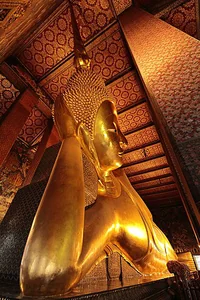
You smell it before you see it: a heady swirl of sandalwood, incense, and something faintly tropical, like crushed lemongrass. Outside, Bangkok roars with motorbikes and street steam; inside, the world goes amber and quiet. Wat Pho — officially Wat Phra Chetuphon Wimon Mangkhalaram — feels less like a tourist attraction and more like a living, breathing museum of Thai craft, faith, and medicine. But let’s be honest, you’re really here for one thing: the Buddha. Not just any Buddha, mind you. The Reclining Buddha. Forty-six metres of gold-flecked serenity, with a serene smile you could almost call mischievous. He fills the entire building, leaving you no choice but to tilt your head, crane your neck, and feel very small — in the best possible way.
Yet Wat Pho is far more than one giant statue. It’s the birthplace of the traditional Thai massage. It’s a university. It’s a royal chapel. It’s a scatter of over a thousand Buddha images, more than any other temple in the country. Wander past the stone galleries, the mosaic-inlaid chedis, the manicured bonsai court, and you’ll see why locals call it the “Temple of the Reclining Buddha” without a single trace of irony. The place simply owns the nickname.
Wat Pho’s roots go deep — far deeper than Bangkok itself. Before the city even became the capital of Siam in 1782, this spot held a smaller, older temple named Wat Phodharam, built sometime during the Ayutthaya kingdom that fell in 1767. After the new Chakri dynasty set up shop across the river, King Rama I came to this very plot in 1788 and ordered a massive rebuild. He renamed it Wat Phra Chetuphon, and it became his royal monastery, a kind of spiritual powerhouse for the freshly minted capital. But the temple’s real transformation arrived half a century later, under King Rama III (1824–1851). He had a grand vision: to turn Wat Pho into a public encyclopedia in stone. He plastered the walls with the teachings of Buddhism, literature, medicine, astrology, and moral law — all inscribed in beautifully carved marble tablets so anyone could read and learn. This is why Wat Pho is often called Thailand’s first university.
It was also during Rama III’s reign that the great Reclining Buddha was born, cast in 1832 to celebrate the temple’s upgraded status. The image represents the Buddha entering parinirvana, the final release from the cycle of rebirth. And it’s stunning. Forty-six metres long and fifteen metres high, built from brick and plaster, then gilded to a burnished gold that catches every shaft of light. But the real showstopper? The feet. Each one is three metres long and covered in mother-of-pearl illustrations depicting 108 auspicious symbols of the Buddha — flowers, dancers, elephants, and a swirling lotus. They look less like feet and more like cosmic maps etched by a jeweller with an impossible deadline.
Beyond the big gold guy, give yourself at least two hours to wander properly. Head first to the main ubosot (the ordination hall), which shelters a majestic Buddha image and walls of gorgeous mural paintings. Then follow the shaded cloisters that wrap around the compound — you’ll pass row after row of bronze Buddha statues, many salvaged from the ruins of the old capital, Ayutthaya. Look for the four giant chedis, each decorated with different coloured porcelain thousands of tiny pieces of blue, orange, and green that shimmer like dragonflies. If you’re lucky, you’ll catch a monk sweeping the courtyard with a wide bamboo broom, his orange robes popping against all that white marble.
Don’t leave without stepping into the on-site traditional Thai massage pavilion. You don’t need to book a treatment — though you absolutely can, and it’s glorious — but at least poke your head through the doors. Wat Pho is the birthplace of this ancient healing art, and its practitioners are trained right here at the temple’s school, which still runs daily. A hermit statue in a shaded corner points to pressure points along his own body, a silent textbook for the curious. If your knees are aching from all that temple-hopping, a foot massage inside this hall might just be the best twenty minutes you spend in Bangkok.
Ticket wise, you’ll pay around 200 baht at the entrance, which gets you a free bottle of drinking water and access to the whole temple complex. That’s a steal, honestly, for a place this vast. You’ll want to time your visit for late afternoon, when the golden chedis catch the low sun and the hordes start to thin. Crowds are thickest between 10 a.m. and 2 p.m., so go early if you’re a morning person, or just embrace the bustle and make your way toward the back corners. The courtyards away from the Reclining Buddha are quiet pockets of pure calm, where lizards scurry over rocks and the only sound is the distant chime of temple bells.
For photos, you have two iconic shots to chase. First, the obvious one: stand at the far end of the Reclining Buddha and use your phone’s wide-angle setting to capture the entire golden mass in one frame. Second, the lesser-known beauty: kneel beside the Buddha’s feet and zoom in on the mother-of-pearl symbols, catching the iridescent swirls as they catch the light. The row of chedis along the eastern side also makes a postcard-perfect backdrop, especially if you frame a striped monk’s robe against the tiled mosaics. And here’s a hidden gem many tourists miss: a small, dusty pavilion tucked behind the library houses a stone collection of old Chinese statues — soldiers, traders, and beasts. Those figures were ballast on junks that sailed to Siam in the 19th century, traded for local goods, then abandoned here. They’re weathered, a little cracked, and utterly charming, a silent testimony to the temple’s centuries as a crossroads of the world.
By the time you step back into the roar of the street, you’ll feel different. Slightly lighter. Perhaps even a little sore from an unexpectedly intense massage. That’s Wat Pho’s magic — it’s not just something you see. It’s something you feel, in your feet, your neck, and deep in that place where travel memories settle. The temple has been teaching and healing for two hundred years. All you have to do is show up, slow down, and let it work.
