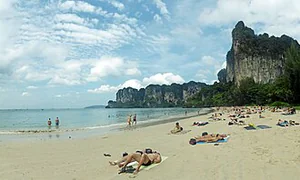
Picture a sliver of land where jungle-tipped limestone cliffs rise straight out of the Andaman Sea, their grey faces glowing like bronze at sundown. That’s Railay Beach. It isn’t really a single beach at all, but a small, almost-isolated peninsula—a world apart—with two dreamlike stretches of sand, hidden caves, and a skyline of sheer karst towers that look like they belong on a film poster. Tucked between Krabi Town and Ao Nang, yet sealed off by rock on every side, Railay has a curious castaway feel. No roads. No traffic. Just paths, footsteps, and the constant pulse of the tide.
People come for the beaches, sure. But Railay’s real fame is vertical. Climbers from across the planet have spent decades turning these brooding cliffs into a living patchwork of bolts and ropes. The result is one of the world’s great rock-climbing and deep-water-soloing destinations, where every blank patch of limestone seems to whisper, ‘Try me.’ It’s magnetic in a way that’s hard to explain until you stand beneath a 200-meter wall and watch a climber shimmer like a dot against the rock.
Railay’s story begins long before the first rope or guidebook. Sea nomads, known as the Chao Ley, sheltered along this coast for generations, riding the monsoon winds and finding refuge in the peninsula’s shadowy grottoes. They left no monuments or markets, but they left something better: a legend. At the southern end of Phra Nang Beach, a dark, dripping cave called Tham Phra Nang—the Princess Cave—holds one of Thailand’s oddest and most enduring shrines. Locals say a princess was shipwrecked here long ago and her spirit claimed the cave as her home. Ever since, fishermen and sailors have come to pay their respects, filling the shelves with carved wooden phalluses. It sounds bizarre at first, but in this place it feels simply natural—a raw, sincere gesture from seafarers hoping for safe passage and a full catch.
For centuries, the outside world ignored Railay. Krabi’s wealth came from tin, rubber, and fish, and a rocky little peninsula with no road and no harbor simply didn’t matter. That changed in the late twentieth century when a small band of pioneering climbers spotted these karsts from the water. They made their way across the sand, hauled their gear up the overhangs, and started the first routes. Through the 1980s and 1990s, more adventurers followed, scribbling topos by lantern light and building simple bamboo bungalows on the east side. As word traveled through the global climbing community, Railay’s reputation grew. Today that scrappy, chalk-dusted scene has become an international icon—yet the limestone still calls the shots, just as it always has.
Once you’re onshore, Railay rewards a slow, wandering pace. Start at Railay West, the classic curved bay where longtails drift in with the tide and the sand seems to swallow your footprints. A short, shady jungle path links West to East in about five minutes, and on the other side you’ll find a ramshackle backpacker village—tattoo shacks, climbing shops, fruit stands, and the smell of pad thai drifting through palm fronds. Railay East itself isn’t a swimming beach; at low tide it turns into a muddy mangrove edge perfect for kayaking. But it’s the heart of the action, and it’s where you’ll feel the pulse of the place.
Phra Nang Beach, a few minutes south, is the jewel. Towering cliffs fold around a scoop of powdery sand and water so clear it looks liquid turquoise. It has been ranked among the world’s best beaches more than once, and on a quiet morning you’ll understand why. Head to the southern corner for the Princess Cave, but don’t rush through it. Give your eyes time to adjust, and you’ll notice the hundreds of wooden tributes tucked into every crevice. For photographers, morning is soft and peaceful; late afternoon sets the cliffs ablaze. And the real hidden gem? The Phra Nang Lagoon. A narrow, easy-to-miss path near the eastern edge leads up a jungle track and then a short rope-assisted climb into a hidden bowl of emerald water ringed by towering karsts. It’s not easy, but that’s precisely the point.
Railay West rules the sunset. As the sun sinks behind the sea, the limestone walls turn peach and magenta and everyone wanders onto the sand, phones out, drinks cold, voices low. If you have energy, climb to the Railay Viewpoint before dusk. The trail starts just behind the Diamond Cave and involves steep ladders, chains, and a fair amount of puffing, but the panorama from the top—two beaches, endless karsts, and the glittering sea—is the shot you came for. Wear proper shoes. There’s a modest entry fee for Diamond Cave itself, about 100 baht, but the beaches and viewpoint are free. If you have more than a day, a two-night stay lets you paddle a sea kayak into hidden coves, climb a beginner route with a local instructor, or simply lie on a sun-warmed rock and let the world turn.
Climbing remains the headline act for many visitors. You don’t need to be a professional; plenty of operators offer half-day lessons where you’ll learn to trust a harness and muscle up your first vertical foot. Even if you never tie a knot, find a spot below Thaiwand Wall and watch the climbers. They move like circus performers, deliberate and fluid, while belayers call encouragement in half a dozen languages. And if you keep walking around the headland toward Tonsai, the atmosphere loosens even further: think tree swings and low-key bars, a dusty, sun-fried vibe that feels decades away from any resort. Railay is that rare place where you can spend your whole holiday without doing anything, or pack each day with routes, caves, and views until your legs burn. Either way, the peninsula meets you where you are—and leaves a little of its limestone dust in your heart.
