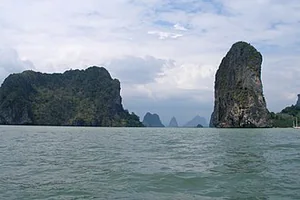
The first time you glide into Phang Nga Bay, the horizon doesn’t feel real. It looks like a giant’s game of pick-up sticks scattered across a jade-green sea. Towering limestone karsts jut straight out of the water, their jagged silhouettes blurred by a humid haze. You’ll hear the soft lapping of water against your boat, maybe a distant longtail engine sputtering, and the strange sensation that you’ve entered a forgotten world. This is southern Thailand at its most dramatic — a natural cathedral of peaks, secret caves, and hidden lagoons that has enchanted travelers for decades.
What makes Phang Nga Bay so famous? It’s not just the otherworldly scenery, though that alone would be enough. This is home to the iconic James Bond Island, where a classic 1970s spy movie left its mark on global tourism. It’s also a sanctuary for mangroves, monkeys, and sea eagles. You don’t just visit Phang Nga Bay; you weave through a labyrinth of stone and water that shifts with every tide. And while it draws crowds, the bay still manages to feel mysterious — there’s always a quieter cove, a darker grotto, or a hidden hong waiting just beyond the tour boats.
The bay is part of Ao Phang Nga National Park, established in 1981 to protect nearly 250 square kilometers of this remarkable seascape. It stretches along the Andaman coast, not far from Phuket and Krabi. But once you’re on the water, those mainland bustles vanish. You’re surrounded by sheer cliffs, overhanging vegetation, and water that changes from emerald to sapphire depending on the sun. It’s no exaggeration to say Phang Nga Bay is one of the most visually stunning places on Earth — and understanding its history only makes it more extraordinary.
Geologically, these karsts are ancient. Roughly 400 million years ago, coral reefs and marine creatures formed limestone beds that were later uplifted by tectonic pressure. Over millennia, monsoon rains and acidic groundwater dissolved the rock, carving the dramatic shapes you see today. Sinkholes collapsed to form the bay’s famous “hongs” — hidden lagoons enclosed by vertical limestone walls, accessible only through sea caves. These aren’t static monuments; they’re still evolving, with waves chipping away at the soft stone and leaving behind overhangs and dramatic notches. In a way, you’re witnessing slow-motion creation.
Human history here is quieter but equally fascinating. Indigenous sea gypsies, known as the Moken, once roamed these waters in wooden boats, living off the sea and trading with coastal villages. Their centuries-old knowledge of tides and weather helped them navigate this tricky terrain long before any map existed. Then came the 20th century, and with it, global fame. In 1974, the James Bond film “The Man with the Golden Gun” featured a steep islet called Khao Phing Kan and its iconic needle-shaped rock, Ko Tapu. After the movie’s release, tourism exploded. The island became known as James Bond Island, and the bay’s fate shifted from local fishing grounds to international wonder.
That fame came with mixed blessings. By the 1990s, unregulated boat traffic and littering threatened the fragile ecosystem. The Thai government responded with stricter park rules, and in the wake of the 2004 Indian Ocean tsunami, which devastated the region, a renewed effort emerged to protect the park’s biodiversity. Today, the bay is a delicate balance between tourism and conservation. You’ll still find fishing villages perched on stilts, like Koh Panyee, where generations of families have lived in harmony with the water. These communities add a human layer to the natural spectacle — a reminder that Phang Nga Bay isn’t just a postcard; it’s a living place with an ongoing story.
Now, for your visit. Most people explore the bay by boat, either a speedboat for quick hops or a traditional longtail for a more leisurely pace. The classic route takes you to James Bond Island itself, where you can stand on the sandy beach and gaze up at Ko Tapu, the 20-meter-tall spire that juts impossibly from the sea. It’s busier than other spots, sure, but still worth it. Arrive early in the morning if you want a few clear photo angles before the crowds build. Your camera will love the spot near the island’s southern tip, where you can frame the spire between two karsts.
Beyond the celebrity islet, don’t miss the sea caves and hongs. Paddle by kayak through the dark, low-ceilinged grottos of Thalu Cave or Hong Island. As your guide pushes you through narrow gaps, the boat enters a hidden lagoon that feels like a secret garden — complete with ancient stalactites, mangrove roots, and maybe a monitor lizard watching from the shade. This is the bay’s true magic. I’d recommend at least four to five hours for a meaningful visit. A half-day tour covers the highlights, but a full day lets you linger, swim in calm spots, and explore lesser-known corners at a relaxed pace.
Ticket information is straightforward. Ao Phang Nga National Park charges an entry fee — typically around 300 Thai baht for adults and 150 for children, though these rates can vary and are often bundled into tour packages. Some areas, like Koh Panyee village, might ask for a small donation or docking fee. Cash is handy, as many local operators don’t accept cards. For photo spots, the James Bond Island viewpoint is the obvious one, but try the entrance of a hong at midday when sunlight pierces the water, creating a glowing turquoise effect. Another gem is the viewpoint from Koh Panyee’s wooden walkways — you get a sweeping panorama of the village and karsts in every direction.
For the truly adventurous, seek out the hidden lagoons of Koh Panak or the bat-filled caves of Khao Khien. These spots don’t feature on every tour, but local guides know them well. If you’re lucky, you might spot rhesus macaques swinging through the mangroves or a brahminy kite circling overhead. One lesser-known feature is the ancient cave paintings at Khao Khien — rice-barge sailors once scratched drawings into the limestone centuries ago. It’s a fragile, quiet piece of history that most visitors never see. And while swimming isn’t allowed in every area, a few sandy coves let you cool off in waters that feel impossibly warm and calm.
Ultimately, Phang Nga Bay rewards those who look beyond the headlines. Yes, you’ll see James Bond Island and take the iconic photos. But the memories that linger are the quiet moments — the sound of dripping water in a dark cave, the sudden opening into a sunlit lagoon, the friendly wave from a fisherman in a longtail boat. This is a place that demands your attention and gives back tenfold. So come with time, curiosity, and a sense of wonder. The limestone giants are waiting, and they don’t disappoint.
