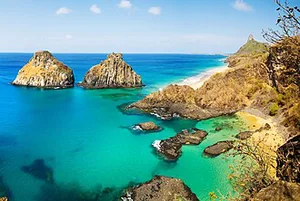
Fernando de Noronha doesn’t feel like Brazil. It doesn’t feel like anywhere, really. This tiny volcanic archipelago, scattered across the South Atlantic some 350 kilometers off Brazil’s northeastern coast, is a world apart. Green cliffs plunge into water so clear it looks like glass. At dawn, spinner dolphins slip through the currents of Dolphin Bay, and by afternoon, sea turtles wobble along sandy shallows. The whole place has a kind of raw, protected silence. Only a few hundred visitors are allowed at a time, and every one of them pays for the privilege. That’s part of the magic.
Millions of years ago, volcanic eruptions raised these rocky peaks from the ocean floor. Today, the islands are a national marine park and a UNESCO World Heritage site, celebrated for one of the richest concentrations of Atlantic seabirds, dolphins, turtles, and reef life anywhere on Earth. But fame hasn’t spoiled it. In fact, the restrictions are part of the experience. You don’t visit Fernando de Noronha to tick a box; you visit to swim, hike, and slow down to the rhythm of the tides.
The history of Fernando de Noronha is as restless as its surf. Portuguese navigators first sighted the islands in 1503, on an expedition backed by a merchant named Fernão de Noronha, and his name stuck. Over the next centuries, the Dutch and French each took a turn at claiming the islands. The Portuguese returned in the 18th century, and in 1737 they began building the Forte Nossa Senhora dos Remédios, a stone stronghold that still caps the headland. For local officials, the real purpose was simple: a distant prison. For most of its colonial life, the island served as a penal station, and prisoners built roads, walls, and one of the oldest churches in the region.
In the 20th century, the island wore a new uniform. In 1938, Getúlio Vargas’s government turned Fernando de Noronha into a high-security prison for political dissidents. Then came World War II, and the Allies built a small U.S. air base here. The runway later became a civilian airport, but the military presence continued for decades. Only in the late 1980s did the government begin moving away from its prison-and-base identity and toward conservation. In 2001, UNESCO confirmed what divers had known for years: this archipelago is extraordinary. Since then, the focus has been on protecting the marine wonder rather than locking anyone away. Some of the cell blocks still stand, but palm trees and tourists have taken over.
Start with Baía do Sancho, the beach that keeps winning ‘best in Brazil’ awards. It sits below towering cliffs, and reaching it means clambering down metal ladders and narrow staircases. The effort is everything. The water is clear and turquoise, and the reef just offshore turns snorkeling into an underwater ballet of parrotfish, grunts, and the occasional green turtle. Sancho is also a nesting beach for turtles, so visitors move gently and keep their distance. If you’re a stronger swimmer, ask a local guide about the drift snorkel at Praia do Sueste, where stingrays and small sharks often cruise through the shallows.
Give the island at least four or five days. A week is better. Trails like the one to Morro do Pico reward you with panoramic views, but they demand time, sunscreen, and a steady pair of legs. For a slower morning, follow the path to Praia do Leão, a wilder beach where seabirds nest on the sand and waves crash with real force. And don’t skip the history. A short walk up to the old Forte Nossa Senhora dos Remédios takes you through weathered ramparts and cannons that still point out to sea, a reminder that this tranquil paradise once guarded a bloody coastline.
If your legs need a rest, take a boat trip around the outer islets. From the water, the cliffs seem even more vertical, and the clarity of the sea is almost dizzying. Dolphins often ride the bow wave, and a good captain will cut the engine to let a turtle pass. It’s another face of Noronha, one you can’t reach on foot.
Entry isn’t by a single ticket. Instead, visitors pay an environmental preservation tax for each day on the island. The rate climbs the longer you stay, which sounds like a trick but is really a conservation tool. Some protected areas, especially during turtle nesting season, require a certified guide and a limited quota. It’s wise to treat those quotas like a slow release of the island’s best secrets rather than a hassle. The best photo moment, for most people, comes at the viewpoint above Baía dos Porcos, where the twin peaks of Dois Irmãos rise from a glittering sea. Go early in the morning, before the sun turns the water to silver and the day-walkers fill in.
Look for hidden layers instead of just the highlights. A short scramble off the main trail leads to Buraco da Raquel, a natural swimming pool that appears empty even when the island feels busy. Nearby, the rocks at Ponta das Carapuças hide tiny pools with urchins, small octopuses, and the perfect echo of a breaking wave. Late afternoon, everyone heads to the Miradouro do Pico for sunset. Maybe the red skies feel predictable. But when the silhouette of the Pico falls across an ocean that looks like melted gold, you won’t care. You’ll just stand there, salt on your skin, and understand exactly why Brazil protects this place so fiercely.
