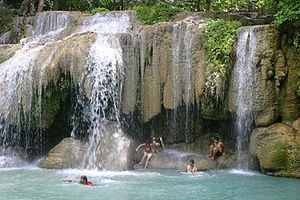
There’s a waterfall in Thailand that doesn’t just pour into a pool; it tumbles down seven distinct steps, each one a different shade of emerald. Known as Erawan Waterfall, this cascading marvel sits deep inside Kanchanaburi province’s lush national park, surrounded by limestone cliffs, bamboo thickets, and the constant hum of tropical insects. The moment you catch your first glimpse of those milky-turquoise basins, you’ll understand why so many travelers pilgrimage here. It’s not just a waterfall. It’s a five-story-high staircase of water, sculpted by millennia of river flow over smooth rock, with each tier feeding the next in a chain of shimmering plunge pools.
You follow a rugged trail through the heat and shadow of the jungle, listening to the river grow louder with every step. At times you wade through shallow streams, your toes hitting slick stones; at other moments you climb wooden ladderways bolted to cliffsides. The reward comes again and again: a new level, a new pool, a new sense of “you must see this.” Some tiers are gentle terraces where water slides over algae-covered rock. Others thunder into deep swimming holes that invite you to float on your back while the spray cools your skin. This is the kind of place that makes you forget your phone for hours—unless you’re using it to capture yet another impossible shade of blue-green.
Erawan Waterfall takes its name from Airavata, the three-headed white elephant that in Hindu mythology carries the god Indra. And if you stand at the top of the seventh tier, you can sort of see it: the rock formation behind the main plunge resembles an elephant’s head, with the cascading water acting as a trunk. That legend, combined with the raw natural beauty, gives the site an almost sacred feel. But it wasn’t always a protected destination. For centuries, this forested corner of Thailand existed far off the beaten track, known mostly to local hunters, herbalists, and the occasional adventurous forest monk. Only in the mid-twentieth century did the country begin to recognize its value as a national treasure.
In 1975, the Thai government officially declared Erawan National Park, covering more than 550 square kilometers of mountains, rivers, and caves. The waterfall quickly became the park’s shining jewel, drawing domestic pilgrims and international backpackers alike. But this history isn’t just about bureaucratic protection. The park also guards crucial watersheds that feed the Kwai Yai River, sustaining villages and farms downstream. The local community has long respected the waterfall as a source of life—a place where spirits were said to dwell. Even today, park staff ask visitors to treat the water with the same reverence, banning soap, sunscreen, and even fish-feeding in an effort to keep the ecosystem pristine. It’s a reminder that natural beauty like this doesn’t survive on its own; it needs careful stewardship.
The history of the trail itself is now part of the experience. Over the decades, the park has built a network of boardwalks, ropes, and cemented decision points that guide you safely from the entrance to the summit. But despite these improvements, Erawan is not a paved theme-park attraction. You still have to climb, slip, and wade your way to the top. And that physical effort is part of the draw. Veterans will tell you that the real magic happens in the early morning, before tour buses arrive, when the only sounds are birdsong and falling water. If you can get there when the gates open, you might have entire pools to yourself.
So what should you actually do inside the park? First, wear shoes that can get wet. The trail to tier seven is about 1.5 kilometers one way, with several creek crossings that require barefoot balance or dedicated water shoes. It’s perfectly acceptable to stop at any level, of course, but the hidden gem is the trail’s upper half. Levels three, four, and five are often overshadowed by the famous seventh tier, yet they offer quieter swimming spots and deeper, more surreal colors. Level two has a great shallow pool for kids, while level six is a narrow, cliff-lined chute that feels like a secret grotto. The top tier—level seven—is the grand finale: a wide, powerful curtain of water crashing into a pool that begs you to swim right up to the rock wall. Just watch for the small cave on the left side of the falls; you can slip behind the curtain and look out at the world through a sheet of water.
You’ll also meet the park’s most delightful residents: the tiny gray fish that nibble away dead skin from your feet and legs when you dangle them in the pools. It’s a ticklish, slightly surreal experience, and absolutely one of the highlights. Many visitors spend an hour just floating in tier four, letting the fish do their work while staring up at the canopy. For photographers, the best light comes late afternoon, but the most dramatic colors show up on cloudy days, when overcast skies make the water glow neon turquoise. The official photo spot is the wooden bridge over the stream just before tier three—angled correctly, you can capture both the cascading water and the reflections below. Don’t forget the viewpoint at tier five, where a small platform gives you a bird’s-eye look at the pools cascading into one another.
A visit typically takes anywhere from three hours to a full day. If you’re pressed for time, a two-hour round-trip to tier four and back is a satisfying taste. For the full experience, leave yourself at least half a day: climb to the seventh tier, swim, picnic on the rocks, and then descend slowly, stopping to soak in a different pool each time. Entrance fees are modest—foreign adults pay around 300 baht, kids about half that—and the ticket also covers the nature trails near the park headquarters. Just remember: no food or drinks in the water, and absolutely no plastic bags beyond the ticket gate. Rangers are friendly but firm about this. Then again, once you see the clarity of those emerald pools, you’ll understand why.
In an age where landmarks often feel hurried and overrun, Erawan Waterfall still demands your patience. It asks you to walk, wade, and paddle your way to beauty. The fish will bite your toes. The rocks will be slippery. The trail will be muddy. And when you finally float on your back in that cool blue-green water, staring up at the jungle canopy, you’ll agree it was worth every step. Erawan isn’t just a waterfall you visit. It’s a place you enter, fully, with all your senses—and one you’ll carry home long after you’ve dried off.
