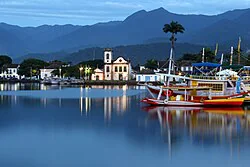
Picture a small town where the ocean sneaks through the streets at high tide, turning ancient cobblestones into mirrors of the sky. That’s Paraty. Tucked between the peaked Atlantic Forest and the blue-green bay on Brazil’s Costa Verde, this 17th-century colonial gem feels more like a living museum than a tourist stop. It’s the kind of place that seduces you slowly—the click of shoes on uneven stones, the clang of church bells, the breeze that smells like salt and maracuja.
Paraty isn’t just a pretty slice of Brazil. It’s a crossroads of history, nature, and creativity. The town rose to prominence during the Gold Rush, shipped Brazil’s riches to Portugal, then fell into a long sleepy silence that preserved its charm. Today, it’s famous for its well-preserved Portuguese colonial architecture, dazzling island-dotted coastline, and a calendar packed with cultural events, including the legendary Flip (Festa Literária Internacional de Paraty). In 2019, UNESCO named the wider Paraty and Ilha Grande region a World Heritage site, cementing its global appeal.
Founded around 1667, Paraty started as a small settlement for Portuguese colonists and their enslaved African workforce. Its harbor was perfect, protected by islands and sheltered from the open Atlantic. As gold was discovered in Minas Gerais in the late 1600s, Paraty became the main port for shipping the precious metal back to Europe. The town swelled with merchants, mule drivers, and slaves. Those mule trains, loaded with gold bars and sugar, trudged the Caminho do Ouro—the Gold Road—a 1,200-kilometer stone pathway that runs all the way to Ouro Preto. That road, much of it still intact, is now one of Paraty’s most rewarding hikes.
Paraty enjoyed a golden age, but success didn’t last. By the 19th century, a new road from Rio de Janeiro to Minas Gerais bypassed the port, and the coffee trade, once the next big boom, fizzled when slavery was abolished in 1888. Paraty retreated into a sort of colonial sleep. Without the money to rebuild, the town kept its original layout and architecture, a winding maze of narrow lanes that intentionally followed the tides. This meant that the famous high-tide flooding wasn’t an accident—it was designed to wash street filth away. In 1966, the Brazilian government declared Paraty a National Historic Landmark, and decades later, the town woke up to a second life as a magnet for artists, writers, and travelers.
The best way to experience Paraty is to simply wander. Start at the historic center, which feels like an open-air gallery of Portuguese colonial style. Whitewashed walls, colorful doors, and churches that range from Santa Rita (which hosts a small museum of sacred art) to the towering Our Lady of Rosário. Slip into the Praça da Matriz, the main square, where locals sell fruit, cheese, and coconut candy. Then walk down to the waterfront. At high tide, the streets edge into the bay, and it’s common to see small boats rowing right over flooded roads. Don’t rush—two to four hours can easily vanish here, but you’ll want more if you’re a photographer or history buff.
For a different view, climb the hill to Fort Defensor Perpétuo, built in 1822 to defend the port. It’s a short walk up, and the panoramic view over the bay and town is worth every step. Back on the water level, you can’t miss the schooner scene. Boats line the harbor offering half-day trips to nearby islands and beaches—the most popular are praia do Pontal and the clear-water pools of Lula Beach. If you’d rather stay dry, hop to a cachaça distillery. The region is Brazil’s sugarcane spirit heartland, and a tasting tour of a historic alambique is a surprisingly interesting way to spend an afternoon. For a hidden gem, follow the signs to the Caminho do Ouro trailhead. You don’t need to hike all 1,200 kilometers—a 30-minute stretch brings you to a tiny waterfall and a slice of Atlantic Forest that feels untouched.
Ticket-wise, Paraty is a street-level pleasure. The historic center is free to wander, which is wonderful. A few sites charge entrance fees: Santa Rita’s museum costs around R$ 10 (about $2), and the Fort is similarly affordable. Guided walking tours, available at the tourism office near the main square, usually run R$ 50–100 per person, and they’re worth the splurge for the stories they unearth. But honestly, the town rewards free-roaming solo explorers just as much. For photo spots, the steps of Santa Rita church at golden hour give that postcard sweep of the rooftops and bay. The flooded Rua do Porto at high tide makes a dreamy mirror shot—check the tide chart beforehand. And the archway at Praça da Matriz, with its thick bougainvillea, frames a spot that’ll earn likes on any platform.
Finally, a few insider tips. Paraty’s historic center closes to cars after 6 pm, so evenings are beautifully quiet, best spent with locals sharing sugarcane punch on a bar stool. The markets on weekends are gloriously chaotic, and the fish fresh off the boats is unreal. Keep in mind the town loves its festivals: during Flip, usually in late November, the streets become a literary carnival, while the Festa do Divino in May brings music and processions to the cobblestones. If you want to knock out the must-see sights in a single day, you can—but slow down. Give Paraty at least one overnight, two if you love the outdoors. The town doesn’t show you its true colors from a passing glimpse. It invites you to stay, to wander, to watch the tide come up and wash the streets clean again.
