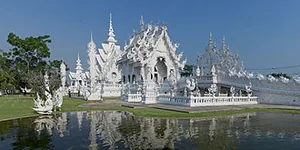
Imagine a temple that glistens like freshly fallen snow under the tropical sun, its every surface studded with millions of tiny mirror shards. That’s Wat Rong Khun, better known as the White Temple, in Chiang Rai, northern Thailand. It’s not ancient, nor is it traditional in any strict sense. Instead, it’s a modern, privately owned masterpiece that blends Buddhist iconography with surrealist fantasy. For many travelers, it’s the single most unforgettable sight in the country — a place where heaven and hell collide in glittering ceramic and plaster.
Step through the main gate, and you’ll cross a bridge over a sea of outstretched hands. A quick glance below reveals sculpted arms clawing upward from a pit of faces — the tormented souls of those who gave in to temptation. Yet above, the white temple gleams, pure and hopeful. It’s a stark, emotional contrast that sets the tone for the entire visit. You’re not just looking at a building; you’re walking through a story about karma, desire, and redemption.
What makes Wat Rong Khun so famous? Partly its aesthetic — white symbolizes the Buddha’s purity, while the mosaic mirrors represent wisdom shining in the world. But it’s also the mind behind it. This is the brainchild of Thai visual artist Chalermchai Kositpipat, who envisioned a temple that would be completely unlike anything built before. Since 1997, it’s been a work in progress, and it remains a living, evolving artwork to this day.
The story of Wat Rong Khun begins in the late 1980s, when Chalermchai, already a celebrated painter, decided to dedicate his life and fortune to constructing a temple that would honor his country and his faith. He chose a site near his hometown, the ruins of an old, neglected temple named Rong Khun. With his own money — and no corporate sponsorship — he broke ground in 1997. The project was ambitious: a full temple complex covering over three acres, with nine buildings planned.
But the journey wasn’t smooth. In 2014, a severe earthquake damaged much of the main structure, cracking the facade and toppling the bridge’s decorative pillars. Chalermchai initially feared the entire temple might collapse. Yet, after months of assessment, he vowed to rebuild, even stronger and more beautiful. The restoration took years, and the temple reopened with a reinforced structure and a renewed vision. That resilience has become part of its legend — a testament to the artist’s unwavering devotion.
Historically, Wat Rong Khun doesn’t follow the typical chronology of ancient Thai landmarks. It’s not a centuries-old royal temple. Instead, its significance lies in its radical break from tradition. Chalermchai deliberately incorporated elements of pop culture and contemporary critique into Buddhist art. The main hall, known as the ubosot, features murals of Spider-Man, Superman, Harry Potter, and even iconic spaceships. This unconventional mix shocked traditionalists at first, but it also made the temple a global sensation. Today, it’s recognized as a unique cultural statement — a modern jewel that challenges what a Buddhist temple can be.
Now, let’s talk about visiting. When you enter the temple grounds, the first thing you’ll see is the white ubosot, glinting in the daylight. Head inside, but remember: you’ll need to remove your shoes and dress respectfully — shoulders and knees covered. The interior walls are covered in murals that blend traditional Buddhist storytelling with modern references. Look closely, and you’ll spot Keanu Reeves as Neo, Michael Jackson, and even the Transformers. It’s a delightful game of hunt-and-seek, but it also carries a deeper meaning: in today’s world, even pop icons can be vehicles for dharma.
One of the most talked-about spots is the gilded restroom block. That’s right — the public toilets are housed inside a gold-painted building, dazzlingly ornate and outlandishly luxurious. It stands as a playful contrast to the white temple, symbolizing how earthly pleasures can distract us from spiritual goals. It’s easily the most photographed restroom in Thailand, so don’t miss it. Another hidden gem is the temple’s art gallery, located just behind the main hall. There, you can view Chalermchai’s original paintings and sketches, offering a deeper insight into his creative process.
Due to its popularity, the temple can get crowded — especially by mid-morning. To make the most of your visit, arrive early, when the light is soft and the tour groups have yet to pour in. A typical visit takes about one to two hours, but if you’re an art or photography enthusiast, you could easily spend half a day. There’s a lot to absorb, from the intricate carvings on the gables to the bronze sculptures of kinnari (half-bird, half-woman celestial beings) scattered around.
As for tickets, the admission fee is just 100 baht (about 3 USD), which is extremely reasonable for a site of this caliber. The money goes directly toward the construction and maintenance of the temple, so every visitor contributes to the ongoing art. No guide is required — you can wander at your own pace, and there are English and Thai descriptions on signboards throughout the complex. If you want a deeper dive, though, a local guide can be hired in the parking area, but honestly, a self-guided stroll is more than sufficient.
Now, the best photo spots. The classic shot is from the main bridge, capturing the white temple reflected in the pond below. For that perfect angle, position yourself at the edge of the pond near the entrance — you’ll get the whole facade and the reflection together. Another underrated spot is the back side of the ubosot, where the building’s curved, sculpted roofline looks stunning against a clear sky. If you’re there late afternoon, the low sun casts long shadows, making the mirrors sparkle even more. And don’t forget the golden restroom at golden hour — the contrast between the gold building and the white temple behind it makes for a striking composition.
Before you leave, take a moment to explore the bridge from a different perspective. Most visitors walk straight across, but if you pause and look down, you’ll notice hundreds of disembodied faces — some serene, some tortured. These are the damned souls of myth, but also, in Chalermchai’s vision, they’re symbols of human craving. It’s a sobering reminder beneath all the beauty. Wat Rong Khun isn’t just a pretty backdrop for selfies; it’s a spiritual meditation on the eternal cycle of greed, death, and longing. And that’s what makes it truly extraordinary. Go, stand on that bridge, and consider — are you walking toward wisdom, or are you one of the grasping hands below?
