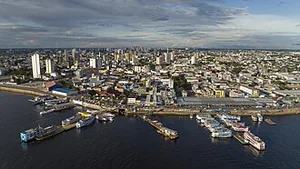
Manaus is a city that shouldn’t exist, a bold, opera-loving metropolis that sprouted like an orchid from the jungle floor. It’s the capital of Amazonas state, Brazil, and it’s where the tawny Rio Negro and the pale Rio Solimões meet but refuse to merge, flowing side by side for miles in a phenomenon they call the Meeting of the Waters. This is a place where the symphony of the Amazon – howler monkeys, squawking macaws, chugging riverboats – never really fades, even in the shadow of a grandiose opera house.
The city’s nickname is ‘Paradise of the Heart,’ and a stroll through its historic center explains why. You’ll find gilded domes, tiled sidewalks, and colonial facades that belong in Europe, yet the heat and humidity are pure tropical. More than a gateway to the Amazon rainforest, Manaus is a destination in its own right, a city whose past is written in rubber, gold, and a stubborn passion for culture in the middle of nowhere.
Long before the opera, Manaus was a humble Portuguese fort, São José da Barra do Rio Negro, founded in 1669. It served as a base for slave raiders and colonial expeditions, but its true destiny ignited in the late 1800s with the rubber boom. The world’s appetite for pneumatic tires created a colossal demand for Amazonian rubber, and Manaus was at its epicenter. Fortune seekers from all over Europe and the Middle East poured in, and the city’s population exploded.
It was a crazy, lavish era. The city’s rubber barons built an opera house that could rival Paris, importing ironwork from Scotland, marble from Italy, and ceramic tiles from Portugal. The theater opened in 1896, and its dome shimmers like a jewel. When the rubber boom collapsed a few years later – thanks to cheaper British plantations in Southeast Asia – Manaus went bust. But the city didn’t die. It reinvented itself as a free trade port, a military outpost, and now the most visited city in the Brazilian Amazon. The opera house remains as the most enduring symbol of its manic, magnificent past.
Start your visit at the Teatro Amazonas, the city’s crown jewel. You’ll want to take the guided tour (tickets are around R$20) which allows you to step into the velvet-lined, frescoed opera hall and see the stage where Enrico Caruso is said to have performed. Time your visit for a performance if you can. While inside, look for the four stacked balconies painted with the world’s greatest composers. And don’t miss the top-floor view of the city – it’s the best photo spot in the whole theater, offering a golden-brick skyline against the jungle.
After the theater, walk over to the Mercado Adolpho Lisboa, a municipal market inspired by Paris’s Les Halles. It’s a maze of fish stalls, tropical roots, and Amazonian fruits. Try a local snack – tacacá, a hot yellow shrimp soup, is an acquired taste but a true local favorite. The market’s metalwork came from France, and the iron structure is a testament to the city’s rubber-era wealth. It’s darker and more atmospheric than the opera house, and a perfect place to observe everyday Manaus.
Of course, you can’t visit Manaus without seeing the Meeting of the Waters. The best way is to join a crowded or private riverboat tour. The boats cruise slowly along the boundary where the black Rio Negro and sandy-colored Solimões meet. It’s a mesmerizing sight. Allocate at least half a day for this trip, and bring a swimsuit because you’ll stop at a jungle beach for a swim. For your photos, stand on the upper deck of the boat and wait for the moment when two tourists in the bow create a foreground. Hidden gems? Ask your guide to take you to the flooded forest if it’s the season – it’s a surreal landscape with river dolphins.
Finally, leave a few hours for the Palácio Rio Negro, an old rubber baron’s mansion turned museum. The gardens are free, and you’ll get a glimpse of how the other half lived before the boom went bust. Also, for a truly local experience, climb to the top of the floating dock, or ‘Flutuante,’ near the Port of Manaus and watch the riverboats unload. Recommended total visiting time for the city’s main sights is at least two full days. Combine theater, market, and palace on day one; the river trip on day two. Wi-Fi is spotty in the jungle, so download your maps and enjoy the disconnection.
