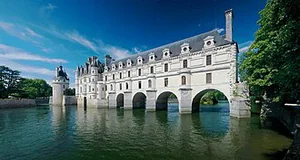
Château de Chenonceau is the kind of place that makes you believe in fairytales. The moment it comes into view, you understand why it draws millions of visitors each year. The castle doesn’t stand on dry land like ordinary palaces. It stretches gracefully across the River Cher, supported by a series of arches that seem to make the entire structure float on water. Morning light dances across the river, casting a perfect mirror reflection that looks almost too beautiful to be real.
But Chenonceau’s charm goes far beyond its picturesque setting. This is the “Ladies’ Castle,” a place whose history was written almost entirely by women. While most châteaux of the Loire Valley are remembered for their kings and warriors, Chenonceau was shaped, saved, and celebrated by a remarkable chain of ambitious, intelligent, and sometimes heartbroken women. That legacy gives the walls a particular warmth and intimacy.
Step inside and you’ll find opulent rooms filled with fine art, tapestries, and period furniture. Walk out into the gallery that spans the river, and you’ll feel as though you’re floating on water. Whether you’re a history lover, a garden enthusiast, or simply someone in search of beauty, Chenonceau delivers an experience that lingers long after you leave.
The story begins in 1513, when a wealthy French financier named Thomas Bohier purchased an old fortified mill on the river. He and his wife, Katherine Briçonnet, demolished everything but the medieval keep and built a stately new home in its place. Katherine was the true driving force behind the project while her husband was away on royal business. She stamped the castle with her own motto and symbol, making Chenonceau a monument to a woman’s perseverance from its very first stone.
Things got even more colorful in the mid-1500s. King Henry II gifted Chenonceau to his famous mistress, Diane de Poitiers. Diane adored the castle and added a graceful three-arch bridge across the river, giving the property an elegance that no other château could match. When Henry died in 1559, his widow, Catherine de’ Medici, forced Diane to hand the castle over. Rather than removing the bridge, Catherine built a magnificent two-story gallery on top of it. That addition—now the castle’s centerpiece—turned Chenonceau into the enchanting hybrid you see today. Catherine also created her own grand garden and organized sumptuous parties, including some of the most lavish celebrations of the Renaissance.
The castle’s later chapters are no less fascinating. Henry III’s widow, Louise of Lorraine, spent her final years here in deep mourning, dressing only in white—you can still visit her somber bedroom with its black and white mourning décor. In the 18th century, the château became the home of Louise Dupin, a writer and intellectual who hosted Voltaire and other leading minds. She also saved Chenonceau from destruction during the French Revolution, protecting it because of her charitable reputation. During the First World War, the castle served as a military hospital, and in World War II it provided a vital escape route between Occupied France and the Vichy zone—the far side of the river was German territory, while the near side remained free. Standing in the long gallery, it’s surreal to think that war once passed through this serene space.
So, what should you see when you get there? Start with the castle’s interior. The lower level houses the Green Study, where Diane de Poitiers once managed her correspondence, and the famous Gallery itself—a stunning 60-meter ballroom with a black-and-white tiled floor that was used for everything from royal festivities to hospital beds. Don’t miss the chapel, a small space with a striking mural of the Annunciation, or the vaulted kitchens built right into the river’s piers. Upstairs, you’ll find the magnificent bedrooms of Catherine de’ Medici and Louise of Lorraine. The latter is a haunting space, decorated with darker tones to reflect her endless mourning.
Allow yourself a full two to three hours to explore, more if you’re a passionate gardener. The two ornamental gardens are equally wonderful. Diane’s Garden, named for the legendary mistress, features a perfect arrangement of flower beds and a central fountain that seems to sparkle in the sunlight. Catherine’s Garden is cozier but still elegant, with its lush lawns and labyrinth of trimmed yew trees. Strolling through them offers a peaceful contrast to the castle’s grandeur.
Ticket prices hover around fifteen euros for adults, with reduced rates for students, children, and seniors. You can also rent an audio guide for a small extra fee, but the displayed panels and information rooms are so thorough that you don’t strictly need one. To capture the best photos, try the view from the left riverbank, where the full reflection of the castle appears in the water. The gallery itself is also a stunning photo spot, especially in the late afternoon when the light streams in through the long row of windows. If you look closely, you’ll notice hidden details—the woven initials of Henry and Diane, the wash basins of old kitchens, and the striking contrast of the cherub sculptures against the river.
One of the best-kept secrets is the view from the far end of the gallery. Most visitors stop in the middle to admire the chandeliers and the river rushing below, but if you walk all the way to the left bank, turn around and look back—you’ll see the castle perfectly centered on its arches, floating once again. For the best crowd-free experience, arrive right when the château opens or in the last two hours before closing. Then, take a final lap around the gardens as the setting sun turns the stone to gold. Chenonceau is more than a beautiful building; it’s a place where history, art, and nature have danced together for centuries, and they’re still dancing just for you.
