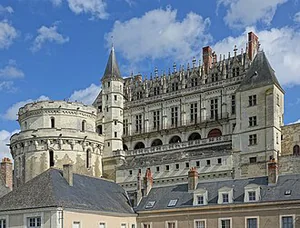
There’s a moment when you first see Château d’Amboise, and it stops you cold. It doesn’t just sit on the banks of the Loire River — it commands them, rising from a rocky promontory like a stone sentinel that’s been keeping watch for five centuries. Tucked between the town’s rooftops and the river’s sweeping curve, this royal fortress has a magnetism that’s hard to shake. Maybe it’s the fairy-tale turrets, or the way morning light paints the tuffeau stone a warm honey color. Or maybe it’s knowing that one of history’s greatest geniuses, Leonardo da Vinci, spent his final years here, and that his bones rest within its walls.
Amboise is not the biggest or grandest of the Loire Valley châteaux — Chenonceau’s arches and Chambord’s spirals steal those crowns. But what it lacks in size, it makes up for in sheer, layered history. This was the royal residence where French kings welcomed Italian artists, where a teenage Mary Queen of Scots lived, and where a massive conspiracy nearly toppled a monarchy. It’s a place where every stone whispers a story. And then there’s the view. Stand on the terrace, and you’ll see the Loire sliding beneath you, the island of Île d’Or stretching out like a green ribbon, and the whole town of Amboise sprawling below. It’s the kind of vista that makes you want to stay forever.
The château’s story begins in the 11th century, but its golden age came later, in the late 1400s. When King Charles VIII returned from his Italian campaigns, he brought back a hunger for Renaissance art and architecture — and he poured that passion into Amboise. He rebuilt the fortress into a palace fit for a young king, importing Italian sculptors, painters, and master craftsmen. The result was a dazzling hybrid: medieval fortifications wrapped around airy, light-filled apartments, with loggias and lanterns that had never been seen in France. Charles, though, never got to enjoy it fully. In 1498, he famously struck his head on a low door lintel while hurrying to a tennis match and died a few hours later, at the age of 27.
His successor, Louis XII, and then François I continued the work. It was François who, in 1516, welcomed Leonardo da Vinci to Amboise with an extraordinary arrangement: the artist would live at the nearby Clos Lucé, but have free run of the château, and the title of “First Painter, Engineer, and Architect to the King.” Leonardo spent three years in this valley, carrying with him the Mona Lisa, and he died here in 1519. That’s why visitors still flock to this spot — not just for the architecture, but for the ghost of a genius who sketched flying machines and painted the world’s most famous smile. The château later fell from royal favor, was used as a prison during the French Revolution, and even suffered a series of demolitions. But enough survives to evoke its former glory, and in 1974 it was placed in the hands of the St. Louis Foundation, which has lovingly restored it.
Inside, your first stop should be the royal apartments, a chain of rooms that takes you from the old Guard Room, with its massive fireplace, to the lavishly decorated bedroom where Charles VIII died. The furniture is sumptuous, the tapestries are intricate, and the ceilings are carved with the salamander emblem of François I. Don’t rush these rooms — look closely at the details, because each one has a story. The Council Chamber, with its beautiful Renaissance pilasters, is where the king would have held court. You’ll also want to linger by the windows. They frame the Loire so perfectly that they’re almost paintings in their own right.
The true highlight, though, is the Chapelle Saint-Hubert, a tiny flamboyant Gothic chapel perched on the edge of the ramparts. It’s decorated with stunning stone carvings, but its greatest treasure lies beneath a simple plaque in the floor: the supposed burial place of Leonardo da Vinci. The chapel was built in the late 1400s for Charles VIII’s hunting wilds, and its patron saint, Hubert, is the patron of hunters — a fitting tribute for a king who loved the chase. Over the centuries, the chapel has seen queens pray and conspirators hide, but now it’s a quiet, reverent space where art lovers come to pay homage.
Give yourself at least two hours to explore properly. If you’re a history buff, you could stretch it to three — there’s so much to absorb that you’ll want time to sit on the terrace and let it sink in. Tickets are sold at the entrance; you can also buy them on the official château website, and it’s worth checking if you want a combined pass that includes Clos Lucé, since the two are linked by a beautiful underground passage. The château does get busy in summer, so arriving early or late in the day will give you a more peaceful experience. Audio guides are available in multiple languages, and you’ll find them genuinely useful — they bring the rooms to life without feeling like a dry history lecture.
Now, for the photo spots. The most iconic shot is from the lower garden, looking up at the château’s eight majestic towers that once dominated the town. But for my money, the best viewpoint is from the terrace itself, where you can capture the château’s ramparts, the river, and the rooftops of Amboise in one sweeping frame. If you want a different angle, head to the small terrace in front of the Chapelle Saint-Hubert. The carvings on the chapel’s exterior are best captured in the late afternoon, when the low sun casts sharp shadows that make the stonework pop. And don’t forget the view from the spiral ramp that you take to enter the château — there’s a perfect moment when you emerge from the darkness into the sky.
A few hidden gems are easy to miss. Look for the winding, underground staircase that connects the château to Clos Lucé — it’s not open to visitors, but you can see its entrance in the lower part of the grounds, and it’s a fun piece of lore. Also, search out the “Tour des Minimes,” one of the massive towers that still survives. Its ramp was wide enough for a horse-drawn carriage to ride all the way to the top — imagine the clatter of hooves echoing up its stone walls. And if you have room for a little architectural curiosity, find the oratory, a tiny prayer room in the royal apartments with a beautifully painted ceiling that most people skip without a second glance. It’s a quiet little jewel.
Before you leave, take one last walk along the ramparts. The gardens here are terraced, filled with rosemary, lavender, and roses, and they drop away suddenly to reveal a dizzying view of the town below. On a clear day, you can see for miles along the river. You’ll understand, then, why this spot charmed kings, housed a genius, and continues to enchant travelers from every corner of the world. Château d’Amboise isn’t just a castle to check off a list —— it’s a place that stays with you, long after the echoes of your footsteps have faded.
