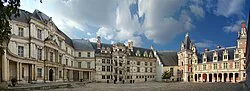
You’re standing in a courtyard that holds nine centuries of secrets. One glance upward, and you’ll see an open-work staircase spiraling into the sky like a stone lace ribbon. Look right, and a Gothic hall stares back from the 1200s. Turn left, and you’re facing an Italian Renaissance loggia that could have been lifted straight from Florence. This is Château de Blois, a place that doesn’t just show you history—it lets you walk through it from every era at once.
Perched on a hillside above the Loire River, Blois might be the most underrated of France’s great châteaux. It doesn’t have the glossy fairy-tale image of Chambord or Chenonceau. Instead, it offers something far rarer: a single building that tells the story of French royalty in all its glory, drama, and bloodshed. Kings and queens lived here. Joan of Arc came to receive her blessing. And one of the most shocking political assassinations in French history happened right inside these walls. No wonder the writer Gustave Flaubert once called it—half joking, half awed—”a building that could only be the product of a dream.”
The moment you step into the main courtyard, you’ll understand what he meant. The château is like a chronicle carved in stone, where four distinct styles stand shoulder to shoulder. You can literally trace the evolution of French architecture just by turning in a circle. But this place isn’t a mausoleum. It buzzes with life, from the museum’s rich collections to the nightly sound-and-light show that turns the façade into a canvas. If you only have a day in the Loire Valley, make it count here. Blois will give you all the grandeur of its flashier neighbors, and then it’ll whisper the secrets they’d never dare to tell.
History, for Château de Blois, is not a thing of dusty archives. It’s written indelibly into every stone. The site first appears in records around the 9th century, but the real story picks up in the 1200s with the powerful Counts of Blois, whose medieval hall still stands in the courtyard. In 1391, the estate passed to the royal House of Orléans, and things started getting dramatic. Charles of Orléans, a poet-prince held prisoner in England for 25 years, dreamed of rebuilding the castle. His son, though, had even bigger plans—he became King Louis XII in 1498, and Blois suddenly became a royal capital.
Louis XII was born here, and he showed his affection by adding a whole new wing in a playful red-brick style known as Flamboyant Gothic. The old drawbridge became a majestic entrance, and the royal apartments sprouted a golden porcupine—his personal emblem—carved over every doorway. But the château’s golden age peaked under Francis I, who ruled from 1515 to 1547. He invited Italian artists and architects to create the Renaissance wing you see today, with its legendary spiral staircase. Yet this beautiful court also harbored a sinister edge. It was in the Salle des États, the Estates General Hall, that King Henry III staged one of history’s most notorious power plays: on December 23, 1588, his guards killed the powerful Duke of Guise, who was seen as a threat to the crown. The assassination happened just after the Duke was summoned to the king—he never made it out of the royal antechamber.
What followed was a long, slow decline. The château became a place where exiled queens and forgotten aristocrats lingered. In the 19th century, it was used as a barracks, and many thought it would crumble into a ruin. But then came a remarkable rescue. The architect Félix Duban led a massive restoration in the 1840s, saving the staircase and rebuilding the interiors with a passion for historical accuracy. Today, the castle is owned by the city of Blois, but its real riches are the stories that linger in every room—a place where the walls genuinely seem to remember.
So, what should you actually do when you’re there? Start in the courtyard and don’t rush it. The famous Francis I staircase is the centerpiece, and for good reason. Its spiraling steps are an exercise in artistic madness, with carved salamanders (the king’s emblem) wriggling up the balustrades alongside intricate flourishes. Climb it slowly, and notice how the daylight plays tricks on the stone. From the loggia, you’ll have a glorious view of the rooftops of Blois and the Loire valley beyond. Inside the Renaissance wing, you’ll wind through a suite of royal apartments. Each room is furnished with tapestries, painted ceilings, and period furniture that makes you feel like the king just stepped out for a hunt.
The museum inside is also a delight—compact but full of genuine treasures. You’ll find hundreds of paintings and sculptures from the 16th to 19th centuries, including works that hung in royal residences. But the most atmospheric stop is the Salle des États, the huge Gothic hall that hosted the Estates General meetings. Stand in the center, and you can almost hear the murmur of plotting nobles. For a total immersion experience, that’s where the audio guide shines—it brings the assassination of the Duke of Guise to life with chilling drama. Don’t skip the medieval wing either, where a separate museum on the history of the château offers a fast, engaging overview. The old Chappelle Saint-Calais, with its exquisitely painted dome, often gets overlooked—make sure to glance up.
How much time do you need? Plan for at least two and a half hours if you want to see everything without feeling rushed. If you’re a history buff or a photographer, give yourself three. The castle can get busy around midday, especially in summer, so consider arriving right at opening time or later in the afternoon when the tour groups have thinned out. Tickets cost about 15 euros for adults, with discounts for students and seniors, and the ticket includes the museum and both wings. You can also buy a combined ticket with the sound-and-light show, which runs on most summer evenings. The show itself is pure magic—the entire loggia becomes a glowing screen for a cinematic retelling of the château’s history, complete with music and narration.
Now, for the photographers among you, let’s talk angles. The classic shot is from within the courtyard, shooting up at the staircase—it frames the spiral beautifully against the sky. Another gem is the view from the garden terraces behind the château, where you can capture the whole silhouette of the building. Look for the small, semi-circular balcony that juts out from the Renaissance wing; it’s a favorite spot for couples, and for a reason. If you’re after a hidden gem, step into the little oratory of Catherine de’ Medici. It’s a tiny, jewel-like room tucked behind the royal apartments, its walls covered with stunning carved paneling that echoes her Italian roots. Many visitors walk right past it.
One last tip—take a moment in the evening after the crowds leave. The château sits on a quiet rise above town, and the light turns amber, casting long shadows across the courtyard. You’ll feel the centuries settle around you. Château de Blois isn’t just a monument; it’s a three-dimensional diary of France’s most turbulent, passionate, and beautiful years.
So give yourself the time to listen. Stand under the staircase where kings walked. Run your fingers along the salamanders and porcupines. And when you leave, you’ll carry with you the warmth of a place that, despite all its conspiracy and bloodshed, remains utterly, romantically French.
