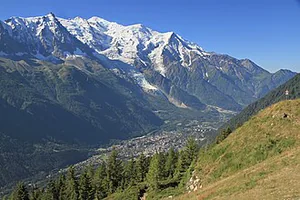
Chamonix isn’t just a town; it’s a threshold. Nestled in a valley beneath the towering massif of Mont Blanc, it’s a place where you tilt your head back, and your spine tingles. The air is crisp, tinged with pine, and the constant low rumble of distant avalanches reminds you that this landscape is very much alive. For many, Chamonix-Mont-Blanc is the beating heart of the French Alps—a destination that has drawn dreamers, daredevils, and poets for centuries.
Stand at the center of the village, and you’ll notice something immediate: everyone walks with their chin tilted upward. The skyline isn’t a horizon; it’s a jagged, snow-clad wall of granite rising straight into the blue. At 4,809 meters, the summit of Mont Blanc—the highest peak in Western Europe—looms like a sleeping giant. But Chamonix isn’t just about looking up. It’s about riding cable cars into the clouds, gripping the railing of a glass box suspended over a void, and standing on the Mer de Glace, a glacier that moves faster than you might think. This is a place that demands participation, not just observation.
The story of Chamonix begins with a mountain that almost nobody wanted to climb. For centuries, the local people regarded Mont Blanc with a mix of fear and respect—call it the “Montagne Maudite,” or cursed mountain. That all changed on August 8, 1786, when two local men, the crystal hunter Jacques Balmat and the physician Michel-Gabriel Paccard, finally conquered the summit. This wasn’t just a technical feat; it ignited an entirely new pursuit, one we now call mountaineering. Within a year, Horace-Bénédict de Saussure, a Swiss scientist, made his own ascent, and the obsession was born.
The 19th century transformed Chamonix into an international playground for British aristocrats who’d journeyed to test their mettle against the icy slopes. Perhaps most famous is Edward Whymper, who tackled the Matterhorn and left his mark on alpine history. To support these daring tourists, the Compagnie des Guides de Chamonix was formally established in 1821, making it one of the oldest guide associations in the world. The town leaned into its new identity, building grand hotels, then a railway, and finally attracting the world’s attention in 1924 as the host of the first Winter Olympic Games.
Chamonix kept evolving, though its defining moment came in 1955 with the construction of the Aiguille du Midi cable car. For years, it held the title of the highest vertical ascent in the world, hoisting passengers from the valley floor at 1,035 meters to 3,842 meters in about twenty minutes. The engineering was considered audacious, even insane. Today, that same ride is a rite of passage, a breathtaking leap from a sleepy alpine town into the frozen sky.
The easiest way to plunge into the heart of this vertical world is the téléphérique de l’Aiguille du Midi. Once you step into the two-stage cable car, the village quickly falls away, replaced by granite cliffs and crevassed glaciers. At the top, the panoramic terrace is jaw-dropping, but the real thrill is the “Step into the Void” glass cage, a glass room that juts out over a sheer 1,000-meter drop. It’s not for the faint-hearted, but it’s undeniably the most photographed spot in the area. Don’t rush it. Give yourself a solid couple of hours up top, just to wander the connecting corridors and soak in the view of the entire Mont Blanc range.
Down in the valley, another must-do is the Montenvers cogwheel train, which creaks and clatters its way to the Mer de Glace. That’s France’s largest glacier, a slow-moving river of ice that snakes 7 kilometers down the slopes. Once you’re at the station, you can take the cable car down to the ice cave, where carefully carved tunnels let you touch the blue, ancient ice. A word of warning: the glacier is melting, and the stairs down have grown steeper over the years. Think of it as part of the adventure.
If you’re wondering how much time to set aside, try to plan at least two full days. The Aiguille du Midi alone deserves half a day, and you’ll want to combine it with a hike into the tranquil Vallee Blanche or along the Grand Balcon Nord trail. For the Mer de Glace and Montenvers, allocate another half-day at least. As for tickets, everything is sold separately. The Aiguille du Midi cable car is pricey—it’s often the single most costly item on a Chamonix itinerary—but the ticket includes the ride both up and down. The Montenvers train is a separate fee, and both can be purchased online or at the stations. Try to buy ahead for the cable car if you’re visiting in summer or peak ski season; the queues stretch long.
For the best photos, you don’t need to be a professional. The glass box at the Aiguille du Midi, of course, is a highlight, but the mid-station at Plan de l’Aiguille offers a gorgeous, less dizzying view of the Chamonix valley. If you’re up for a short hike, Lac Blanc, a mirror-like lake at 2,352 meters, reflects the massif with breathtaking clarity on calm mornings. For a quiet hour, slip into the old Chamonix church—Saint Michel’s—which hides a beautifully painted interior and a calm that feels a world away from the adrenaline-charged streets. And don’t miss the Alpin Museum, tucked into the old palace building, where you’ll find fascinating photos and relics from the first ascents. Those hidden gems are often the ones people remember long after the snaps fade.
