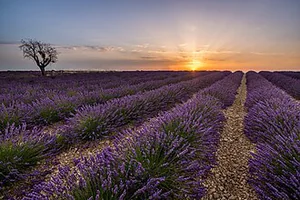
There’s a certain day in early summer when the Plateau de Valensole turns into something close to a dream. Cool morning mist burns off the fields, and the air fills with the heavy, honeyed scent of lavender – thousands and thousands of acres of it, rolling in purple waves to the foothills of the French Alps. This, not the postcard, is why so many travelers lose their hearts to Provence.
The tiny village of Valensole itself perches above the plateau, a golden-stone cluster of narrow lanes, shuttered windows, and a prideful old bell tower. For half the year it’s a quiet farming town, the kind where conversations drift from street café tables. But when the lavender blooms, usually from the last days of June into mid-July, that quiet explodes into a slow-motion frenzy. People come from Tokyo, Sydney, Austin, everywhere. They walk into the rows, kneel for photos, and leave with sachets stashed in their luggage and purple pollen on their shoes.
Long before lavender made it famous, Valensole had other claims to history. Flints and coins found beneath the soil suggest hunters and shepherds wandered here thousands of years ago, and the Romans later passed through on their way north from the Mediterranean. The name itself likely comes from the Latin Vallis Solis – ‘Valley of the Sun’ – a fitting title for a place that feels like the roof of the world.
The medieval village grew up around a Benedictine priory, and for centuries the plateau sustained monasteries and farmers with wheat, almonds, and grapevines. Lavender, which was already used by local women to dry scented laundry, didn’t become a serious crop until the nineteenth century. That’s when steam distillation arrived, allowing distilleries to turn the flowering spikes into an intensely perfumed oil for the new grand apartments of Marseille and Paris. The market exploded – and so did the fields. By the early twentieth century, Valensole was already being called the heart of French lavender production, and after the big frost of 1956 devastated older lavender varieties, farmers simply replanted in the straighter, more uniform rows you see today.
Begin your visit right in the village. Wander the main square, where an ancient stone fountain still does its job, and curl into the shaded lanes past stone houses with blue shutters. You’ll find old doorways, a church with a plain Romanesque bell tower, and a 19th-century windmill at the village edge that frames the plateau beautifully. If you’re into smells and science, drop into a distillery (the local ones are used to visitors) where copper stills and big sacks of dried flowers explain the craft – and the difference between the more precious “fine” lavender and the hardy lavandin.
Then you go out to the fields, and the scale is what catches you first. The plateau spreads in every direction, each ridge lined with lavender, each row curving with the land. Half a day is enough if you’re simply driving and snapping photos, but you’d honestly be better off giving yourself a full day. There are no fences and no entry gates. You can park on a shoulder, walk straight into the purple chaos, and lose yourself – at least until your feet say you’ve had enough.
For tickets: no ticket booth for a landscape. The plateau is free. A few themed gardens and lavender museums nearby will ask a small fee for guided walks, but nobody’s charging you for the sky. What will cost you is provisions: water, sunscreen, a hat. The summer sun is relentless. And yes, you’ll want those sachets of lavender honey and soap from the roadside stalls – they make perfect souvenirs you can actually pack home.
Photo hunters, listen up. The light at dawn turns the whole plateau into a hush. Wait for the first horizontal rays and the purple rows gain a strange, almost glassy depth. At sunset, you get the opposite: warm, honeyed light that slides along the rows, making orange and violet dance together. The classic shot includes the old windmill on the hill outside town, but for the real hidden gems, leave the main road and take any small farm path. Just don’t tread on the plants themselves; as beautiful as they are, they’re a living business. And if you come in late July, when the harvest starts, you might just catch the end of the magic – watching a farmer cut lavender by sickle while the modern world waits in the parking lot.
