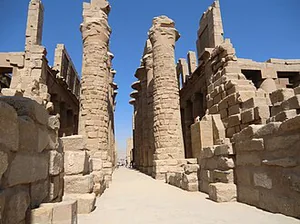
There are temples, and then there’s Karnak. If you’ve ever imagined what it feels like to stand before a monument built by gods, Karnak is the closest you’ll get. This isn’t a single building; it’s a vast, sprawling complex of sanctuaries, pylons, obelisks, and halls that grew wild for over two thousand years. It’s the largest ancient religious site in the world, and it’s staggering in every sense of the word.
From the moment you enter through the great avenue of ram-headed sphinxes, you feel small. Overwhelming, awe-inspiring, and utterly unlike anything else in Egypt — those are the words that spring to mind. Karnak is not a polished museum piece; it’s a raw, sprawling testament to human ambition and divine obsession. Dust swirls in the sunbeams that cut through colossal columns, and the air hums with the weight of centuries. You don’t just visit Karnak. You walk through a stone forest of history.
Karnak’s history is the history of Egypt itself. Construction began around 2000 BCE during the Middle Kingdom, but the great expansion came in the New Kingdom (1550-1070 BCE). Pharaohs like Hatshepsut, Thutmose III, Seti I, and Ramesses II all left their mark, each adding a pylon, an obelisk, or a chapel to outdo their predecessors. The complex was the main sanctuary of the god Amun-Ra, the king of the gods, and it served as the religious and political heart of Thebes (modern Luxor). For centuries, it was considered the dwelling place of the divine on Earth.
The scale is almost impossible to process. The precinct of Amun alone covers about 250,000 square meters — think of a large sports stadium, then multiply it by a hundred. The sacred lake, the largest of its kind in Egypt, still shimmers in the desert heat. But Karnak’s decline came when foreign powers, particularly the Persians and Romans, exploited Egypt’s waning strength. Earthquakes, time, and the rise of Christianity and Islam led to neglect and burial under sand. In the 19th century, the site began to reveal its secrets again, and today it’s one of the most carefully studied and partially restored archaeological wonders on Earth.
So, what do you actually do inside? First, give yourself at least three to four hours — ideally at sunrise when the crowds are thinner and the light turns the sandstone gold. Start with the Great Hypostyle Hall. This is the postcard image of Karnak: 134 massive columns, each carved with hieroglyphs, arranged in 16 rows. The central columns are so thick that it takes six people holding hands to wrap around them. Stand in the middle, look up, and you’ll feel like an ant at the base of a redwood. But don’t stop there. Walk to the obelisk of Queen Hatshepsut, the tallest surviving obelisk in Egypt (nearly 30 meters). It’s still perfectly intact, a marvel of engineering that she built to proclaim her divine authority.
Don’t miss the Sacred Lake, where priests once performed ritual ablutions. It’s a peaceful spot, and you’ll often see birdlife and even a few local cats lounging on the edges. For a hidden gem, seek out the small Temple of Ptah, tucked away in the north-west corner. It’s quiet there, rarely crowded, and the sanctuary houses a beautiful fragment of a triple statue of Ptah, Sekhmet, and Ramesses III. Another lesser-known feature is the scarab beetle statue by the sacred lake. It’s said that walking around it seven times brings good luck. You’ll see people doing just that — don’t be shy to join them.
Photography at Karnak is a dream, but there are a few spots you shouldn’t skip. The aforementioned Great Hypostyle Hall is the obvious one. For a different angle, find the avenue of sphinxes just outside the first pylon and shoot back toward the temple. The perspective is stunning, and you can frame the massive pylon with the sphinxes as a foreground. If you can, stay until late afternoon. The shadows stretch and carve out the hieroglyphs in sharp relief. From the south side of the sacred lake, you can capture the giant columns and the surviving pylon reflected in the water — a perfect shot that few travelers manage to get.
One practical piece of advice: bring water and wear comfortable shoes because you’ll be walking on uneven stone for hours. There’s no shade inside the hypostyle hall, so a hat and sunscreen are non-negotiable in summer. The complex is open daily from around 6 a.m. to 5:30 p.m., but check the exact times near your visit. Tickets are purchased at the entrance gate, and they’re quite reasonable compared to other major sites in Egypt. You can also hire a guide at the gate or buy a guidebook, but honestly, wandering with a map and letting the mystery wash over you works just fine. There is no single “best” route — get lost among the stone giants and you’ll stumble on the real magic of Karnak.
A final hidden gem: just north of the main enclosure, you’ll find the open-air museum, which many visitors skip. It contains the beautifully preserved White Chapel of Senusret I and the red chapel of Hatshepsut, reconstructed from thousands of stone blocks that were found reused in later buildings. It’s like a quiet sanctuary within a sanctuary. Karnak isn’t just a place you see; it’s a place you feel. The sheer ambition of the ancient Egyptians is written in every chiseled groove and every towering pillar. When you leave, you’ll carry a sense of wonder that no photo can ever capture. And that’s exactly what makes Karnak unforgettable.
