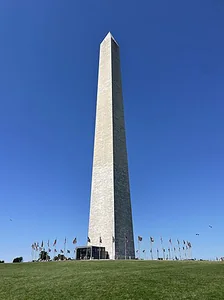
There it is—a stark, white stone needle piercing the blue Virginia sky. From almost anywhere in Washington, D.C., your eyes eventually settle on it. The Washington Monument isn’t a fussy building. It doesn’t have columns or domes or ornate carvings. It’s just a simple, tapering shaft of marble and granite, rising five hundred fifty-five feet off the National Mall. And yet, that simplicity is precisely what makes it so powerful. It feels less like architecture and more like ambition made solid.
As you walk closer, the sheer scale dawns on you. The base is enormous, weighing in at nearly 91,000 tons. You tilt your head back and follow the towering obelisk until it narrows to a tiny aluminum point that catches the afternoon light. This is America’s great vertical gesture—a monument to George Washington, the man who led a rebellion, shaped a constitution, and then had the sense to walk away from power. But it’s also a monument to the country’s stubborn, often chaotic effort to honor him. The story of its construction is a story of stalled starts, political squabbles, and a Civil War. Perhaps that’s why it feels so human, despite its colossal size.
The idea for a monument to Washington emerged before he even died. In 1783, the Continental Congress called for an equestrian statue, but it took decades for the project to gain real momentum. Finally, in 1836, a design competition was held. Robert Mills, an architect who loved the ancient world, proposed a stark obelisk, one that would echo the great Egyptian pylons. The original design planned for a circular colonnade at the base, decorated with statues. But money ran out early, and the builders wisely focused on the obelisk itself—the colonnade was never built, and the D.C. skyline is the better for it.
Construction began in 1848, with Washington’s own nephew and a towering group of dignitaries looking on. Over the next few years, donations flowed in from private citizens, states, and foreign nations. Many sent memorial stones—carved blocks of marble, granite, and even volcanic rock from Italy, China, Turkey, and beyond. They were embedded in the interior walls. But in 1854, a controversial stone from the Pope sparked a political firestorm. The anti-Catholic party seized on it, donations dried up, and the project ground to a halt. Then the Civil War came, and the unfinished stump of a monument sat awkwardly on the Mall for nearly two decades. Cows grazed around it. It was a national embarrassment.
After the war, the government finally took charge. The army engineers inspected the foundation, realized it was shaky, and made a crucial decision: they would build on the existing base but not with the same material. That’s why, if you look carefully, you’ll notice a slight change in the color of the stone about a foot off the ground—the lower section is a duller, bluish marble, while the upper portion is brighter, whiter. They raced to the top, and in December 1884, they set the nine-inch aluminum cap in place, completing the tallest stone obelisk in the world. It held the title of tallest building on Earth until the Eiffel Tower arrived five years later. In 2011, an earthquake cracked the stone, but the monument was painstakingly repaired and reopened in 2014, as stoic as ever.
So what’s it like to actually visit? Well, first things first—it’s not a climb. You take an elevator from the ground floor to the observation deck at the top, and it’s a smooth, quick ride that takes about seventy seconds. The deck sits just below the pyramidion, with windows on all four sides. You’ll see the White House to the north, the Jefferson Memorial to the south, the Lincoln Memorial to the west, and the U.S. Capitol to the east. It’s an incredible 360-degree view, but bring your patience. The deck is small, and on a busy day, it can get crowded. Still, there’s something special about standing at the highest point in D.C. and watching the city unfold beneath you like a living map.
You’ll also want to spend time in the museum on the lower level. There you’ll find exhibits about Washington’s life, the monument’s construction, and even a replica of the original design. But the real hidden gem is the memorial stones themselves. As you wait for the elevator, you can peek through small glass windows into the interior shaft—there, you’ll see carved stones from the Sultan of Turkey, the Kingdom of Siam, and a group of Indiana schoolchildren. Some are ornate, others are crumbling, but every one tells a little story about who wanted a stake in Washington’s legacy.
Plan to spend about forty-five minutes to an hour inside, not counting the security line. The elevator ride, the view, and a quick wander through the museum will fill your time nicely. Admission is free, but here’s the catch: you need a timed entry pass. These are released on recreation.gov, usually thirty days in advance, and they go fast. Same-day tickets are sometimes available on a first-come, first-served basis if you line up early at the Washington Monument Lodge on the southwest side, but reserving ahead is the smarter move. There’s a seven-dollar processing fee per ticket, which feels like a steal for the experience.
As for photos, the classic shot is from the steps of the Lincoln Memorial, looking down the Reflecting Pool—the monument frames the entire scene. But you can also get a gorgeous angle from the Tidal Basin, especially in spring when the cherry blossoms frame the white stone in pink. For something a bit different, stand directly underneath the obelisk and look straight up. The flat sides converge into a diamond of stone, and the top feels impossibly distant. It’s a vertigo-inducing perspective that tourists rarely use, so you’ll likely have it all to yourself.
Don’t rush past the ground level, either. The monument sits on a low hill, and from its base you get a sweeping view of the Mall in both directions. The American flag at the top flies twenty-four hours a day, as mandated by a presidential proclamation, and at night the whole structure is floodlit, glowing against the dark sky. As you leave, take one last look back. That simple needle is so much more than a landmark. It’s a story of a nation’s patience, mistakes, and eventual triumph—stuck into the ground, pointing toward the endless sky.
