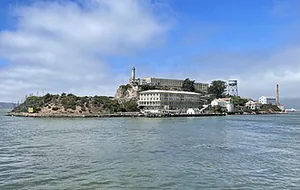
Alcatraz Island isn’t a place that grabs you with bright colors or cheerful sounds. It grabs you slowly, with a cold wind off the bay and the distant wail of a foghorn. From the city of San Francisco, it sits like a rusted ghost, a cracked concrete slab floating in the water. Tourists tend to whisper when they arrive. There’s something in the air here, a heavy silence that drips down the cellhouse walls.
For nearly three decades, this fortified federal prison held some of America’s most dangerous criminals. But long before the gangsters arrived, it was a military fortress, and long after the prison shut down, it became a symbol of Native American resistance. Today, it’s one of the most fascinating national park sites in the country. It’s equal parts penitentiary, bird sanctuary, and open-air museum. If you’re headed to the Bay Area, Alcatraz should sit near the top of your list.
You get the sense immediately that this place is more than a tourist stop. The moss, the peeling paint, the rusted metal — they all tell a story. And as the ferry floats away, leaving you on the concrete dock, the island seems to dare you to leave. Don’t worry. You’ll be glad you stayed.
The story of Alcatraz goes back further than most people realize. Native Americans visited this small island centuries ago. Then, in 1775, the Spanish explorer Juan Manuel de Ayala charted it and called it “La Isla de los Alcatraces,” or “Island of the Pelicans.” Those seabirds had been there for thousands of years, and they may have been the most honest residents the place ever had.
During the Gold Rush, the U.S. military understood that this deep-water island could guard the San Francisco harbor. In 1853, the Army began building a fortress that later morphed into a military prison. By 1911, a massive concrete cellhouse dominated the island. Yet the place gained real infamy in 1934, when Alcatraz became a federal penitentiary. Its first residents included Al Capone and George “Machine Gun” Kelly. More than a thousand men served time in those cells over the next 29 years. The routines were rigid: wake at 6:30, work at 8:15, lock in at 4:30. And despite countless escape attempts, not one prisoner ever reached freedom successfully.
The prison closed in 1963 because the salt air corroded everything and maintenance costs ballooned. Just six years later, Native American activists occupied the island for nineteen months, demanding civil rights and recognition. That occupation forever changed the island’s future, and in 1972 Alcatraz became part of the Golden Gate National Recreation Area. So this isn’t a sanitized monument. It’s a layered slice of American history, and every layer is worth exploring.
The heart of any visit is the cellhouse, and the audio tour there is one of the best in the world. It’s narrated by real former correctional officers and inmates. You’ll walk along “Broadway,” the central cell block, and hear a cacophony of keys, doors, and shouting voices mixed with personal memories. It’s a strange feeling to stand inside a cell that once held Al Capone, looking out at the same sliver of sky he saw every day. You’ll also see where the famous 1962 escape happened — the gap behind the wall, the false ventilation grate, the dummy heads made of soap and hair.
Give yourself at least three to four hours on the island. That might seem like a long time for such a small piece of rock, but the place is dense. If you’re racing back to the ferry, you’ll miss the quieter layers. Wander through the gardens on the western terraces. They look almost impossibly green against the stone, and they hide a softer side of Alcatraz that few visitors expect. Those gardens, once buried under layers of debris, now bloom with roses, succulents, and exotic plants.
As for practical details, tickets are attached to a specific ferry departure from Pier 33, and they sell out days or weeks ahead in summer. Reserve yours in advance. The price covers the ferry, island entry, and the audio tour, so you won’t need to pay for extra admission once you arrive. If you can, take the first ferry of the morning. The light is dramatic, the crowds are thinner, and the cells feel even more mysterious before they flood with visitors.
For photography, start in the recreation yard. The prison yard looks straight out toward the Golden Gate Bridge, and the framed view is stunning. Then find the cellhouse windows on the east side. Through the rusty bars, you’ll catch the San Francisco skyline in a way you’ll never see anywhere else. The lighthouse is another favorite — it’s one of the oldest on the West Coast, and its white tower against the blue water is picture-perfect. If you want a quiet shot, head to the parade grounds near the dock. You get a sweeping panorama, and it’s usually far emptier than the cell block above.
Now for the hidden gems. Most visitors rush through the main cell block and miss D Block, the segregation unit. It sits at the far end of the cellhouse, where the hallways feel darker, colder, and almost unbearably quiet. Some people say that’s the most haunting part of the entire island. Also, keep an eye out for Alcatraz’s wild side. During nesting season, the island becomes a genuine bird sanctuary. Black-crowned night herons perch on old cell walls, and the sound of gulls rivals any ghost story. And don’t skip the ruins of the warden’s home. It burned down in 1970, but its skeletal walls and scattered bricks are a powerful reminder that history here isn’t always polished or pretty.
Alcatraz is a strange mix of beauty and dread. You can stand on a sunlit path with native flowers at your feet, then turn and see the shadow of a prison tower looming above. That contrast is exactly why the island sticks with you long after the ferry pulls away. Come for the infamous history, but stay for the gardens, the seabirds, the views, and the quiet chance to listen closely to a place that made America hold its breath.
