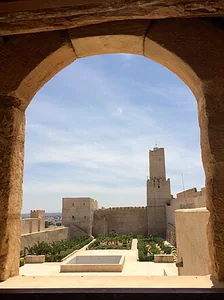
Sunlight spills across a labyrinth of white-and-blue washed walls, where the cry of a muezzin mingles with the clatter of metalworkers hammering brass. This is the Medina of Sousse, a UNESCO World Heritage Site that rises like a stone fortress from Tunisia’s eastern coast. Wander through its gates, and you’re not just visiting a monument—you’re stepping into a living, breathing medieval town that has traded, prayed, and fought for more than a thousand years.
For all its beauty, the medina is best known for something unexpected: its military soul. This isn’t one of those ornate medinas built for pleasure, like Marrakech’s. Sousse was the empire’s guard post on the sea. Its thick stone walls, square towers, and windowless facades speak of a time when every building had a second job as a bunker. Yet those same ramparts now enclose some of Tunisia’s liveliest souks, where vendors sell leather slippers, ceramics, and carpets in every shade of saffron and indigo. The whole place feels alive—kids kicking soccer balls past stacked couscous bowls, old men chain-smoking over dominoes, shopkeepers calling out friendly greetings in three languages.
The story of Sousse begins long before the medina you see today. Phoenician sailors founded a trading post here called Hadrumetum in the 9th century BC, and it grew prosperous under the Romans. But the walled city as we know it dates from the 9th century AD, when the Aghlabid dynasty—the same rulers behind the great mosque of Kairouan—decided to turn this coastal settlement into a ribat, a fortified monastery where Muslim warriors lived, trained, and kept watch for Byzantine raids from the sea.
The centerpiece of that early defense is the Ribat of Sousse, completed around 821 AD. Its square Khalef Tower still rises proudly above the skyline, and climbing its winding stairs is the single best thing you can do here. Around the same time, the Great Mosque went up next door. In most Islamic cities, a mosque is a sanctuary of peace. Sousse’s version looks like a fortress, with crenellated walls and a massive, windowless exterior—because, well, it was one. Built largely from the recycled rubble of Roman-era buildings, it stands as a magnificent example of pragmatic medieval architecture.
From the 10th century onward, Sousse passed through a series of hands. The Fatimids, the Zirids, a short-lived Norman occupation in the 12th century, and then the Ottomans from the 16th century each left their traces in the medina’s fabric. But it was under the Husseinid dynasty in the 18th century that Sousse truly hit its stride, becoming a powerhouse of the olive oil trade. Warehouses, artisan workshops, and fondouks—traditional caravanserais where traveling merchants bunked alongside their camels and goods—packed the narrow lanes. That’s the texture you can still feel today when you wander off the main tourist routes.
Ready for the practical side? You can enter the medina through its grand old gates, the most dramatic being Bab el Gharbi on the western side. Give yourself at least two to three hours—more if you’re the type to linger over a mint tea on a rooftop terrace. Start with the Ribat. The entrance fee is about 7 Tunisian dinars (a couple of dollars), and it’s worth every millime. The climb is steep, and the steps are narrow and worn, but the reward is a sweeping panorama across the medina’s terraces, the minarets and domes, and the glittering Mediterranean beyond. Late afternoon, when the light turns everything golden, is the money shot.
Just across from the Ribat sits the Great Mosque. Non-Muslims can’t go inside, but you can admire its intimidating walls and catch a glimpse of the courtyard through the ancient gate. Then make your way uphill to the Kasbah, the 9th-century citadel that crowns the medina. It now houses the Museum of Sousse, home to an extraordinary collection of Roman mosaics pulled from nearby archaeological sites. The floor mosaics alone—vibrant scenes of gods, hunters, and sea creatures—are reason enough to make the trek. Admission runs about 10 dinars, and remember to bring cash; they don’t take cards.
Down in the souks, the experience is as much about people-watching as it is about shopping. Merchants spread out rainbow stacks of woven blankets, copper pots gleam in the half-shade, and the air carries the scent of spices, leather, and jasmine soap. Bargaining isn’t just accepted; it’s expected. Treat it as a conversation rather than a confrontation, and you might walk away with a Berber carpet or a hand-tooled leather bag—and a new friend to boot. If you want to find something genuinely special, look for the fondouks tucked down the side alleys. A few have been gracefully reborn as cafes and artist cooperatives, offering a quiet corner away from the bustle.
Hidden gems are everywhere if you know where to look. There’s a tiny museum of traditional costume hidden inside a restored mansion near the Kasbah, and a handful of rooftop terraces where coffee comes with a front-row seat to the sunset. For photographers, the most striking angles come from the smaller, unnamed alleys that branch off the main drag—the ones with crooked staircases, peeling blue shutters, and stray cats basking on warm stones. Head out early, before the crowds and the heat arrive, when the medina feels like it belongs entirely to you.
One more tip: wear sturdy shoes. The paving stones have been polished smooth by a thousand years of footsteps, and on damp mornings they’re treacherous. And if you can, stay for the call to evening prayer. The muezzin’s voice echoes through the corridors of white-washed stone, and the city seems to pause, just for a moment, to remember all the centuries it has held within these walls. It’s the kind of memory that stays with you long after you’ve left Tunisia behind.
