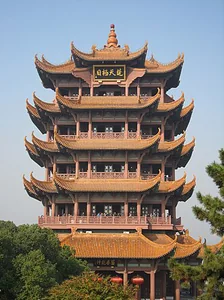
Perched atop Snake Hill in Wuhan, the Yellow Crane Tower isn’t just another pagoda. It’s a poem you can climb, a phoenix that’s risen from its ashes dozens of times, and a place that has haunted the imagination of China’s greatest writers for over a thousand years. The moment you pass through its arched gate and look up at those flying eaves, you understand why. Golden roof tiles catch the morning light, red pillars rise against a canvas of blue sky, and the Yangtze River glints far below like a living ribbon. It’s a scene that feels both ancient and utterly alive.
For many visitors, the tower’s fame precedes the sight of it. Generations of Chinese schoolchildren have memorized lines from a Tang dynasty poem about this very place — a poem about loss, distance, and a crane that flew away forever. But the real tower has never left. It’s stood witness to dynasties crumbling, battles raging, and cities transforming, all while maintaining the quiet grace of a cultural immortal. In a country of breathtaking landmarks, the Yellow Crane Tower stands out as the rare one that poets actually sang to. And when you’re standing at its base, you’ll understand exactly why.
History didn’t start with a masterpiece of architecture. It started with a practical need. The original tower was built in 223 AD, during the Three Kingdoms period, as a simple watchtower for a general defending his territory. No one could’ve predicted that this utilitarian outpost would evolve into one of China’s most beloved cultural icons. Its location was strategic — commanding a bend in the Yangtze River — but its destiny was poetic. By the Tang dynasty, the tower had shed its military roots and become a scenic retreat, a place where scholars gathered to drink wine, exchange verses, and watch boats drift by.
The tower’s story is one of endless rebirth. It’s been destroyed and rebuilt at least 27 times, with the most devastating losses coming from fires and, later, armed conflict. The last traditional version was erected in 1868, only to be demolished in 1884, leaving nothing but scorched earth and memories. For nearly a century, the site lay empty, a ghost on a hillside. Then in 1981, the Chinese government began a grand reconstruction, finishing in 1985. The current tower, designed to mimic the aesthetics of the Tang dynasty, stands a magnificent 51.4 meters tall spanning five floors. Every beam, bracket, and flying eave honors the ancient architectural traditions that made the original so special, even though the building itself is thoroughly modern. Walking through its halls, you’re not stepping back in time — you’re stepping into a collective memory of what time has always meant here.
What awaits inside is far more than a climb. Each of the five floors unfolds a different chapter of the tower’s story. The first floor greets you with a massive mural of the legendary crane in flight, surrounded by celestial clouds — a nod to the folklore that a Taoist immortal once drew a crane on the wall, which came to life and carried him away. The second floor dives deeper into the tower’s history, with miniature models showing how it looked in various eras. Don’t rush past these. They’re intricate little time machines. The third floor is where poetry comes to life, with calligraphy and ink paintings of the famous Tang poets whose names are forever tied to this place. Look for the Qing dynasty edition of “Yellow Crane Tower” by Cui Hao, the poem that supposedly made even the great Li Bai bow his head in awe. Rumor has it that when Li Bai came to write his own piece, he admitted, “The scene before my eyes cannot be described — Cui Hao’s poem has stolen the show.”
You’ll want at least two hours here, maybe three if you’re like me and linger over every plaque and panel. The ticket booth charges around 70 yuan (roughly $10), which is a bargain for the mix of art, history, and scenery you get. But here’s a tip: go early. The tower opens at 8 a.m., and the first hour is pure magic. You’ll have whole corridors to yourself, and the morning mist often turns the river into a watercolor painting. Head straight to the fourth floor, which houses a series of lacquered wooden panels depicting the tower’s epic rebuilding history — few visitors stop here, but it’s the closest you’ll get to the soul of the place.
The real payoff is the climb to the top deck. The fifth floor’s wraparound balcony gives you a 360-degree view that’s nothing short of theatrical. To the west, the Yangtze River stretches into a haze; to the north, the vast span of the Wuhan Yangtze River Bridge dominates the skyline — a 1950s feat of engineering that feels like a millennium away from the tower’s ancient bones. On clear days, you can see the distant hills and the sprawling city below, a beautiful chaos of old and new. This is the spot where poets found their muse, and you’ll feel the urge to scribble something down, even if it’s just a quick photo for your camera roll. For the best shot, position yourself on the southwest corner of the balcony, where the red pillars frame the bridge perfectly. Another classic photo op is at the bronze crane statue near the tower’s base — get there in the afternoon, when the light hits its wings at a golden angle.
If you wander beyond the main building, you’ll stumble onto a few hidden gems. Just west of the tower, there’s a lesser-known stone archway and a small pavilion called the White Cloud Pavilion, named after a famous line from Li Bai. It’s a quiet spot, perfect for escaping the crowds. Also keep an eye out for the Great Bell — a massive bronze bell in the eastern courtyard that you’re encouraged to strike, the deep sound resonating through the hillside. And here’s a quiet secret: on the south side of the tower, look for the old foundation stones excavated during the 1980s reconstruction. They’re humble, gray, and easily missed, but touching them connects you to the actual centuries of history beneath your feet — the real heart of the Yellow Crane Tower, hidden in plain sight.
The tower is not just a place to see; it’s a place to feel. It’s a monument to resilience, to the human desire to create beauty again and again, no matter how many times the flames consume it. You don’t have to know a single Tang dynasty poet to be moved by it. You just need to climb, breathe, and look out over that ancient river. And for a moment, you’ll understand why a crane flew away — and why everyone who visits hopes it will one day fly back.
