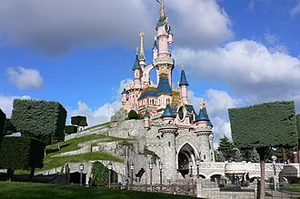
There’s a moment when you first lay eyes on the Sleeping Beauty Castle here, and it hits you: this isn’t just any Disney park, and it isn’t just any castle. Its turrets rise like something out of a storybook illuminated by moonlight, its pink and blue spires echoing the Château de Chambord more than the Cinderella Castle in Florida. This is Disneyland Paris, a place where American imagination got a distinctly European soul. The cobblestones beneath your feet, the ornate ironwork, the scent of buttery crêpes drifting from Main Street U.S.A. — every detail feels both familiar and thrillingly foreign.
For over three decades, this park has welcomed millions of dreamers to its 4,800 acres of pure escapism. It’s not just a theme park; it’s the most visited tourist destination in France by a long shot, drawing more visitors than the Louvre or the Eiffel Tower. That’s saying something. But you don’t come here for the records. You come to watch a parade that turns the street into a musical, to ride that legendary Space Mountain that feels scarier than its American siblings, and to share a churro with a family from Milan or Tokyo while a dragon sleeps beneath the castle. Disneyland Paris is a wild, wonderful contradiction: a French landmark that’s actually a piece of California, a place where every corner whispers, “Rejoice, you’re a kid again.”
The story of this magical kingdom begins with a vision — some might say an obsession. In the late 1980s, Walt Disney’s successor, Michael Eisner, and his team dreamed of a European outpost. They scouted sites from Spain to Portugal, but finally settled on Marne-la-Vallée, a sleepy agricultural area just a little way from Paris. Construction was a herculean effort: 2,800 acres of former sugar-beet fields were sculpted into Seven Wonders-style terrain. In March 1987, ground was broken under an enormous white tent, with the then-Mayor of Paris, Jacques Chirac, in attendance. The project was a logistical epic, with 60 cranes running day and night, 900 workers on-site at peak, and enough concrete to build a small city. The crowning masterpiece, the fairy-tale castle we see today, was designed by Tony Baxter and his team — and they made it deliberately more ornate than the ones in America, because it had to impress a European audience that had grown up on real medieval fortresses.
When Disneyland Paris (originally called Euro Disneyland) opened on April 12, 1992, it was a spectacular, star-studded affair. But the magic nearly didn’t last. The first year was a financial nightmare: attendance was thinner than hoped, and critics called it a cold, American transplant. French intellectuals famously called it a “cultural Chernobyl.” The park had also made some local stumbles — like banning alcohol in the beginning (sacrilege in France) and not offering croissants, which you’d never do if you knew French breakfast habits. The park scrambled to adapt. It introduced café culture, sold wine, and let the park’s original bilingual signage become more French-first. In 1994, the whole resort was capitalized with a massive rescue package, and by 1995 the name shifted to Disneyland Paris to soften the edge. Slowly, attendance grew. The opening of Space Mountain in 1995 and the 1996 “Once Upon a Mouse” launch solidified its comeback. By the new millennium, Disneyland Paris had become Europe’s most popular theme park, embracing its French identity with a wink — you’ll find Remy’s Ratatouille Adventure in a Paris-inspired area and a Hall of Presidents that pays tribute to French-American friendship.
Now, let’s get you inside because that’s where the real magic lives. With five magical lands — Main Street U.S.A., Frontierland, Adventureland, Fantasyland, and Discoveryland — you could spend three full days and still leave dreaming of more. But if you only have one day, here’s the honest truth: you can’t do it all, so prioritize. Your must-list should include Phantom Manor (Disney’s most atmospheric haunted house, with a genuinely spooky storyline and a gorgeous Twilight Zone twist), Pirates of the Caribbean (which gets an interactive upgrade unique to this park), and Hyperspace Mountain, a wild inversion ride through a Star Wars battle that will make you scream in pure joy. For more gentle magic, don’t skip Buzz Lightyear’s Laser Blast (you can duel with photos at the end) and the peaceful Le Passage Enchanté d’Aladdin, a miniature diorama walkthrough that feels like a hidden little gem. And for little ones (or big ones), the Carrousel de Lancelot and the adorable Dumbo the Flying Elephant are pure joy.
Time is precious here, so arrive at least 30 minutes before official opening. The crowds are real — especially during school breaks and summer — but you can trick the lines. Ride the big coasters in the morning before 11 AM, then have a slow French lunch — yes, that’s allowed here — at a sit-down place like Au Chalet de la Marionnette (pastries and character meet and greets). You’ll want to allocate at least 10 to 12 hours to see the highlights. If you have two days (which I highly recommend), you can properly explore the castle’s dragon’s lair, watch the 25-minute “Mickey and the Magician” show in the Animagique Theater, and actually walk into every land without your feet crying for a break. Ticket-wise, a one-day one-park ticket costs around £85 to £110 depending on the season, while a one-day two-park ticket lets you hop into Walt Disney Studios next door — worth it only if you’re desperate for the Avengers Flight Force or the wildly immersive Ratatouille ride. You can book online, but honestly, you’ll find that same price at the gate, so it’s not a hassle either way.
Now, about those photo ops. The iconic spot is at the front of Sleeping Beauty Castle, on the central plaza as the walkway splits — go there right after park opening, and you might even get it to yourself. Another underrated angle: the charming footbridge by the entrance to Discoveryland, which frames the castle with rocket-ship spires. For a truly magical shot, wait for the “Disney Stars on Parade” around 5:30 PM on the street corners, and snap the floats as they round the bend. But here’s the hidden gem that even some locals don’t know: Venture to the back of Adventureland and find the little gate that leads to the quiet “Le Village des Contes de Fées” (Fairytale Village). It’s a sleepy, storybook enclave with tiny cottages and talking storybook characters — and it’s almost always empty, even at peak season. Another secret: the arcade on Main Street U.S.A. (right side if you’re facing the castle) is heated and has seats with lovely, quiet views of the street — perfect for a quick recharge.
Disneyland Paris isn’t just an attraction; it’s a living, breathing proof that storytelling knows no borders. Yes, the history is dotted with financial scares and cultural clashes, but today it stands as a triumphant hybrid — a French art de vivre wrapped around an American dream. You’ll see toddlers in princess gowns carrying baguettes, French grandparents humming “It’s a Small World,” and 20-somethings laughing with a shared softness in their eyes. This is a place that asks you to believe, even if you left your childhood back home. And against all odds, you probably will. Bring your camera, bring your appetite for churros, and definitely bring your sense of wonder. The magic is waiting, and the dragon under the castle is still breathing fire. Just don’t forget to look up — you might just catch a star from somewhere right overhead, shining down on the happiest place in Europe.
