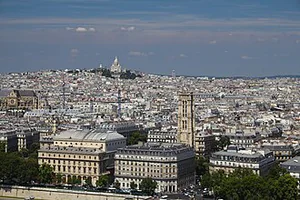
There’s a place in Paris that doesn’t feel like Paris at all—and that’s exactly why the world falls for it. Montmartre sits high on a hill in the 18th arrondissement, a tangle of cobblestone alleys, vine-clad facades, and stairways that seem to lead straight into the sky. The air smells like fresh crêpes and possibility. Street artists sketch portraits under faded awnings while accordion music drifts from open café doors. You come for the panoramic views. You stay for the strange, stubborn magic of a neighborhood that refuses to be anything but itself.
At its crown, the gleaming white basilica of Sacré-Cœur anchors the whole scene, visible from nearly everywhere in Paris. But Montmartre is not just a viewpoint—it’s a living, breathing village that once housed Picasso, Van Gogh, and a hundred other starving geniuses. It’s a place where history mingles with modern tourists, where every cobblestone seems to whisper a scandal or a song. Step off the main drags, and you’ll find hidden vineyards, secret gardens, and the ghosts of cabarets that changed entertainment forever. This isn’t just a landmark; it’s a state of mind.
Montmartre’s story begins long before the artists arrived. The name likely comes from “Mont des Martyrs”—the Mount of Martyrs—where Saint Denis, the first bishop of Paris, is said to have been beheaded in the third century. Legend says he picked up his own head and walked several miles, preaching as he went. That gruesome tale set the tone for a hill that has always attracted the strange and the sacred. By the 12th century, Benedictine nuns had built an abbey here, and for centuries, Montmartre remained a quiet patchwork of windmills, vineyards, and convents on the outskirts of the city.
The real pivot came in the late 19th century. Paris was modernizing, Haussmann’s wide boulevards were flattening the old medieval quarters, and rents in central neighborhoods soared. Artists, writers, and bohemians looked up the hill and found cheap studios, open fields, and a glorious view. They also found the cabarets. Le Chat Noir opened in 1881, and the Moulin Rouge followed in 1889. Suddenly, Montmartre was the epicenter of avant-garde culture—can-can dancers kicking their legs, Toulouse-Lautrec painting the nightlife, and Renoir capturing the dance hall at the Moulin de la Galette. By the early 1900s, Picasso, Braque, and Modigliani were living in a ramshackle building called the Bateau-Lavoir, where Cubism was essentially born. Montmartre wasn’t just a place to live; it was a place to explode.
Sacré-Cœur came later, and it almost didn’t come at all. After France’s defeat in the Franco-Prussian War, a group of Catholic devotees proposed building a basilica to honor the Sacred Heart of Jesus and atone for the nation’s sins. The cornerstone was laid in 1875, but construction dragged on for four decades—through political scandals, world war, and endless debates. The building’s final design, a Romano-Byzantine confection of white travertine stone, was the work of architect Paul Abadie. The stone famously whitens with age, so the basilica has never lost its luminous glow. It was finally consecrated in 1919, after World War I had ended. Today, more than 10 million people a year climb its steps, making it one of the most visited landmarks in France.
So, what should you actually do once you’re on the hill? First, give yourself at least half a day—ideally three to four hours if you want to really soak it in. Start with the basilica itself. Entry is free, which still feels like a miracle in central Paris. Inside, the ceiling is covered in one of the largest mosaics in the world—a golden, glowing Christ with outstretched arms. The atmosphere is hushed, reverent, and surprisingly cool, even in summer. If you’re willing to climb the 300 winding steps of the dome (for a small fee, around €6–€8), you’ll be rewarded with the most spectacular 360-degree view of Paris. On a clear day, you can see the Eiffel Tower, Notre-Dame, and the entire city sprawled out like a glittering carpet.
But Montmartre isn’t just Sacré-Cœur. Wander behind the basilica to Place du Tertre, the old village square where artists have set up their easels for over a century. Yes, it’s touristy. Yes, the caricature artists will call out to you. But it’s also an authentic living tradition—you can commission a portrait, watch a watercolorist at work, or just sip a coffee and absorb the chaos. For a quieter experience, slip into the tiny vineyard on Rue des Saules. That’s right: Montmartre has its very own vineyard, the Clos Montmartre, which still produces a small batch of wine every year. It’s usually fenced off, but you can view it from the street, and there’s a charming museum of Montmartre history right next door.
For the best photo spots, head to the top of the dome for the obvious money shot. But if you want something more unique, find the little street called Rue de l’Abreuvoir, often dubbed the prettiest street in Paris. It’s a cobbled lane with a pink house at the corner and the vines of Montmartre nearby—pure postcard material. Another gem is the Wall of Love (Le Mur des Je t’aime), a dark blue wall covered with “I love you” in over 250 languages. It’s tucked away in a small garden square beneath the hill—easy to miss, but absolutely worth the detour. And here’s a hidden secret: the terrace overlooking the Sacré-Cœur steps at sunrise. Come early, before the crowds and the vendors arrive. You’ll have the whole basilica to yourself, and the soft morning light turns the white stone into something almost unreal.
A word on practical matters: while the basilica is free, the dome and the crypt require separate tickets, and you’ll want to check timings because they can close for religious services. The stairs up from the metro are brutal—hundreds of steps—but the funicular railway on the north side is a gentle save, and it’s included with a regular metro ticket. Inside the basilica, silence is golden; it’s an active church, so dress modestly and keep conversations to a whisper. And if you’re hungry, skip the overpriced cafés right on Place du Tertre. Walk a few blocks down to Rue des Martyrs or Rue Lepic, where the bakeries have real baguettes and the local bistros serve honest French food at half the price.
The true charm of Montmartre lies in the getting lost. Wander down a random staircase, and you might find a hidden garden, a forgotten fountain, or a fading mural of Dalida, the Egyptian-French singer who once ruled the neighborhood. Follow the sound of a jazz band into an underground cellar, and you’re in a caveau that’s hosted artists for a century. The hill has been loved, painted, and fought over for two thousand years, and it still holds its secrets close. That’s what makes it more than a landmark. Montmartre is the soul of bohemian Paris, a living painting that changes with every visitor, every season, and every glimpse of the city far below.
