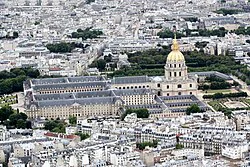
There’s a moment, when you emerge from the narrow streets of the 7th arrondissement, when the sky seems to split open. A massive river of gold—the great dome of Les Invalides—catches the afternoon light and makes you stop dead in your tracks. It’s not just a building. It’s a declaration. A place where France’s military history, architectural brilliance, and a certain imperial swagger all collide under one gilded roof.
Most people know it as the final resting place of Napoleon Bonaparte. But that’s only half the story. Les Invalides is a sprawling complex—a church, a museum, a hospital, a retirement home, and a military pantheon all rolled into one. It whispers of battles won and empires lost, of soldiers who limped home and tyrants who conquered continents. You don’t just visit Les Invalides. You walk through centuries of French pride, pain, and resilience.
The first impression is almost cinematic. The long esplanade stretching toward the Seine, the immaculate lawns, the cannon barrels lined up like obedient sentinels—it feels less like a museum and more like a stage. Even before you step inside, you understand that this place was built to awe. And it does.
Les Invalides began with a simple act of royal compassion. In 1670, King Louis XIV—the Sun King, the man who built Versailles—ordered the construction of a hospital and retirement home for wounded, elderly, and impoverished soldiers. At the time, these veterans were often left to beg on the streets. Louis, ever conscious of his own image, decided that a grateful nation should shelter those who had bled for it. The architect Libéral Bruant designed the complex, and construction began in 1671. By 1676, the first soldiers moved in. They found not a cold barracks, but a grand residence with courtyards, workshops, and a chapel. It was a radical idea: the state owed its veterans dignity.
The complex grew over the decades. The most iconic feature—the gilded dome—came later, added by Jules Hardouin-Mansart, the king’s chief architect, who gave the chapel its soaring, sun-drenched crown. That dome, rising over 100 meters, was meant to echo the glory of Louis XIV himself. Little did anyone know that, just over a century later, it would become the shrine of an entirely different legend. In 1840, Napoleon Bonaparte’s remains were brought back from Saint Helena and interred beneath the dome, after years of pressure from the French people. Since then, Les Invalides has become a strange sort of national heart: part military hospital, part cathedral of memory, and part tourist magnet.
Now, let’s talk about what you actually do when you get inside. First thing: don’t just rush to Napoleon’s tomb. Start in the Musée de l’Armée, the military museum that fills most of the complex. It’s one of the biggest in the world, and if you love history, you could easily get lost for hours among the armor, uniforms, swords, and cannons. There’s everything from medieval battle axes to Charles de Gaulle’s staff car. The exhibits tell the story of warfare from ancient times through the world wars, and they’re arranged with a cinematic flair. But here’s a tip: don’t try to see it all. Pick a wing—maybe the two world wars—and let yourself linger. Trying to see everything in one visit is a recipe for a headache.
The centerpiece, of course, is the Dôme des Invalides. This is where Napoleon lies in his massive sarcophagus. It’s made of porphyry, a deep red stone that seems to glow in the dim light. Around him are statues, reliefs, and mosaics that narrate his greatest victories. Standing there, you feel the weight of it—the ambition, the tragedy, the sheer scale of the man. It’s quieter than you’d expect, and that hush makes it all the more powerful. But here’s a hidden gem: beneath the dome, look down at the circular floor. There’s an inscription that reads, simply, “Napoléon.” It’s a subtle moment, easy to miss in the crowd.
If you’re short on time, you can see the dome in about 45 minutes. But to truly appreciate Les Invalides, plan for at least three to four hours. That gives you time for the museum, the dome, and a wander through the Cour d’Honneur, the grand inner courtyard lined with ancient cannons. For a quick hit, you can buy a ticket just for the dome and the tomb. But honestly? If you’re already here, splurge for the full museum access. The combination ticket is a steal, especially when you consider the sheer volume of artifacts. As for the best photo spot, here’s a local secret: just after you cross the Pont Alexandre III, on the esplanade, you can frame the entire dome between the trees. At sunset, the golden dome turns amber against a blue-pink sky. That’s your money shot. Inside the complex, the Cour d’Honneur at golden hour looks incredible, too, with the facade glowing behind the old cannons.
For a hidden gem that most tourists skip, walk to the north side of the complex, past the main crowds. There you’ll find the Musée de l’Ordre de la Libération, a smaller museum that tells the story of the French Resistance during World War II. It’s haunting, intimate, and deeply moving—a real contrast to the grandeur of the dome. Another lesser-known spot is the cathedral itself, the Cathédrale Saint-Louis des Invalides. It’s right next to the Dôme, and it’s the church where Napoleon’s body was formally received before being placed in the tomb. It’s a quieter, more austere space, with military flags hanging from the arches. Not many travelers bother to look in, but it adds a layer of context to everything else.
You’ll also notice, as you wander, that this isn’t just a relic. Les Invalides still functions as a hospital and retirement home for veterans. You might see an elderly gentleman in a beret, walking slowly with a medal on his chest, glancing at the exhibits with a weary familiarity. That’s the real soul of this place—it’s alive, still serving its original purpose. That’s something you don’t feel in most museums.
Before you leave, take a moment to sit on a bench in the esplanade garden. Watch the tourists, the pigeons, the occasional soldier crossing the courtyard. Listen to the wind rattle the chains around the cannons. There’s a strange peace here, amidst all the history. You’ll walk away with that image burned into your mind—not just the golden dome, but the quiet weight of it all. Les Invalides isn’t just a museum. It’s a mirror held up to France, and for a few hours, you get to look right into it.
