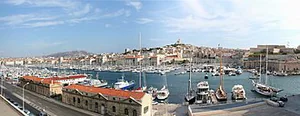
The air smells of salt, diesel, and freshly caught sea bream. Gulls shriek overhead, wheeling between the masts of hundred-year-old fishing boats. Sunlight dances off the water in a million shattered sparks, and the golden statue of Notre-Dame de la Garde watches over it all from its hilltop throne. This is the Vieux-Port — the Old Port of Marseille. It’s not just a pretty postcard; it’s the living, breathing heart of France’s oldest city, a place where every stone has a story and every wave carries a memory.
For first-timers, the vast semicircular harbor feels instantly grand yet wonderfully approachable. The quays are lined with cafés serving pastis, vendors selling bright yellow “savon de Marseille,” and fishermen showing off their night’s catch straight from the boat. At dawn, the famous fish market at Quai des Belges comes alive with shouted prices and salty banter. It’s raw, colorful, and utterly captivating. But the real magic? It’s in the way the old and new intersect — where sleek luxury yachts bob beside weathered wooden pontoons, and where centuries-old forts guard a city that’s been reinventing itself for millennia.
You don’t just visit the Old Port; you feel it. It’s a place to wander aimlessly, to sit with a coffee and watch the tide of daily life, to let the rhythm of the sea slow your heartbeat. Whether you’re a history buff, a foodie, or simply someone who loves to watch the world go by, Marseille’s Vieux-Port will get under your skin.
The story here begins in 600 BC, when Greek sailors from Phocaea — in modern-day Turkey — rowed into this natural harbor and set up camp. They called it Massalia, and it quickly grew into a thriving trading hub. The port became a gateway to the Mediterranean, connecting the Celtic heartland to the great civilizations of Greece and Rome. For centuries, Marseille prospered on the back of this vibrant maritime commerce. Then in 1666, King Louis XIV decided to tighten his royal grip on the rebellious city. He ordered the construction of two formidable forts — Saint-Nicolas and Saint-Jean — flanking the harbor entrance. Locals joked they were built to keep the city in check as much as to defend it. Today, those twin stone giants still stand, silent guardians of nearly four hundred years of history.
The 19th century brought the French colonial empire, and the port boomed. Ships loaded with silk, spices, olive oil, and human cargo moved through these waters. The port’s warehouses swelled with goods from Africa, the Middle East, and the Far East. But the darkest chapter came during World War II. In November 1942, the German army occupied Marseille and systematically demolished the old quarters around the port, evicting thousands of residents. The harbor became a military zone, and much of the city’s ancient charm was lost to explosives. After the war, the Vieux-Port entered a long, slow recovery. By the 1970s, commercial shipping had moved to new terminals further west, leaving the old harbor as a marina, a cultural focal point, and a symbol of resilience. In 2013, when Marseille served as the European Capital of Culture, the city poured new life into the waterfront, adding sleek promenades and the stunning MUCEM museum — a modern lace-like cube that sits just beside the historic Fort Saint-Jean.
Now, let’s talk about what to do inside this open-air wonder. Start your visit at Quai des Belges, the southern edge of the harbor. Get there early — around 7 a.m. — to see the fish market in full swing. Local fishermen sell their prized rascasse and rouget from crates on the ground, and the scene is wonderfully chaotic. You don’t need to buy; just soak in the atmosphere, listen to the rapid-fire Provençal banter, and snap photos of the gleaming, freshly caught fish. From there, stroll along Quai du Port on the north side. You’ll pass charming façades painted in warm ochres and pastel blues, each one telling its own story. About a ten-minute walk brings you to the entrance of Fort Saint-Jean, a 17th-century fortress with a drawbridge and imposing walls. Climb to the top for panoramic views — you’ll see the entire port, the rolling hills, and the glittering Mediterranean stretching to the horizon.
How much time do you need? Honestly, give yourself at least half a day. The port itself is completely free to wander, and much of its pleasure comes from lingering. The big-ticket attractions, however, have their own fees. Fort Saint-Jean and the MUCEM museum are connected by a striking elevated footbridge. You can walk around the fort’s grounds without a ticket, but to enter the museum’s galleries, you’ll need to purchase a pass — usually around 11–14 euros for adults, with discounts for students and free entry for EU residents under 26. If you’re a keen observer, do what the locals do: grab a fresh baguette, a wedge of cheese, and a bottle of chilled rosé, then settle on the steps near the harbor’s edge. The scene is your entertainment.
For photographers, the golden hours are non-negotiable. At sunrise, the soft pink light washes over the moored boats and the old lighthouse, reflecting beautifully in the still water. At sunset, the sky erupts in orange and violet, and the silhouette of Notre-Dame de la Garde becomes a dramatic centerpiece. The best photo spot? It has to be the top of Fort Saint-Jean, looking back over the bowl of the harbor. But don’t miss the “Ombrière” — a colossal mirrored steel canopy designed by Norman Foster at the port’s entrance. It isn’t just a photo op; it’s a clever architectural mirror that lets you capture the entire harbor in a single surreal image. Wait until midday, when the light bounces off the polished steel and creates a shimmering, almost dreamlike reflection.
Hidden gems? Plenty, if you know where to look. Tucked along the Quai de la Fraternité, you’ll find the busy repair yards where skilled artisans still craft and restore wooden fishing boats using techniques passed down for generations. Stick around for a few minutes and you’ll see the incredible skill up close. Another lesser-known treasure is the “Escalier des Arts” — a small, unmarked stairway that winds up from the western corner of the port toward the Abbaye Saint-Victor. It’s a quiet, steep climb lined with quirky street art and tiny cat shrines, offering a private, elevated view of the harbor that most crowds never see. And if you’re curious about the actual working heritage of the port, take a look at the old chain links embedded in the quay stones near the entrance — they’re remnants of the original medieval harbor barrier, a subtle relic hiding in plain sight.
The Old Port of Marseille isn’t a museum you pass through; it’s a living organism that breathes, changes, and welcomes. It’s seen Greek sailors, Roman merchants, French kings, and global travelers. And guess what? It doesn’t care about your itinerary. It invites you to slow down, get lost, and let the Mediterranean work its magic. In a world that’s constantly rushing, that’s a truly rare gift. So come for the history, stay for the sunshine, and leave with your heart a little more open and your soul a little more salty. That’s the power of this place — it lingers long after you’ve gone.
