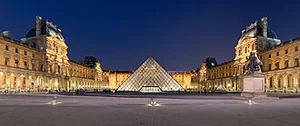
You’ve seen the glass pyramid in a thousand photos, but stepping into the Cour Napoléon is a different thing entirely. The gleaming triangles catch the Parisian light and seem to float above the honey-colored stone of the grand old palace. You hear a dozen languages, and you see faces craning upward, sharing the same silent wonder. This isn’t just a museum—it’s a world within a world, where history, mystery, and sheer artistic brilliance collide.
The Louvre holds more than 380,000 objects, though you’ll only ever see a fraction at once. It’s the most visited museum on Earth, and for good reason. The Mona Lisa lives here. The Winged Victory of Samothrace stands at the top of a sweeping marble staircase. Venus de Milo gazes out with calm, armless grace. But beyond the blockbusters, the place is a labyrinth of quiet corners, forgotten masterpieces, and stories etched in every gilded ceiling. It’s huge, it’s overwhelming, and if you let it, it’ll sweep you off your feet.
This began life in the late 12th century as a fortress, built by King Philip Augustus to guard the Seine from Viking raids. You can still see its thick, damp foundations in the basement—a startling contrast to the glittering galleries above. By the 16th century, François I tore down the old keep and turned the site into a Renaissance palace. He also bought this weirdly modest painting of a smiling woman by Leonardo da Vinci, and well, the rest is history. For centuries, French kings added wings, courtyards, and opulent galleries. Louis XIV, the Sun King, preferred Versailles, so the Louvre sat as a sprawling royal spare bedroom until the French Revolution swept it all away.
In 1793, the revolutionary government threw open the palace doors and welcomed the public into the first national museum of France. It was a radical idea: art belonged to the people, not just the crown. Napoleon later filched a fortune in artworks from his conquests and stuffed them into the Louvre, briefly renaming it the Musée Napoléon. After his fall, many treasures returned home, but plenty stayed. The real modern icon arrived in 1989, when Chinese-American architect I.M. Pei unveiled his glass pyramid. Critics howled. Now, of course, it’s inseparable from the Louvre’s magic—light, air, and a nod to the future at the heart of an ancient palace.
So, what should you actually do once you’re inside? First, let go of the idea of ‘seeing everything.’ That’s a fool’s errand. Instead, pick your must-haves. For first-timers, the Denon Wing is the classic route. It shelters the Mona Lisa (yes, she’s smaller than you think), the Winged Victory at the top of that stairway, and Napoleon III’s lavish apartments—over-the-top velvet and gold that make every period drama look tame. If you love ancient history, head to the Sully Wing and wander through Egypt, Mesopotamia, and the medieval Louvre. Don’t miss the Great Sphinx of Tanis; it’s been here since the 1820s, guarding a room that feels like a temple.
Rit’s a big place. So how much time do you need? Honestly, a rushed visitor can speed through the highlights in about three hours, but that’s like eating a five-star meal while running a marathon. I’d recommend a good half-day if you want to breathe. For serious art lovers, a full day (or two) still won’t feel like enough. The key is pacing. Walk for a couple hours, then sit in the Cour Visconti or the Café Richelieu under the skylights. Your feet and your brain will thank you.
Tickets are an essential step. Buy them online before you go, with a timed entry slot, and you’ll skip a colossal line. You’ll want to enter via the pyramid’s main entrance, but check for the other doors—the Carrousel du Louvre and Porte des Lions are often quieter. If you’re under 18, admission is free for everyone, and under 26 if you’re a resident of the EU or EEA. On the first Friday of every month (and a few other dates), entry is free for all, but those slots vanish fast. So plan ahead, or be ready to queue like everyone else.
Now, about photos. The pyramid trick is natural: stand on the terrace near the Arc de Triomphe du Carrousel, get low, and angle your shot so the pyramid appears to rise out of a sea of rooftops. Inside, the Apollo Gallery is a selfie goldmine—christened with ceiling paintings by Delacroix and a jewel-encrusted crown of Louis XV. Don’t be shy to snap the grand staircase of the Denon Wing; the Winged Victory at the top makes for a dramatic second photo. And for a less-crowded backdrop, the medieval foundations of the original fortress in the Sully Wing offer moody, ancient stone that feels like a secret.
Hidden gems? Oh, there are plenty. Seek out the Salle des Cariatides, a stately hall with marble caryatid sculptures, where the royal court once threw lavish balls. The room is often nearly empty, and the acoustics are wild—maybe a hum or two just echoes off the vault. Then there’s the little-known staircase right beside the Mona Lisa, which leads to a quiet painting gallery full of Italian Renaissance gems. You’ll have it almost to yourself while the crowds grind away downstairs. Also, don’t miss the café inside the Richelieu Wing, which overlooks the pyramid from above—check the ceiling one more time before you go.
The Louvre is a living paradox. It’s chaotic, immense, and occasionally exhausting. But it’s also one of the few places on Earth where centuries of human imagination hang on the walls and speak to you in whispers. Go with a plan, but leave room to get lost. That’s where the real magic hides. You’ll leave with tired feet, a full heart, and a thousand images you’ll never forget.
