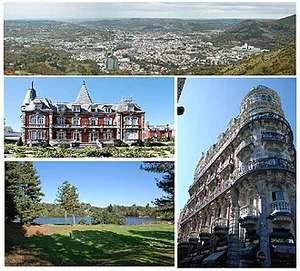
Nestled at the foot of the Pyrenees in southern France, Lourdes is a town that defies simple description. On the surface, it’s a modest commune of just over 13,000 residents, but its spiritual gravity pulls in millions of visitors each year. This is the site of the Marian apparitions of 1858, where a young girl claimed to see the Virgin Mary, and the story that followed has turned a quiet valley into one of the world’s most significant Catholic pilgrimage destinations. But you don’t have to be religious to feel the weight of the place. There’s a tangible hush that settles over the Sanctuary grounds, broken only by the soft rush of the Gave de Pau river and the distant murmur of prayer.
Candlelight, stone, and water define the atmosphere here. You’ll see pilgrims from every corner of the globe, many in wheelchairs or supported by volunteers, others walking with quiet determination. The air smells faintly of wax and damp rock. Even if you’ve never set foot in a church, you’ll find yourself slowing down, lowering your voice, and paying attention. That’s the strange magic of Lourdes—it asks nothing of you, yet it leaves you changed. The town itself is a curious mix of souvenir shops and sacred art, but once you cross the bridge into the Sanctuary complex, the commercial noise fades away. What remains is a space designed for reflection, prayer, and an almost inexplicable sense of hope.
The history of Lourdes begins—or rather, accelerates—on February 11, 1858. That’s when 14-year-old Bernadette Soubirous, the eldest daughter of a poor miller’s family, went gathering firewood near the Massabielle rock. She later said she saw a “small young lady” in a grotto, dressed in white with a blue sash and a rosary. Over the following weeks, the apparition appeared to her eighteen times. On one occasion, Bernadette dug into the grotto floor at the lady’s direction, and a spring began to flow. That spring is still there today, and its water has become the focal point of countless prayers and reported healings. During the sixteenth vision, the lady identified herself: “I am the Immaculate Conception.” For a barely literate peasant girl, the theological term was astonishingly precise—and for the Catholic Church, it was a powerful confirmation.
The local priest and eventually the bishop undertook long investigations. In 1862, four years after the visions, the Church officially declared the apparitions authentic. Construction soon began on a church above the grotto, and by 1871 the Crypt was complete. It was followed by the Basilica of the Immaculate Conception, often called the Upper Basilica, in 1876. As the crowds grew, so did the sanctuary. The Rosary Basilica opened in 1889, and the vast underground Basilica of Saint Pius X, which can hold 25,000 people, was consecrated in 1958 to mark the centenary. Bernadette herself left the area in 1866 to join the Sisters of Charity at Nevers, where she died in 1879 at age 35. She was canonized in 1933, and today her body lies incorrupt in a glass coffin at the chapel in Nevers—though her heart remains in Lourdes, preserved in a reliquary at the Sanctuary. That’s a hidden detail many visitors miss.
Now, let’s guide you through the Sanctuary itself. The heart of the experience is the Grotto of Massabielle, carved into the limestone cliff. You’ll want to spend time here—this is where it all happened. Lines of pilgrims snake past the grotto, many pausing to touch the rock face or light a candle. You don’t need a ticket to approach it; the entire Sanctuary is free to enter. There’s no admission fee for the grotto, the basilicas, or the grounds. That’s a rare blessing in the world of famous landmarks. What you’ll want to bring is patience. During peak season, especially from May to October, expect to wait in line to touch the spot where Bernadette stood. But the queue moves steadily, and the moment you’re there, the noise of the crowd seems to melt away.
A full visit takes about two to three hours if you’re simply absorbing the atmosphere, but you could easily stretch that to half a day. Start at the grotto, then wander up the paved esplanade that leads between the Upper Basilica and the Rosary Basilica. Inside the Rosary Basilica, don’t miss the gold mosaic panels that glow in the dim light. From there, take the staircase or ramp up to the Basilica of the Immaculate Conception. The view from its forecourt reaches across the river to the Pyrenean foothills, and it’s one of the finest photo spots in the complex. Come at golden hour, just before sunset, when the warm light washes over the white stone and the carved gables catch the glow. Another superb shot is from the far side of the river, where you can capture the whole ensemble—the churches stacked on the rock, the bridge, and the ever-present candles flickering near the water.
There are also several experiences that reward those who linger. The baths (or pools) are the most famous: you’ll wait in line to be assisted into a small pool filled with the same cold spring water that flows from the grotto. It’s a deeply moving ritual for many, but you should know there’s a dress code, a specific protocol, and it’s not a quick dip—you’re toweled, helped, and led out almost immediately. If you’d rather stay dry, join the nightly candlelight procession at 8:30 PM. That’s when the esplanade transforms into a river of light, as thousands of pilgrims walk together singing the Ave Maria. For something quieter, consider the Way of the Cross, a three-kilometer path that climbs the hill behind the basilicas. It features life-size bronze statues depicting the Stations of the Cross, and along the way you’ll encounter little grottoes that offer surprising solitude. Most visitors miss this route because they stick to the main plaza—that’s your hidden gem.
One final piece of advice: mind your feet. The esplanade is smooth gravel, but the paths around the hill can be uneven, and you’ll be walking more than you expect. Pack a light scarf or sweatshirt, because the Pyrenees mornings and evenings can be surprisingly cool even in midsummer. And those candles? Thousands are burned every day, and the wax can melt into little puddles near the stands—watch your step, but also take a moment to watch the flames. There’s something universal about a candle lit by a stranger in the dark. That silent, shared hopefulness is perhaps the truest essence of Lourdes, a place that doesn’t just tell you a story from 1858. It invites you to add your own flame to the centuries-old prayer. Whether you come for faith, for history, or simply for the rare sense of stillness, this corner of France offers something that lingers long after you’ve crossed the bridge back to the modern world.
