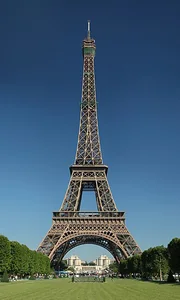
There’s a moment when you first glimpse the Eiffel Tower that feels almost impossible. It rises from the Champ de Mars like a lattice of lightning frozen mid-strike, its iron curves catching the sun in a thousand different glints. You’ll see it from a café terrace, from the Seine’s edge, or suddenly at the end of a narrow street—and every time, it stops you. This isn’t just a monument; it’s a punctuation mark in the city’s skyline, a promise that you’ve truly arrived in Paris.
For over 130 years, this 330-meter-tall wonder has been the world’s most recognizable symbol of France. But the Eiffel Tower isn’t merely a postcard image. It’s a feat of engineering that was once considered an eyesore, a radio tower that saved lives, and a living museum of Parisian history. Step closer, and you’ll feel its scale. The iron lattice isn’t cold or sterile; it’s alive with structure, rhythm, and light. By night, it transforms into a golden beacon, and on the hour, it twinkles like a slow-motion firework display.
Visit the Eiffel Tower and you’re not just seeing a landmark. You’re climbing a piece of human ambition, one that has welcomed over 300 million visitors since its doors first opened. It’s grand, yes, but it also feels intimate—each level offers a new perspective on the city below, from the winding Seine to the distant towers of La Défense. This is Paris in its purest, most theatrical form.
The story begins in 1889, when Paris hosted the World’s Fair to celebrate the 100th anniversary of the French Revolution. The government wanted a centerpiece—something colossal, something unprecedented. A competition was launched, and Gustave Eiffel’s company won with a design for a 300-meter iron tower, the tallest structure in the world at the time. Construction began in January 1887, and it was a race against time. Just over two years later, on March 31, 1889, the tower was completed. The speed was astonishing: 18,038 pieces of iron, 2.5 million rivets, and a workforce of around 300 laborers, working in freezing winters and sweltering summers.
But not everyone was thrilled. Paris’s artistic elite, including writer Guy de Maupassant and composer Charles Gounod, signed a public letter calling the tower a “monstrous” and “useless” eyesore. Maupassant reportedly ate lunch in the tower’s restaurant every day—when asked why, he shrugged that it was the only place in Paris where he couldn’t see the tower itself. Yet the public fell in love with it. The tower became a giant advertising hoard, a scientific laboratory, and even a military radio transmitter. It was almost demolished in 1909, saved only because its height made it ideal for telegraphy. During World War I, the tower intercepted enemy radio messages, effectively turning the tide in the First Battle of the Marne. So the “monstrous” creation became a national savior, and it’s never looked back.
Nowadays, visiting the Eiffel Tower is a rite of passage, but smart travelers know it’s more than a single photo. Start at the bottom, where the four massive pillars anchor the structure. You’ll find a security check, then elevators or stairs—over 1,600 steps if you’re feeling adventurous. The first level is the most underrated. It houses a glass floor that gives you a dizzying view straight down to the ground below, and it’s also home to a small museum dedicated to the tower’s history. Wander through the exhibits, then press your face against the glass panels to spot hidden details: the names of 72 French scientists and engineers, engraved on the tower’s girders in gold letters, hidden in plain sight.
The second level offers that classic panoramic view, but don’t rush it. This is where the tower’s legendary restaurant, Le Jules Verne, sits. You can book a meal with a front-row seat to Paris’s rooftops, but even if you don’t dine, the observation decks here are the sweet spot—close enough to feel the city’s energy, high enough to see forever. The view toward the Trocadéro across the river is iconic, but spin around and you’ll catch the golden dome of Les Invalides, the Arc de Triomphe, and the gleaming modern towers of La Défense. It’s a timeline of Paris in a single glance.
The summit is the crown. It’s a separate ticket, and the elevator ride feels like a slow ascent into a dream. Up top, you’re 276 meters above the ground, with a 360-degree view that stretches for 70 kilometers on a clear day. There’s a small champagne bar, so you can toast the moment. But the real hidden gem is Gustave Eiffel’s private apartment, tucked into the top—complete with wax figures of Eiffel and Thomas Edison. It’s a tiny, wood-paneled room that feels impossibly human, a quiet retreat in a giant of steel. On the way down, pause on the third level’s open-air deck. The wind howls, the lights flicker, and for a second, you’re suspended between earth and sky.
Timing is everything here. The tower is busiest from late morning to early afternoon, so aim for right when it opens, or later in the evening after the dinner rush. I’d recommend at least two hours for a relaxed visit—three if you want to climb the stairs and linger on every level. Tickets vary, but you can buy them online in advance, and the priority access is absolutely worth the few extra euros. Plan for around 25 to 50 euros depending on how high you go and whether you take the lifts. And here’s a travel writer’s secret: the tower looks best from the northern end of the Trocadéro at dusk, when the sky turns purple and the lights begin to flicker on across the city.
Hidden gems are everywhere. On the first level, look for the small red and gold floors that mark the former offices and workshops—they’re now interactive displays. On the east pillar, you’ll find a post office (the only one in Paris with a special Eiffel Tower postmark), so grab a postcard and send it home. And if you visit after sunset, you’ll witness the five-minute sparkle show that starts every hour on the hour—a tradition since 2000. The tower has been repainted over 20 times, and each repaint uses around 60 tons of paint. Right now, it’s a warm bronze color, but it’s been yellow, red, and even ochre. Painters use brushes and harnesses, a tiny army of alpinists who keep the Iron Lady gleaming.
The Eiffel Tower is many things: a symbol, a viewpoint, a restaurant, a piece of history. But it’s also a deeply human creation, built with grit and ambition, almost torn down, then saved by science and stubbornness. When you stand beneath its arches, look up. The iron lines converge like a cathedral’s vault, but they’re open to the sky. You’re not just seeing Paris—you’re seeing what happens when a city dreams big and yanks the future down from the clouds. That’s a moment worth standing in, even if only briefly, before the lights come on and you remember to breathe.
