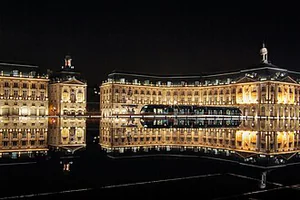
Step out onto the broad cobbles of Bordeaux’s Place de la Bourse and you might wonder whether you’ve stumbled onto a film set. The sweeping crescent of 18th-century buildings glows like warm honey in the afternoon sun, while at your feet an enormous slab of polished dark stone can suddenly turn into a shallow sheet of water. On one side of the square, the old stock exchange palace holds its elegant pose; on the other, the Garonne slips quietly past. It’s unmistakably French, remarkably grand, yet somehow welcoming.
This is the postcard that first draws most people to Bordeaux. Visitors crowd around, not just to admire the architecture but to join the joyful dance of children and adults splashing through the Miroir d’Eau, the world’s largest reflecting pool. The scene feels utterly modern, but the bones of this place are all royal. It’s a square that captures centuries of French history while still inviting you to kick off your shoes and play.
The square’s story begins in the early 18th century, when the intendant of Guyenne, Louis Urbain Aubert de Tourny, persuaded city officials to tear down the medieval walls and turn Bordeaux’s face toward the river. He wanted a grand royal square that would match the elegance of Paris. In 1730, royal architect Ange-Jacques Gabriel — the same man who later designed the Place de la Concorde in Paris — sketched the plans. Construction began in 1735 and took about twenty years to complete. When it was finished in 1755, the square was named Place Royale, with a bronze equestrian statue of Louis XV at its heart.
But like so many royal landmarks in France, the square did not keep its king for long. The French Revolution arrived, toppled the statue, and gave the space a new name. By 1848, the name had become Place de la Bourse because the city’s stock exchange moved into the grand northern palace, the Palais de la Bourse. Then, in 1869, the ornamental Fountain of the Three Graces was added in the center, three elegant figures rising above the stone circle where the king once stood. The square survived revolutions, wars, and urban renewal. Yet its greatest transformation came in 2006, when landscape architect Michel Corajoud created the Miroir d’Eau just beyond the square’s river side. That thin layer of water, barely a few centimeters deep, turned the entire square into a shimmering mirror and made Bordeaux’s old royal plaza an internet sensation.
When you visit, take your time. Start by walking the full arc of the square itself and let your eyes wander upward. The facades are loaded with detail: carved masks, garlands, urns, and delicate wrought-iron balconies. Look for the golden monograms and the allegorical figures perched above the central pediments. The northern wing is still called the Palais de la Bourse, and the western wing was originally the Hôtel des Fermes, the royal tax office. The Fountain of the Three Graces now anchors the middle of the square, and its water pours gently under the sculpted ladies, offering a cool burble on hot days.
There’s no admission fee and no ticket booth. Place de la Bourse is an open public space, which means you’re free to stroll, sit, and soak up the atmosphere at your own rhythm. Most travelers spend 45 minutes to an hour simply wandering the square and waiting for the water mirror to do its magic. But you could easily linger longer, especially in the late afternoon when the golden light softens the stone and the crowd thins. If you want a more structured visit, check the local heritage calendar. During the annual European Heritage Days, parts of the Palais de la Bourse occasionally open to the public, and you can glimpse the grand courtyards and rooms that are normally off-limits.
For photographers, the best spot is almost too easy: stand at the water mirror’s edge, crouch low, and snap the classic reflection shot. The entire palace seems to float on a perfect silver surface. For something different, move to one side near the fountain and use the Three Graces as a foreground silhouette against the glowing facade. At night, the square lights up with a warm amber glow, and the reflections double in brightness. If you don’t mind walking a little, head down to the stone quay along the Garonne and photograph the whole plaza from an angle, with the river curling out behind it.
A few hidden details reward close attention. Above the windows on the palace facades, you’ll spot rows of carved mascarons — strange, expressive faces that seem to pop out of the stone. Some look like gods, others like monsters, and they’re easy to miss if you’re busy with your phone. Around the back, through the small streets that connect the square to the old town, you can still see the original scale of the neighborhood and how the grand plaza was carved into the medieval city. And while everyone talks about the water mirror during the day, few stay for its quieter nighttime cycle. When the crowds leave, the water lies still, and the illuminated columns and statues wrap the whole square in a dreamy, almost theatrical calm.
Place de la Bourse isn’t just another beautiful square in France. It’s a place where the past and present keep trading glances. You can stand where nobles once paraded before the king, then look down to see a modern child laugh as a sheet of water washes over her feet. That balance — between royal history and joyful public life — makes it one of Europe’s most enchanting urban spaces. Give it an hour, give it an evening. You’ll leave with a few dozen photos and the memory of a city that knows exactly how to reflect its own beauty.
