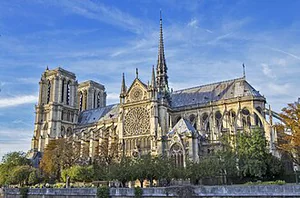
Standing on the Île de la Cité, Notre-Dame is more than a cathedral. It’s a living stone chronicle of Paris. Its twin towers, flying buttresses, and haunting gargoyles have watched over the Seine for eight and a half centuries. You don’t just see Notre-Dame; you feel its weight — the weight of kings, revolutions, prayers, and, most recently, a devastating fire that nearly claimed it forever.
Famous for its Gothic grandeur, this cathedral has been immortalized in Victor Hugo’s novel, in countless films, and in the memories of millions of pilgrims and travelers. But the real magic lies in the details: the luminous rose windows, the eerie quiet of the nave, and the way light filters through ancient glass, painting the stone in colors that seem to breathe.
Construction began in 1163, during the reign of Louis VII, on the ruins of two earlier churches. The design was radical: pointed arches, ribbed vaults, and flying buttresses that allowed walls to soar and windows to grow. Over 180 years, generations of masons, carpenters, and glassmakers shaped a masterpiece. The cathedral was finally completed in 1345.
But history here is turbulent. In 1431, Henry VI of England was crowned within these walls. During the French Revolution, mobs ransacked the building, smashing statues and melting bells. The cathedral was even used as a warehouse for food storage. Victor Hugo’s 1831 novel ‘The Hunchback of Notre-Dame’ didn’t just tell a story — it sounded an alarm. The book sparked a public outcry over the dilapidated state of the cathedral, leading to a major restoration in 1844 by architect Eugène Viollet-le-Duc, who added the famous spire and legendary gargoyles.
The 20th century saw Notre-Dame survive two world wars, only for a routine renovation to turn catastrophic. On April 15, 2019, flames consumed the roof and collapsed the spire. The world watched in collective grief. But from the ashes came an extraordinary pledge: rebuild within five years. And now, the cathedral stands reborn, its ribs rebuilt from the same ancient forest oaks, its spire restored with gold leaf, and a fresh blaze of light pouring through cleaned stained glass.
Stepping inside Notre-Dame today is to witness a miracle. The nave, stretching 130 meters long, feels larger than life. Your eyes will immediately be drawn to the three breathtaking rose windows — the western one dates back to the 13th century and survives with most of its original glass. The north and south roses are equally dazzling, their blues and reds almost impossibly vivid. Don’t rush. Take a seat on one of the wooden chairs and just let the atmosphere soak in.
For a small fee, you can climb the towers — 422 steps, no elevator, but the reward is immense. Up top, you’ll come face to face with the gargoyles and chimera that have become the cathedral’s unofficial mascots. The view from the south tower, looking down at the Seine, the Eiffel Tower, and the islands below, is one of the best in Paris. Just remember: you’re walking through a living church, so speak softly and dress respectfully.
Budget at least two hours for a thorough visit, more if you’re a history buff. Entrance to the cathedral itself is free, but you’ll need a reservation slot — be sure to book online for a specific time to avoid the queue. The tower climb and the treasury, which holds precious relics including what is believed to be the Crown of Thorns, cost a small admission. During certain religious services, visitors can listen to the majestic grand organ, re-tuned after the fire, which boasts over 8,000 pipes. Check the schedule for evening Masses — you won’t need to be Catholic to be moved by the sound.
As for photo spots, the classic shot is from the Petit Pont bridge to the south, where you can frame the entire cathedral with its flying buttresses. For something more unique, head to the square in front, known as Parvis Notre-Dame, and find the golden ‘Point Zéro’ marker — the official center of France. A less known gem is the archaeological crypt beneath the square, where you can see ancient Roman ruins and traces of medieval Paris. Most visitors walk right over it without realizing.
Another hidden delight is the rooftop — if you can get on a guided tour, you’ll see the lead roof ridges, the restored spire crowned with a new rooster (a symbol of hope), and, if you’re lucky, the beehives that have been kept on the roof since 2013. These bees survived the fire, and their honey is still sold to charity. It’s these tiny, unexpected details that make Notre-Dame feel less like a monument and more like a living being.
Finally, don’t leave without stepping out to the back of the cathedral, to the peaceful Square Jean XXIII. Here, the apse is visible — the rounded east end with its engineering genius of flying buttresses. It’s a quieter spot, perfect for a final glance and a moment of gratitude. Notre-Dame has been burned, restored, and reborn; it stands as a testament to human resilience. Whether you’re secular or spiritual, a visit here is a profound experience — a conversation with history that you won’t forget.
