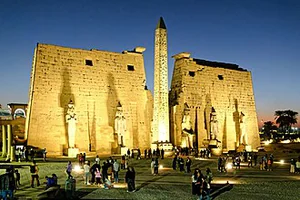
There’s something hauntingly different about Luxor Temple. Unlike the sprawling, desert-bound temples of Karnak or Abu Simbel, this one sits right in the heart of the modern city, its sandstone walls brushing shoulders with minarets, markets, and street vendors. And it’s not turned away from the Nile. It faces it, as if forever waiting for the river’s ancient processions to return. That alone would make it special. But Luxor Temple isn’t just another monument to marvel at, snap a few photos of, and tick off a list. It’s a place that feels alive.
Come at sunset, and you’ll understand. As the crowd thins and the muezzin’s call echoes from the nearby Abu Haggag Mosque, the temple’s carved stones begin to glow a deep honey-gold. The shadows lengthen across the towering columns, and the colossal statues of Ramesses II seem to stir. By night, the floodlights cast a warm, amber glow that makes the hieroglyphs pop like they were chiseled yesterday. You might even catch the sound of a sound-and-light show drifting across the Nile. This is Luxor Temple at its most magical—a place where time collapses and you half-expect a procession of priests to emerge from the shadows.
But what truly sets this temple apart is its very purpose. While most Egyptian temples were dedicated to gods, Luxor Temple was dedicated to the renewal of kingship itself. It’s here that the divine barque of Amun would sail during the annual Opet Festival, a grand spectacle of music, dance, and ritual that celebrated the pharaoh’s divine connection. And unlike many ancient sites that crumbled into obscurity, this temple never really went away. It’s been a place of worship for over 3,000 years, and it still is today.
The story of Luxor Temple begins around 1400 BC, during Egypt’s 18th Dynasty. Pharaoh Amenhotep III oversaw the construction of the temple’s core, a grand sanctuary dedicated to Amun, his consort Mut, and their son Khonsu—the Theban triad. Later, Ramesses II, the great showman of ancient Egypt, added the massive pylon, the two towering obelisks, and the colossal seated statues of himself that still guard the entrance today. He was nothing if not ambitious, and his additions gave the temple its unmistakable monumental facade.
Over the centuries, the temple’s story took unexpected turns. Alexander the Great left his mark with a small granite shrine in the inner sanctum. The Romans turned the temple into a cult site, painting over reliefs and converting chambers to suit their own rituals. When Christianity swept through Egypt, a church was built inside the Roman court. And centuries later, the Arabs erected the Abu Haggag Mosque over part of the site, which remains in use to this day. In 1989, workers excavating beneath the main pylon discovered a hidden cache of statues—a breathtaking find that’s still fascinating archaeologists. Each empire, each faith, each generation left its fingerprint on these stones, making Luxor Temple not just an Egyptian monument but a layered palimpsest of human belief.
Stepping inside Luxor Temple is like walking through a three-thousand-year-old time capsule. Begin at the great pylon—the massive gateway that Ramesses II built. There, flanked by his colossal seated statues and two of the original six obelisks (one was taken to Paris in the 19th century and now stands in the Place de la Concorde), you’ll feel the ancient ambition in every granite fold. Move beyond the pylon, and you’ll enter the Court of Ramesses II, a sun-drenched courtyard lined with double rows of papyrus-shaped columns. On the side, look for the little chapel with the unfinished reliefs—it’s a rare glimpse of ancient artists’ working methods.
The real showstopper is the Colonnade of Amenhotep III, a breathtaking corridor of fourteen towering columns, all decorated with vivid carvings of the Opet Festival. Stand at one end and let your eyes travel down that stone forest. It’s impossible not to feel small, but in a thrilling way. At the end of the colonnade, you’ll find the sun court with its neatly lined columns and, beyond that, the deeply shadowed sanctuary of Amun. This is the most sacred spot in the whole complex, where the statue of the god once resided. Later, Alexander the Great added his own granite chapel—known as the barque shrine—adjacent to the sanctuary. The reliefs here show the Macedonian conqueror, decked out in pharaonic regalia, making offerings to Amun.
Aim to spend at least two to three hours exploring the site. That gives you enough time to wander, soak in the details, and just sit for a while in the colonnade. The temple is generally open from 6 AM to 9 PM in summer and 9 AM to 9 PM in winter, though hours can shift, so check the day of your visit. As for tickets, you can buy a standard entrance ticket at the gate; it’s reasonably priced, and if you’re into photography, you don’t need a separate permit for general shots. Just bring cash, because card payments aren’t always dependable.
Photographers, listen up. The best photo spots come at the edges of the day. At golden hour, position yourself in front of the pylon, near the sphinxes, and wait for the light to catch the colossal statues. At night, shoot from the large open plaza in front of the temple to capture the floodlit majesty of the facade. Inside, the colonnade offers perfect symmetry; a wide-angle lens from either end will give you that classic “tunnel of columns” shot. And don’t forget the Abu Haggab Mosque, perched high above the temple structure. You can actually see it from inside the complex—it’s an incredible image of layered history.
For a hidden gem, look for the small Roman-era chapel tucked into the northeast corner of the temple. It’s oddly shaped and easy to miss, but it’s a fascinating relic of the temple’s later life. Also, keep an eye out for faint, deeply scratched graffiti on some of the columns near the pylon—left by Napoleon’s soldiers during the French expedition to Egypt. They were, in their own way, just another layer of pilgrims in a site that has been sacred for millennia. Luxor Temple doesn’t just show you Egypt’s ancient past; it shows you how that past keeps breathing, evolving, and slipping into the modern world. Come as a tourist, and you’ll leave as a witness.
