Imagine a temple so beloved that when the waters rose to swallow it, engineers moved an entire island to save it. That’s Philae. Sitting on Agilkia Island in the shimmering Nile near Aswan, this ancient sanctuary to the goddess Isis feels like a mirage. You approach by boat, and with every pulse of the engine, the golden columns and towering pylon emerge from the river, glowing like a dream.
The first impression is staggering. The sheer quiet, broken only by the lapping of water, makes the place feel sacred. Palm trees frame the stone, while the grand pylons are covered in carvings of gods and pharaohs. This isn’t just another temple on a tour bus route—it’s a place you arrive at like a pilgrim, crossing the water just as the ancients did millennia ago.
Philae is famous not only for its extraordinary state of preservation but for its story of survival. It was the last bastion of the ancient Egyptian religion, where the cult of Isis thrived long after Rome had turned Christian. And when the Aswan High Dam threatened to flood it forever, an unprecedented international effort relocated the entire complex—stone by stone—to higher ground. That’s why you can still walk these halls today.
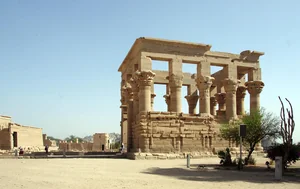
The story of Philae begins more than two thousand years ago. The earliest temple on the site was built in the 26th Dynasty, though most of the standing structures date from the Ptolemaic period, when Greek pharaohs ruled Egypt. From around 380 BCE, Nectanebo I laid the foundations, but it was Ptolemy II and his successors who gave Philae its magnificent form. Later Roman emperors—Trajan, Hadrian, Diocletian—added their own touches, including Trajan’s famous kiosk, a beautiful open-air pavilion that now sits right at the water’s edge.
This was the heart of the cult of Isis, a goddess of magic, motherhood, and devotion. According to myth, Isis gathered the pieces of her dismembered husband Osiris on the nearby island of Bigeh, buried his body, and gave birth to her son Horus. Philae became the central shrine for these mysteries, attracting pilgrims from across the ancient world. Even as Christianity swept Egypt, the temple remained active, and it wasn’t until the sixth century CE that it was finally converted into a church. The Coptic congregation scratched crosses and prayers into the old reliefs, adding a fascinating layer of history to the same stones.
But the true drama came in the twentieth century. When construction of the Aswan High Dam began in the 1950s, Lake Nasser slowly consumed the original Philae Island, leaving the temple submerged for half of every year. In a breathtaking rescue, UNESCO launched a campaign in the 1970s to dismantle the entire complex. Over 40,000 stones were moved to Agilkia Island, a site carefully landscaped to mimic Philae’s original setting. The temple was reassembled, stone by stone, and reopened to the public in 1980. Walking around today, you’d never know it wasn’t always here—that’s the true genius of the restoration.
Stepping off the boat, you’ll find yourself before the great first pylon, two enormous stone towers flanking a central entrance. Here, carvings show the king offering incense to Isis and Horus. The pylon gates open into a courtyard ringed with colonnades that echo with every footstep. To your right is the Mammisi, the birth house, where the birth of Horus was celebrated. Its walls are covered with unforgettable reliefs of the young god suckling at his mother’s breast, and the worn stone feels almost alive.
Inside the main temple, the hypostyle hall is a forest of columns, each crowned with carved capitals of palm, papyrus, and lotus. The reliefs here are surprisingly vivid in places, thanks to centuries of desert wind and the careful work of restorers. The sanctuary itself is a quiet chamber where the statue of Isis once stood. Look for a dramatic carving of Isis with outstretched wings on the wall behind—it’s one of the most photographed details in Egypt. Take your time. The atmosphere is so peaceful that you’ll feel the ancient presence.
Plan to spend at least two to three hours on the island. That’s enough time to explore the main temple, wander the small temple of Hathor, and admire the Kiosk of Trajan, which sits at the water’s edge like a stage set. The kiosk, with its fourteen graceful columns and screen walls, is the postcard image of Philae; you’ll want to capture it from every angle. For the best photos, come in the late afternoon when the sun warms the sandstone and the river’s reflection is at its glassiest. Another hidden gem: look for the graffiti left by ancient Greek and Roman visitors on the walls—they wandered these same courts as tourists, just like you.
One lesser-known spot is the staircase that climbs inside the first pylon to the rooftop. It’s not always open, but when it is, you’ll be rewarded with a brilliant view over the island and the Nile beyond. And don’t miss the small nilometer on the eastern edge of the island, a stairwell once used to measure the river’s flood level. You’ll also need to purchase an entrance ticket before boarding your boat at the marina, and the short motorboat ride across the channel is an adventure in itself. After sunset, the Sound and Light Show transforms the temple with colored lights and narrated stories, a dramatic finale to a magical day. Bring water, wear comfortable shoes, and remember that the sun here is relentless even in winter—but the wonder of Philae is worth every drop of sweat.
