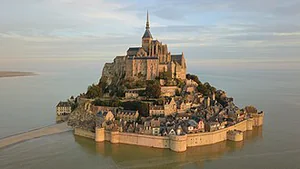
There are places you see in photos a hundred times, and still, nothing prepares you for the moment they appear on the horizon. Mont Saint-Michel does exactly that. It rises from the flat expanse of the bay like a medieval ship made of stone, its spire pointing toward heaven with a defiance that feels both ancient and utterly alive. For a few hours, you wander through a labyrinth of narrow lanes and granite walls, and the rest of the world just melts away. Then the tide comes in, and the mount becomes an island again—ocean circling its base, sealing it off from the mainland like a secret preserved from another age.
This is no ordinary landmark. It’s a whole village, a fortress, a monastery, and an icon all at once. The crowds can be overwhelming, sure. But step away from the main drag, press your hand against the rough stone, and you’ll feel why people crossed continents to reach this spot. In fact, many still do. For over a thousand years, Mont Saint-Michel has drawn pilgrims, wanderers, and the plain curious. You’ll come for the postcard shot, but you’ll stay for the silence in the abbey’s cloisters.
The story starts way back in 708, when Aubert, the local bishop, claimed the Archangel Michael appeared to him in a dream, insisting he build a sanctuary on the rocky islet. The good bishop, it seems, needed a nudge—a divine finger to his skull, legend says—before he got on with the job. A small chapel rose, then a village, then a mighty abbey. Over the centuries, Romanesque walls grew into soaring Gothic spires, each generation stacking stone upon stone, faith upon faith. The Hundred Years’ War? Mont Saint-Michel held firm against English sieges, thanks to those tides and sturdy ramparts. The French Revolution? The abbey was converted into a prison, a strange fate for a sacred site. By the 19th century, it fell into ruin, saved only by passionate restorers who brought its ghostly beauty back to life.
You could race through the mount in an hour, but that’d be a shame. Plan for at least three, ideally more. First, walk the Grande Rue, the main street lined with souvenir shops and creperies. Yes, it’s touristy. Yes, you should still do it. The half-timbered houses lean over you, and you’ll catch glimpses of hidden courtyards if you’re patient. But the real treasure lies at the top: the Abbaye de Mont-Saint-Michel. That’s where you’ll need a ticket—around €13 for adults, with discounts for under-26s and free entry for EU residents under 18. The ticket includes access to the abbey’s highlights: the Great Hall of the Knights, the crypts, and the stunning cloister, its two rows of slender columns framing a tiny garden. Stand there for a minute. The sound of the crowd fades, replaced by seabirds and wind off the bay.
Now, photography. The classic shot from the mainland bridge is gorgeous, especially at sunset, but it shows the mount as a distant silhouette. Instead, aim for the West Terrace, just behind the abbey. From there, you get an uninterrupted view of the bay, the beach, and the island’s dramatic drop-offs. The light at golden hour paints everything in honey tones—bring your wide-angle lens. Another trick: wander along the ramparts, especially on the south side. You’ll find fewer tourists, better angles, and a real sense of being inside a fortress that’s watched the sea for centuries. Don’t ignore the church itself, either. The Église Abbatiale is vast and severe, but the stained glass softens everything, and the chancel’s oculus lets in a shaft of light that shifts throughout the day.
Hidden gems? Absolutely. On the northern side of the mount, a little path leads to the Chapel of Saint-Aubert, built on the spot where the archangel is said to have appeared. It’s a peaceful, windswept stop, and most guided groups don’t bother. Another gem is the small museum set in the former chaplain’s quarters—it tunes you into the history through maps, models, and old possessions. And here’s a local secret: the houses along the Grande Rue have their own back alleys. Slip through an open passageway if you can, and you’ll find gardens hanging over the bay, wildflowers, and washing lines swaying in the Atlantic breeze. It feels less like a monument and more like a living place.
Then there’s the tide. Mont Saint-Michel is famous for having one of the fastest tides in Europe, and it roars in faster than a horse can gallop—up to six kilometers per hour. Once, that meant actual danger for pilgrims who strayed too far. Today, you can watch it safely from the ramparts, but if you’re tempted to walk out onto the sands with a guided group, wear sturdy shoes. The sand is packed but uneven, and you’ll feel mud squelch beneath you. Just don’t do it alone. The ocean won’t wait for you to take that perfect selfie.
Inside the mount, you’ll also notice just how vertical it all is. There are stairs everywhere—nearly 200 steps up to the abbey—and narrow stone staircases between lanes. Take your time. Stop at the little café on the south terrace, sip a proper espresso, watch the tide erase the causeway. The entire experience is a lesson in patience, humility, and awe. No wonder generations of pilgrims walked through knee-deep mud to get here.
Leave the mount as the sun drops. The crowds thin out, the shops close their shutters one by one, and the floodlights click on. The island glows against the darkening sky, mirroring itself in the wet sand. You might think you’ve seen all of it, but Mont Saint-Michel has a way of hiding layers. You’ll climb down, cross the causeway, and look back once more. The tide has returned, the island is complete—and so, somehow, is the moment. This isn’t just a day trip; it’s a pilgrimage, no matter what you believe.
So go ahead. Explore the fortified walls, linger in the abbey’s cool shadows, and let the wind whip your hair off the ramparts. Skip the overpriced magnets if you like, but buy a postcard and send it to someone back home. They won’t believe it anyway. Not really.
