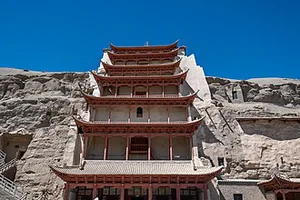
Imagine a cliff face a mile long, baked golden by the Gobi sun, pockmarked with hundreds of dark openings. That’s your first glimpse of the Mogao Caves, and if the sight doesn’t stop you in your tracks, nothing will. These aren’t just caves. They’re an entire civilization carved into stone, a treasure vault of Buddhist art that somehow survived 1,600 years of sand, war, and neglect. When you step out of the blazing dust and into that cool, dim darkness, you’re stepping into a world where every inch is covered in pigment, gold leaf, and stories. It’s overwhelming. It’s holy. And it’s a place you’ll never quite shake off.
The Mogao complex, also known as the Caves of the Thousand Buddhas, sits near the edge of the Taklamakan Desert, about 25 kilometers from the oasis city of Dunhuang in northwest China’s Gansu province. Over a millennium, Buddhist monks, merchants, and local rulers chiseled 735 caves into these cliffs. Inside, they painted more than 45,000 square meters of murals and sculpted over 2,000 painted statues. That makes this one of the largest and richest troves of Buddhist art on the planet. It’s also a UNESCO World Heritage site, drawing travelers and scholars from across the globe. But numbers only tell you so much. The real magic is in the silence, the dust motes floating through a beam of centuries-old sunlight, and the quiet gasp you’ll make when a thousand-year-old Bodhisattva first meets your eyes.
So, why is this place so staggeringly important? Because the Mogao Caves aren’t just an art gallery. They’re a time capsule of the Silk Road, that ancient network of trade routes that connected China to the Middle East and beyond. Dunhuang was the gateway city where merchants, missionaries, and monks collided. They brought not only silk and spices but also ideas, languages, and religions. And those ideas found their most beautiful expression in these caves.
The story of Mogao begins in the year 366 AD. Legend has it that a wandering Buddhist monk named Le Zun had a vision — a golden light, like a thousand Buddhas, glowing against the rugged cliffs. He took it as a divine sign and carved the first cave to meditate there. Others followed, and over the next thousand years, generation after generation added to the grottoes. The Northern Wei, Sui, Tang, Song, and Yuan dynasties all left their mark. Each era added its own artistic style, transforming the cliffs into a living canvas. Sponsors ranged from emperors to rich merchants, and even ordinary pilgrims who scraped together enough to commission a small niche.
The caves reached their golden age during the Tang dynasty (618–907). That’s when you see the most confident, flowing brushstrokes, faces that seem to smile at you, flying apsaras (celestial dancers) trailing ribbons of color across the ceiling. The artists were talented and fearless, mixing mineral pigments like lapis lazuli and malachite into blues and greens that still look dazzling today.
But here’s the twist: for centuries, the caves were sealed up, nearly forgotten. In the early 1900s, a Chinese Daoist priest named Wang Yuanlu discovered a hidden chamber packed with over 40,000 manuscripts, paintings, and sutras — the famous Library Cave. That stash was ancient, preserving texts in Chinese, Tibetan, Sanskrit, and even Hebrew. Word spread fast. European explorers like Aurel Stein and Paul Pelliot arrived and walked away with huge portions of the collection. It was a heartbreaking loss, but it also alerted the world to Mogao’s existence. Today, those fragile manuscripts are scattered across museums from London to Paris, and much of that story is part of the reason people visit — to see where it all happened.
Now, for your visit: the experience isn’t a freewheeling wander. You’ll join a guided tour that takes you into a rotating selection of roughly 8 to 12 caves. That’s your only way inside, and honestly, it’s perfect. You’ll follow a ranger carrying keys like a gaoler from history, unlocking heavy doors one by one. Each chamber reveals something different. In Cave 96, you’ll crane your neck to see a 35-meter-tall seated Maitreya Buddha, its serene face partly obscured by an elaborate wooden facade. In Cave 158, you’ll find a colossal sleeping Buddha, a figure entering nirvana, with mourners painted along the side wall who seem to grieve for humanity itself.
How long do you need? Plan on a solid two to three hours. The tours are about 75 minutes long, but you’ll also want time to walk the cliffside promenade, peek into the museum on-site, and climb the iconic nine-story pagoda that towers over the center of the complex. It’s the unofficial symbol of Mogao, and it hugs the huge Buddha in Cave 96. Great photo spot? Absolutely — just don’t wait until the end of the tour, because the light gets harsh and the crowds get thick. Another lesser-known gem: the conservation research center, where you’ll find exact replica caves. You can get up close to details that the original caves won’t allow, and it’s far less crowded.
Ticket info? You’ll need to reserve a timed entry slot, which you can do through the official Dunhuang Academy system. It’s strict, so don’t be late. The entrance includes the guided tour and entrance to the museum. Photography is not allowed inside the caves — the flash damages pigments — but you’ll have plenty of chances to snap the exterior. And honestly, that’s a blessing. You’ll be too busy staring, too busy gripping your breath, to remember your camera.
Here’s the hidden secret that most visitors miss: the surrounding cliffside. After your tour ends, walk a little bit away from the crowd and look back at the carved façades etched into the rock. You might notice bare spots where plaster once stuck, old doors no one opens, and a network of ladders pointing to higher ledges. That’s a reminder that this is a living, breathing archaeological site, still being studied and restored. Each generation, just like the monks before them, is taking care of this story.
A visit to the Mogao Caves is more than a sightseeing stop. It’s a pilgrimage. You’ll come out with sand in your shoes, dust on your sleeve, and a deep stillness in your heart. The colors might fade, but the feeling won’t. If you’re making the journey to China, don’t just pass by Dunhuang. Let these caves change the way you see art, history, and the wild persistence of faith.
