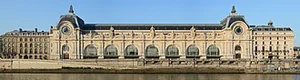
Step through the enormous, arched stone entrance and the first thing you feel is light — golden, filtered, streaming down from a vast glass canopy that seems to hold the entire building in its palm. But you’re not in a cathedral, and you’re not in a train station anymore, even though the giant clock face at the end of the hall still marks the hours. You’re at the Musée d’Orsay, and it’s impossible not to pause and simply stare.
This is no ordinary gallery. It’s a place where the art on the walls and the building itself are in constant, breathtaking conversation. The long, cavernous former railway station gives the artworks room to breathe, with sculptures placed right in the center of the main aisle as if they’re old friends waiting for you. Above them, the arched glass ceiling lets in changing Paris skies, making the marble glow and the bronze shimmer. It’s a vivid, almost dramatic setting for some of the most revolutionary paintings ever created.
The Musée d’Orsay is world-famous for one simple reason: it holds the greatest collection of Impressionist and Post-Impressionist art anywhere on the planet. That name almost understates its treasures. Here, you’ll come face-to-face with Monet’s water lilies, Renoir’s boisterous “Bal du moulin de la Galette,” Degas’s fragile little ballerinas, and Van Gogh’s frantic, swirling starry night. But it’s more than just a greatest-hits album. It’s a time capsule of a truly explosive period in French art, roughly from 1848 to 1914, when painters, sculptors, and photographers were breaking every rule they could find.
The story of this magnificent museum begins as a story of modern engineering and national pride. It was built specifically for the 1900 Exposition Universelle, the World’s Fair that brought the Eiffel Tower to global fame. The Paris-Orléans Railway Company commissioned a new, modern, electric-powered train station to replace an older one, and they wanted it to be a showpiece. Architect Victor Laloux rose to the challenge, designing a stunning Beaux-Arts masterpiece with a huge iron-and-glass train shed disguised behind a handsome, ornate stone facade.
When it opened on April 14, 1900, the Gare d’Orsay was a marvel. It wasn’t just a station; it had a hotel, a restaurant with a vaulted ceiling, and a ballroom. For decades, it served travelers arriving in the heart of Paris. But by the 1930s, its platforms were too short for the longer trains that were being introduced, so the station’s days were numbered. It limped along for a while, first as a suburban station, then a mailing center during World War II, and even against demolition in the 1960s. The plan? To tear it down and build a modern hotel in its place.
The building was saved by a groundswell of opposition and, more practically, by a change in transport plans. In 1970, the station was granted historic monument status. Then, in the 1970s, President Valéry Giscard d’Estaing had a vision: instead of a hotel, why not turn this magnificent space into a museum for 19th-century art? Architects ACT Architecture transformed the cavernous interior, and in 1986, the Musée d’Orsay opened its doors. The transformation is stunning. They kept the soaring glass roof and the vast hall, but created a series of bright, airy galleries, bringing the old train station carefully into the future before handing it over to beautiful things.
Now, let’s get you inside. The absolute must-sees are the Impressionist galleries on the upper level. This is the museum’s heart and soul. Wander through rooms filled with the bright, joyful works of Monet, Sisley, and Pissarro. Look closely at the brushstrokes — they feel like they were painted in a single breath. Then, head to the top floor for the Post-Impressionists: Van Gogh’s self-portraits, Gauguin’s tropical scenes, and Cézanne’s geometric apples. On the ground floor, keep an eye out for the sensational large-scale paintings, like Courbet’s massive “The Origin of the World,” which is displayed without apology behind a plain glass cover.
A comfortable visit takes about two to three hours. If you’re an art lover, you could easily spend half a day, but for most travelers, three hours is plenty to soak in the highlights without getting museum fatigue. Ticket-wise, it’s smart to book a time-slot ticket in advance online. It costs around 16 euros, and it lets you skip the often long entrance line. If you’re under 26 and from outside the EU, you can get in for free (so be sure to bring your passport). And remember: the museum is closed on Mondays, so plan your visit accordingly.
For the best photos, the clock is the undeniable star. There are two massive clock faces, but the one at the end of the Café des Hauteurs balcony offers an iconic view of the Seine and the Louvre beyond. It’s the perfect spot to frame a shot with the clock’s golden details in the foreground. Another tip: stand in the center of the main aisle and look up. The glass ceiling and the iron frame make an architectural selfie that’s hard to beat.
Now, for the hidden gems. The museum’s uppermost terrace is a quiet, often overlooked spot with a bird’s-eye view of the nave below — it’s practically empty, even on busy days. Also, don’t skip the museum’s own restaurant, with its stunning original Belle Époque chandeliers and painted ceiling from 1900. You can just walk in for a coffee and a pastry without being a sit-down diner. And if you love architecture, look for the tiny, beautifully preserved model of the original Paris Opera House on the lower level.
Finally, take a moment to sit on one of the stone benches in the main sculpture hall. Watch the way the sunlight changes the colors of the walls as clouds drift by. You’ll feel the hustle of Paris fade away, replaced by the gentle hum of conversations in ten different languages and the clink of footsteps on marble. That’s the magic of the Musée d’Orsay. It is not just a museum; it’s an experience — a remarkable journey through art, time, and a stunningly reused piece of French history.
