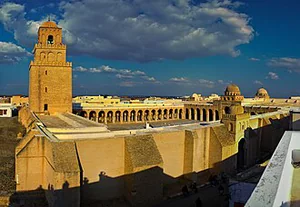
In the heart of Tunisia’s ancient city of Kairouan, the Great Mosque rises from the dusty plains like a vision from another age. Massive honey-colored walls, crowned with jagged battlements, give it the severe bearing of a desert fortress. Yet this is no military stronghold—it’s a monument to faith, built over 1,300 years ago and still standing as one of the most important Islamic sites in North Africa. Even from a distance, the enormous square minaret dominates the skyline, a bold, enduring symbol of a civilization that once ruled the entire Maghreb.
Step under its heavy wooden doorway, and the world suddenly hushes. The clamor of the medina disappears, replaced by a quiet so profound it feels almost sacred. You’re standing in a vast marble courtyard, surrounded by a forest of columns recycled from ancient Roman and Byzantine ruins. Sunlight paints dramatic shadows across the arched porticoes, and the air smells of aged stone and faint incense. This is the Great Mosque of Kairouan—the oldest mosque in North Africa and, for devout Muslims, the fourth holiest place on Earth. It’s a traveler’s dream, an open-air museum of history, design, and unbroken spiritual tradition.
The story begins in 670 CE, when Arab general Uqba ibn Nafi founded Kairouan as a military base and religious outpost. The first mosque on this spot was a humble structure of mudbrick and reeds, replaced within a generation as the city’s importance exploded. In 836 CE, the Aghlabid ruler Ziyadat Allah I commissioned a complete rebuild, using craftsmen and materials gathered from far-flung ruins, including Carthage. The result was a masterpiece of early Islamic architecture—a practical, powerful design that blended local tradition with elements borrowed from the ancient world.
For centuries, the Great Mosque served as a magnet for scholars, mystics, and pilgrims. Its university was a hub for Maliki Islamic jurisprudence, and Kairouan’s holy status grew with each passing dynasty. The minaret, built in the ninth century, is the oldest in the world, and its design—a massive square tower with a ramp-like staircase—later inspired centuries of North African and Andalusian architecture. In 1988, the mosque became part of UNESCO’s World Heritage listing, ensuring its protection for generations to come. Standing in its shadow today, you feel the layers of time compressed into a single, breathtaking moment.
When you visit, start in the courtyard, known as the sahn. This is the soul of the complex. Wander along the porticoes and note the mismatched columns—each one tells a story of Roman temples, early churches, and the great architectural salvage project the Aghlabids pulled off. Near the center, you’ll find a beautifully preserved well. Pilgrims once performed their ritual ablutions here, but today it’s a favorite spot for quiet reflection. Also look for the famous Door of the Thread, a richly carved wooden portal that leads into the prayer hall; legend says pilgrims would tie threads to it as a sign of devotion.
The prayer hall is the crown jewel. Brace yourself for sheer visual impact: over 400 columns arranged in seventeen aisles, bathed in dim, golden light that filters through small windows in the vaulted roof. The columns are a patchwork of styles—some Corinthian, some smooth, some with barely visible Latin inscriptions. At the front is the mihrab, the ornate niche that marks the direction of Mecca. It’s covered in luster-painted tiles that seem to glow from within; countless worshippers have faced this exact spot for over a thousand years. Beside it rests the minbar, the oldest surviving wooden pulpit in the world, adorned with intricate geometric carvings that still look crisp today.
Plan for at least an hour and a half to truly absorb the details. You’ll pay a modest entry fee—roughly 10 Tunisian dinars, about three US dollars—and you can freely wander the courtyard and, outside prayer times, step into the prayer hall. Dress modestly out of respect; no head covering is required for women, though a scarf is a considerate touch. The best photo opportunities are found from the far edge of the courtyard, where you can frame the minaret against the open sky. Inside the prayer hall, try shooting straight down an aisle for a mind-bending perspective of the unending columnar arcades. The mihrab is spectacular up close, but skip the flash and keep your shutter quiet.
If you’re hungry for hidden gems, head to the staircase of the minaret. Depending on current conditions, you may be allowed to climb its 120 steps to a small balcony that offers a panoramic sweep of Kairouan’s whitewashed rooftops, the surrounding olive groves, and the vast plains that stretch toward the desert. Do it if you can—it’s worth every step. Another subtle detail: examine the column capitals closely. Some carry ancient carvings of leaves and faces, long forgotten by the craftsmen who reused them. These stone remnants are silent witnesses to the many civilizations—Roman, Byzantine, Arab—that shaped this fragile, beautiful place. When you finally step back out into the glare of the sun, you’ll carry the mosque’s quiet, ancient energy with you—a memory that lingers longer than any photograph.
