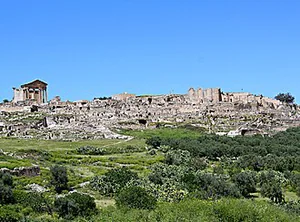
Imagine a hillside scattered with honey-colored stones, olive trees leaning in the breeze, and the jagged silhouette of a Roman temple cutting into a crystal blue sky. That’s Dougga. It’s not the most famous ancient site in the world, and that’s exactly what makes it so magical. This sleepy village in northern Tunisia is actually one of the best-preserved Roman towns anywhere on Earth, and yet you’ll likely have the place almost to yourself.
Dougga earned its UNESCO World Heritage status back in 1997, but it’s been quietly sitting there for centuries. Unlike the grand ruins of Carthage or Ephesus, Dougga never became a crowded tourist stop. It’s a place where you can walk through a 3,000-year-old history without elbowing anyone else for a photo. As you wander past crumbling temples and a stadium-sized theater, you get the sense that time just gave up and walked away. It’s vivid, haunting, and utterly unforgettable.
Long before the Romans, Dougga mattered. The Numidians founded it around the 6th century BC, using the natural defensible hilltop as a trading post and a royal capital. The name Thugga, as it was known, means ‘pastures’ in the Amazigh language. When Rome took control in the 2nd century BC, the city didn’t vanish. Instead, it became a strange and beautiful mix—Numidian and Punic traditions blended with Roman engineering and law. The result is what you see today: a city that feels Roman, but with deeper, older layers bubbling right up to the surface.
The golden age hit under Emperor Antoninus Pius in the 2nd century AD. This is when the biggest monuments went up: the soaring Capitol, the magnificent theater, the massive public baths. Dougga became rich from olive oil and grain, and it showed. But all good things fade. By the Byzantine era, the city shrank, and after the Arab conquest of North Africa, Dougga was gradually abandoned. For over a thousand years, it just sat there, half hidden under farmland and wild brush. Local farmers used its columns for hitching posts. Finally, in the late 19th and early 20th centuries, archaeologists started uncovering it. What emerged was a nearly complete Roman town, frozen in time.
Your first stop inside Dougga should be the Capitol, the single most jaw-dropping structure on site. Steep stairs lead up to six massive Corinthian columns still holding a huge lintel and the remains of a pediment. Inside, you can see the original carvings dedicated to Jupiter, Juno, and Minerva—the three gods who watched over the city. Stand at the top of those steps and look out over the valley. You’ll understand instantly why they chose this spot.
Just a short promenade away sits the Roman theater, holding up to 3,500 spectators. It’s smaller than many stadiums, but it’s beautifully intact, and you can still climb up to the top rows of seating. The view from the highest tier is pure gold, especially in late afternoon. While you’re there, try a little experiment: stand in the center of the orchestra and speak in a normal voice. The acoustics are so perfect that someone at the back can hear you clearly. It’s a thrill you won’t forget.
Don’t rush past the smaller landmarks either. The Temple of Juno Caelestis is a rare gem with a C-shaped portico and a deep, mysterious sanctuary. The Arch of Septimius Severus sits at the edge of the site like a royal gatekeeper. And then there’s the Libyco-Punic Mausoleum, one of the few surviving Numidian tombs in existence—it’s actually located at the edge of the archaeological area, slightly beyond the main fence. You might have to ask a guard to point you the right way. It’s worth it. The carvings and structure are utterly unique, mixing African and Greek styles.
The baths are another highlight, but don’t just wander the main hall. Head down into the underground chambers, where you’ll find the furnace rooms and steam ducts. It’s dark, cool, and a little eerie down there. You’ll also find the public latrines—a row of stone seats facing each other with a communal trough. It’s one of those details that makes history wonderfully human. People actually sat there and chatted, just like we might at a café.
How much time do you need? Give yourself a solid three to four hours if you want to soak it in. The site is spread out, and there are some natural trails and uneven stones, so wear good walking shoes. The open sun can be brutal in summer, but bring a hat and water. Ticket prices are refreshingly low—around 10 Tunisian dinars, which is roughly three or four dollars. There’s also an on-site museum near the entrance, with a handful of lovely mosaics and statues that explain more about everyday life in the city. If you can, hire one of the local guides at the gate. They’ll bring the stones to life.
Now, about photos. You’ll want to capture the Capitol’s columns against a clear blue sky—early morning gives you that warm golden glow and thinner crowds. But for a truly epic shot, climb to the top rows of the theater just before sunset. The light floods the stage and hits the hillside behind you. Another lesser-known spot: the olive grove just below the Temple of Juno Caelestis. From there, you can frame the temple’s curved portico between ancient tree branches. It’s a photo that looks like a painting.
Finally, let me tell you a secret. Wander down the main street toward the old marketplace, and you’ll find a set of ordinary-looking stone steps. If you pause there and listen, you might catch the faint sound of water running far beneath you. Those are the remains of Dougga’s underground aqueduct system, still doing its quiet job over 1,800 years later. That little moment sums up Dougga beautifully. It’s not a dead ruin. It’s a sleeping town, waiting patiently for you to wake it up, if only for an afternoon.
