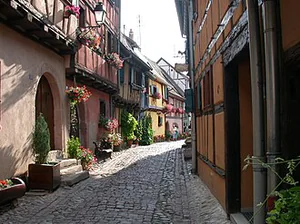
Picture a village that seems to have been painted onto the canvas of your imagination: cobblestone lanes curving like gentle ribbons, half-timbered houses painted in dusty pinks, sunflower yellows, and deep Bordeaux reds, each one overflowing with geraniums and petunias. That’s Eguisheim for you. Nestled in the heart of France’s Alsace wine country, this small village is a real-life storybook, a place where every turn of a corner makes you half-expect to see a princess leaning out of a turret window. It’s no wonder that travelers from around the globe constantly rank it among the most beautiful villages in France — and once you set foot here, you’ll instantly understand why.
But Eguisheim is more than just a pretty face. It’s an active, thriving community, a winegrower’s paradise, and a site of profound historical significance. The village sits just a few kilometers from the larger town of Colmar, yet feels a world apart. Here, time slows down to the pace of a gentle vineyard breeze. The air smells of ripe grapes, fresh bread, and wood smoke from the stained-glass workshops that dot the streets. Whether you arrive on a sun-soaked summer afternoon or a misty autumn morning, Eguisheim wraps itself around you like a warm, fragrant hug.
The story of Eguisheim begins centuries ago, in the mists of the early Middle Ages. The village was first mentioned in a chart in 742, but its real transformation happened in the 11th century when the powerful Counts of Eguisheim made this place their home. It was in one of their castles, right on the hill overlooking the village, that a boy named Bruno was born in 1002. He would go on to become Pope Leo IX, one of the most influential popes of the medieval era, and his name is still woven into the village’s very fabric. The three feudal castles — Dagsbourg, Wahlenbourg, and Pflixbourg — that stand atop the wooded hill as silent ruins today were the anchors of this great family’s power.
What makes Eguisheim truly remarkable, though, is its layout. Unlike most villages that grew organically in a jumble of streets, Eguisheim was deliberately constructed in concentric circles around that central castle. You’ll see it the moment you glance at a map: two perfect rings of streets, the Rue du Rempart and the Rue des Tilleuls, circling the central Place du Château. This octagonal design was both defensive and symbolic — it created a natural fortress for the villagers while ensuring that the castle at the heart was the undisputed center of life. Even today, as you wander along these cobbled rings, you’re walking the same paths that medieval merchant gave in the shadow of the pope’s birth home. That sense of history pressing against the present is almost tangible.
Now, let’s talk about what you actually do when you’re there. The first and most delightful activity is simply getting lost. Start at the central square, Place du Château, where a striking statue of Pope Leo IX stands before the old castle courtyard. Then pick a direction along the Rue du Rempart, the outer circular street. Here, one colorful half-timbered house after another lines the route, each one adorned with flowers, ornate signs, and shingle patterns that feel like abstract art. Allow at least an hour just for these lanes — you’ll find yourself stopping constantly for photos, peering into boutique wineries, and pausing outside the beautifully restored wells and fountains. Don’t miss the Fontaine Saint-Hubert, a Renaissance-era well with a fabulously whimsical carved figure atop it.
If you’re a wine lover — and let’s face it, why wouldn’t you be in Alsace? — Eguisheim will be your paradise. The village is surrounded by four Grand Cru vineyards, and nearly every alley houses a family-run winery where you can taste Gewurztraminer, Riesling, and Pinot Gris right in the cellar. You don’t need an appointment; just walk in the tasting rooms and the growers will gladly pour. Some houses even have direct wine dispensers — wine ATMs, essentially — where you can buy a fresh glass for a couple of euros. That’s a hidden gem you won’t find in many tourist guides. Spend a couple of hours tasting, then grab a savory tarte flambée or a plate of local cheese at one of the modest, wood-beamed winstubs (Alsatian taverns).
How much time should you budget? Honestly, you could rush through Eguisheim in two hours, but that would be a crime. Plan on a minimum of half a day to truly absorb the atmosphere, and a full day if you’d like to take the short but steep hike up to the three ruined castles. The trailhead starts just at the village’s edge, and the reward at the top is a panoramic view that has you looking down upon the village’s concentric rings like a living mandala. The ruins themselves are free to explore, and there’s something awe-inspiring about touching 900-year-old stones that once echoed with the footsteps of emperors and popes. The best photo moment from up here is, without question, at golden hour — the warm light makes the colorful rooftops glow as if they were made of boiled sweets.
Back down in the village, you’ll find another hidden delight: the old washhouse (lavoir) tucked behind the church. It’s a shaded, stone-built structure with a long rectangular basin, silent and still except for the trickle of spring water. Almost nobody visits it, which makes it a wonderful spot for a quiet pause. And speaking of the church, the Église Saints-Pierre-et-Léon is worth a look for its simple neo-Gothic charm, but the real treasure lies outside: a medieval carved stone depicting a head wearing a pensive expression, believed to be one of the oldest sculptures in Alsace.
A visit to Eguisheim is nothing less than a sensory feast. There’s the clink of glass wine bottles, the hum of bees in the flower boxes, the occasional clip-clop of a horse-drawn carriage on the cobbles, and the aroma of fresh pastry wafting from a corner bakery. The village’s small size is its greatest strength; it never feels overcrowded, and even in high summer, you’ll find quiet alleys all to yourself. There are no grand museums or monumental cathedrals here, and that’s exactly the point. Eguisheim doesn’t try to impress you with size or spectacle. Instead, it wins you over with charm, authenticity, and the warm, unhurried rhythm of Alsatian village life. That, in the end, is the kind of magic that stays with you long after you’ve left.
