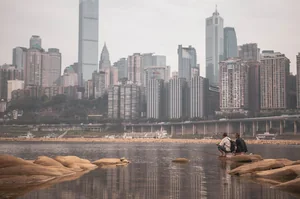
Dusk settles over Chongqing, and the city begins to glitter like a handful of scattered sparks. Then you spot it – a cluster of golden-roofed wooden pavilions that seem to grow straight out of the stone cliff, stacked seven, eight, ten stories high. Below them, the Jialing River reflects every warm light, and for a moment you’d swear you’ve wandered into an animated film. This is Hongya Cave, or Hongyadong, one of China’s most theatrical attractions. It’s not a cave at all, really. It’s a towering complex of stilted buildings that cling to a sheer cliff like bright barnacles on a ship’s hull.
By day, Hongya Cave shows its bones: ancient-style gray tiles, carved wooden balconies, and narrow stairways that twist and zigzag. But by night, it transforms into something out of a reverie. Lanterns and neon strips trace every eave and rafter, and the whole cliff side glows warm amber against the dark water. Travelers from all over the world snap photos endlessly, hoping to capture that dreamlike moment. And speak of Spirited Away – you’ll hear the comparison constantly. It’s deserved. The place feels alive with stories, even if the stories are half yours, half Hollywood.
The history here runs deeper than the shimmering facade suggests. The site was once a militia fortress during the Ming Dynasty, guarding a strategic bend in the river. Its name, 洪崖洞, literally translates to “Flood Cliff Cave,” a nod to the seasonal monsoon torrents that once raged against this very rock. Over the centuries, merchants and boatmen built wooden homes on stilts to survive the impossible terrain. These weren’t just houses; they were a solution for engineers who had no choice but to build upward on a city that some people describe as a mountain jutting out of the water. Riverside trade flourished here, and for a time, Hongya served as a vibrant hub for cargo ships and travelers passing toward the Yangtze.
The modern Hongya Cave you see today is a bold reconstruction completed in 2006 after eight years of design and labor. Local enthusiasts and architects wanted to revive the Bayu culture of old Chongqing, and they did so with flair. Eleven levels of shops, restaurants, and lookout decks now rise from the river to the road above. Yet the site still honors its past: traditional han-style arches bracket doorways, and the wooden pillars supporting the entire structure were built using ancient joinery techniques – no nails, just interlocking beams and pegs. It’s an ambitious homage, and it works. The result isn’t just a shopping center; it’s a walkable history book that happens to sell cobblers and hot pot.
Inside Hongya Cave, the adventure is wonderfully confusing. You could enter from the top level, which opens onto a busy city street, and wander down through restaurants, souvenir stalls, and tea houses. Or you could start at the riverside boardwalk and wind upward. Either way, you’ll soon lose track of which floor you’re on. The elevators are notoriously crowded, so embrace the stairs. Along the way, you’ll discover a cascading indoor waterfall – yes, inside the building – that spills over artificial rocks and into a small pond. It feels like a secret grotto carved into the middle of a shopping mall, and it’s one of those delightful surprises that make the place so memorable.
If you’re wondering how long to stay, plan for at least two hours – three if you want to linger over dinner or catch the sunset. The best strategy is to arrive about an hour before nightfall. Stroll through the quieter upper terraces, watch the sky redden over the river, and then wait for the lights to flicker on one by one. That gradual transformation is pure magic. As for tickets, the main complex is completely free to enter. A few niche exhibitions inside – like the small folk-art museum and a virtual reality historical show – might charge a modest fee, but the core experience costs nothing at all. That’s rare for a world-famous landmark.
Now, about those photos. The classic shot is from the Qiansimen Bridge, which spans the river just beside the complex. From there, you see the full, staggering height of Hongya Cave against it, the river in front, and the city skyline behind. If you’d rather avoid the bridge crowd, head to the riverbank park directly opposite – you’ll get a lower angle, but the reflection on the water is stunning. Inside the complex, the third-floor courtyard offers a handsome upward view of balconies and lanterns, though it’s often busy. For a quieter moment, step out onto the hidden platform at the back of the seventh level. Most tourists hurry past it, but that’s exactly where you’ll find the best view of the wooden pillars strutting down the cliff like ancient robot legs.
One lesser-known gem is the “New Year’s Eve” mini-hall at level four. It’s a tiny exhibition with clay figurines and old photographs showing the original Hongya Cave as it appeared during the 1930s. It deserves a few minutes of your time. Then, if you’re feeling peckish, go native: try the fried skewers or a bowl of spicy suanlafen noodles from one of the many small vendors inside. The whole complex is a sensory overload, and that’s precisely its charm. Hongya Cave isn’t a polished museum; it’s a loud, aromatic, kaleidoscopic celebration of Chongqing’s verticality. Bring a camera, comfortable shoes, and your sense of wonder. You’re going to need all three.
