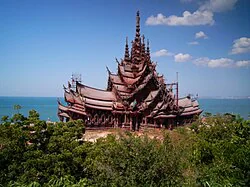
Imagine a colossal structure built not from stone and steel, but entirely from hand-carved wood, rising from the rocky edge of the Gulf of Thailand. That’s the Sanctuary of Truth, a breathtaking architectural wonder in Pattaya. It’s not just a building; it’s an open-air museum, a philosophical statement, and a breathtaking feat of human hands. Every inch of its towering spires, sweeping roofs, and massive pillars is covered in meticulous carvings of gods, demons, and mythical creatures. Walking through this place feels like stepping into a sacred forest of timber and mythology. For many travelers, it’s the single most memorable stop in all of Thailand.
What truly sets this place apart is its purpose. It was never meant to be a typical temple. Instead, it’s a symbolic representation of ancient wisdom, blending Hindu and Buddhist cosmology. The structure was designed to teach visitors about the cycle of life, the bond between family, and the search for truth. It’s a stunning, sprawling lesson in philosophy, made tangible through chisel and wood. Whether you’re an architecture enthusiast, a spiritual seeker, or just someone chasing a unique photo, the Sanctuary of Truth delivers an experience that lingers.
The history of this striking monument starts with a man and his vision. In 1981, Thai businessman Lek Viriyaphant, who had previously created the Erawan Museum in Samut Prakan, decided to build something even more ambitious. He wanted to preserve ancient Thai craftsmanship while sharing universal philosophical truths. So he gathered hundreds of skilled artisans and began carving a hand-built masterpiece on a plot of land jutting into the sea at Laem Naklua. The project was named the Sanctuary of Truth, reflecting its goal of awakening visitors to the deeper meaning of existence.
Here’s the twist: the Sanctuary has never been fully finished. It was designed as a perpetual work in progress. The tropical sun and salt-laden sea breeze constantly erode the teak and other hardwoods, so as old carvings wear away, fresh ones are chiseled in their place. In that way, it’s a living tradition, rather than a static monument. While many tourists mistake it for an ancient temple, the building is entirely modern in origin, yet inspired by antique artistic styles. It stands as a tribute to the resilience of human creativity, and each visit to the site supports the continuous work of its dedicated artisans.
Step inside, and you’ll be surrounded by a dense forest of mythological imagery. The building is divided into four wings. The east wing honors the father’s spirit, the west wing honors the mother’s, the south wing explores universal creation, and the north wing represents a serene and balanced mind. You’ll see Hindu deities like Brahma, Vishnu, and Shiva, alongside countless celestial dancers and epic scenes like the churning of the ocean of milk. Every column, wall, and ceiling panel is carved with incredible depth. Don’t rush. Look up and down, close and far. And if you’re curious, watch the live craftsmen who work on-site, adding new details with every passing day.
Most visitors should plan for about two hours to explore the entire complex. You’ll want time to circle the outer terraces, climb to the main hall, and just sit by the shore listening to the waves. There’s also a traditional Thai dance and puppet performance that takes place inside the structure at regular intervals. It’s included in your admission, so you don’t have to pay extra. While the ticket price of around 500 baht may seem steep for some, the sheer scale and craft of the building make it well worth the cost. You can explore independently or join the complimentary guided tour, but either way, you’ll leave your shoes at the entrance, following local custom and protecting the polished teak floors.
For photo lovers, this place is a goldmine. One of the most iconic shots is from the beach level, where the entire western facade rises in front of you, with the sea behind you. Golden hour, when the low sun catches the carvings, is pure magic. Inside, head to the central courtyard and point your lens upward. The ceiling’s layered lattices and soaring spires create a surreal, cathedral-like frame. Here’s a hidden gem most people miss: the narrow side corridors near the rear wings. They’re quiet, moody, and framed with latticework that lets in ribbons of sunlight. Another quiet secret is the small back shrine, barely used by tourists, where you can sit in the soft shade and feel the ocean breeze drifting through the carvings.
In the center of the building, you’ll find the true sanctuary room. It’s a shadowy, peaceful hall designed for quiet reflection. And that’s the ultimate takeaway from this place. It’s not just a sight to see; it’s a space to feel. The scent of fresh-cut wood hangs in the air, the rhythmic sound of chisels echoes in the background, and the sea glimmers in the distance. The Sanctuary of Truth encourages you to slow down, breathe, and appreciate the effort behind every curve and knot. Whether you’re there for 90 minutes or a whole afternoon, you’ll leave with a deeper respect for the hands that keep this wooden wonder alive.
