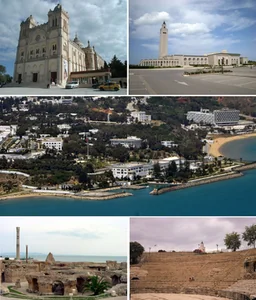
Imagine standing on a hillside where the Mediterranean breeze carries the scent of jasmine and salt, and the ruins beneath your feet once thundered with the hooves of Hannibal’s war elephants. That’s the Archaeological Site of Carthage, a UNESCO World Heritage site that spreads across the hills and coastline of modern Tunis, just a stone’s throw from the azure sea. This isn’t one contained ruin, but an open-air puzzle—fragments of a city that dared to challenge Rome and, for centuries, ruled the waves. You’ll find crumbling Roman villas beside Punic burial grounds, and the ghost of a legendary queen woven into every stone.
The site’s fame rests on its sheer audacity. Carthage was the superpower of the ancient Mediterranean, a wealthy Phoenician colony that grew into an empire stretching from North Africa to Spain. Its destruction was so complete that the Romans reportedly sowed the earth with salt, yet you can still feel its pulse today. For travelers, it’s a chance to walk through layers of civilization—Punic, Roman, Byzantine, and Islamic—all stacked like geological strata. Arrive in the late afternoon, when the golden light softens the ruins and the sea below glitters like hammered tin, and you’ll understand why the poet Virgil called it a ‘city of magnificence.’
Carthage’s story begins in 814 BCE, when Queen Dido (Elissa) fled Tyre and, legend says, bargained for as much land as an oxhide could cover. She cleverly cut the hide into thin strips and encircled a hill—the Byrsa Hill, where the site’s core stands. For centuries, Carthage thrived as a trading titan, its merchants sailing to Britain, the Canaries, and the coasts of Africa. It was the rivalry with Rome, though, that sealed its fame. The Punic Wars—three brutal conflicts fought over Sicily and supremacy—culminated in the fabled Hannibal crossing the Alps with elephants in 218 BCE. He won stunning victories, but Rome never gave up. In 146 BCE, after a three-year siege, Roman general Scipio Aemilianus leveled the city. Historians say the Romans burned it for seventeen days and tore the rooftops from their stone houses.
Yet Carthage wasn’t finished. A century later, Julius Caesar ordered its refoundation, and Roman Carthage became the empire’s wealthiest city in Africa—second only to Rome itself. It boasted spectacular baths, a massive circus for chariot racing, and a grand aqueduct. The city later vibed with early Christianity; it was here that Saint Augustine studied and the famous martyr Perpetua was jailed. When the Vandals sacked it in 439 CE, and the Byzantine Empire recaptured it a century later, Carthage became a shadow of its former self. The Arab conquest in 698 CE sealed its final decline, and its stones were pillaged for the buildings of Tunis. It wasn’t until the 19th century that archaeologists began unearthing the awe-inspiring remnants you see today.
Exploring Carthage feels like being a detective in a time machine. The must-see spots are spread out, so give yourself at least three to four hours—ideally half a day if you want to linger. Start at the Carthage Museum on Byrsa Hill for orientation; its artifacts and scale model will help you visualize the sprawling metropolis. Then wander the Tophet, a sinister yet sacred Punic cemetery where urns containing the ashes of children and small animals were deposited. It’s chilling, but it’s also the single most important relic of the Punic world. Don’t miss the Antonine Baths, the largest baths outside Rome, where you can wander among towering marble columns and imagine senators soaking in steaming pools while gazing at the sea.
Your ticket, which costs roughly 12 Tunisian dinars (about 4 USD), covers the main areas: the Byrsa Hill museum, the Antonine Baths, the Punic ports, and the Tophet. You can also buy an extended ticket for the adjacent villas of the Roman elite, which sit a short walk away. The good news? The site isn’t fenced off like a theme park—you can walk on the original mosaics and touch the rough-hewn stones. That intimacy is a blessing and a curse. Wear shoes with grip, since the ancient flagstones are slippery and uneven. And bring water; the site has almost no shade, and Tunisia’s sun is relentless, even in early spring.
Photo hunters, rejoice. The best photo spot is the view from Byrsa Hill looking out over the Punic ports and the modern bay. The twin circular harbors—the commercial port and the naval port where Hannibal’s fleet once hid behind a boom-and-chain defensive mechanism—are best captured just before sunset when the water turns to liquid copper. Another killer shot: the Antonine Baths’ remaining columns crashing against the sea, with the Gulf of Tunis as a backdrop. If you’re a drone flyer, check local rules—the site is often under flight restrictions due to its proximity to the presidential palace, so stick to ground-level angles.
Hidden gems are everywhere if you look. Down near the Punic ports, you’ll find the old Tophet’s smaller sibling, lesser visited and haunting. Beside the Antonine Baths, look for the remains of the enormous cistern complex called La Malga, which once stored the city’s water supply. And in the villas—the House of the Mosaic Horses and the Villa of the Aviary—you’ll discover exquisite floor mosaics depicting wild beasts and mythical creatures, often completely ignored by tour groups. For a moment of peace, walk the quiet path between the Roman theatre and the Odeon; these restored performance spaces still host open-air concerts during the summer Carthage Festival. You might literally sit where a Roman senator once laughed at a comedy.
One practical tip: the site is vast and disjointed, with the major ruins separated by busy roads and suburban streets. You can’t just walk in one straight line; you’ll need to cross between zones using the designated pedestrian paths. Seriously consider hiring a local guide at the museum entrance—they charge about 15 dinars for an hour and half, and their stories transform bare stones into living history. If you prefer to explore solo, download an offline map of the site, because GPS can be flaky among the ruins. And while you’re there, do yourself a favor: after visiting the Punic ports, walk ten minutes to the village of Sidi Bou Saïd, a clifftop dream of white and blue buildings. It’s technically outside the archaeological zone, but its charm complements your visit perfectly.
Here’s the thing about Carthage—it doesn’t yell. Other ruins hit you with towering arches and perfectly restored façades. Carthage whispers through fragments: a scattered fluted column, a fragment of a floor mosaic showing a galloping horse, a carved marble foot pointing toward an invisible temple. You’ll need to fill in the blanks with imagination. But that’s exactly the point. The city that Rome tried to erase survives in the spaces between stones. As you leave and the sun dips behind the Bay of Tunis, the ghosts of Phoenician traders, Roman patricians, and early Christians settle back into the twilight. You won’t have seen all of Carthage—nobody ever does—but you’ll have touched something timeless. That’s more than enough.
