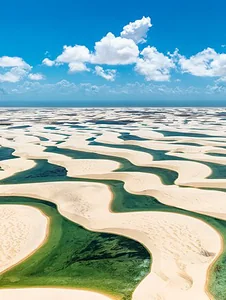
Imagine a desert that fills up with rain and turns into a thousand swimming pools. That’s Lençóis Maranhenses National Park in Brazil – a surreal stretch of sand dunes and crystal-clear lagoons that looks more like a dream than a place you can actually visit. For miles, the soft white landscape rolls to the horizon, broken only by vivid blues and greens of freshwater pools that appear overnight during the rainy season. Travelers who make the journey here often find themselves speechless. How can something so barren be so alive?
The park hugs Brazil’s northeastern coast in Maranhão state, tucked between the Atlantic Ocean and the vast inland highlands. It’s often called a desert, but that’s a myth. The region gets more than 1,200 millimeters of rain every year, and the dunes act like giant sponges, holding water in the low-lying valleys between them. By June, these hidden pockets overflow into lagoons of stunning clarity. You’ll see locals swimming, splashing, and floating in water that changes color from emerald to sapphire depending on the light. It truly doesn’t feel real.
That’s what makes Lençóis Maranhenses so famous – it’s a landscape that defies expectations. You’d imagine a barren, empty wasteland, but instead you find a blue-water paradise. It’s no wonder that this national park has become one of the top highlights of a trip around South America.
The name itself tells a story. ‘Lençóis’ means bed sheets in Portuguese, and when early explorers looked at the endless dunes, they saw a giant set of white linen laid out to dry. Long before those explorers arrived, indigenous peoples lived in the area, leaving traces that still linger in the local culture and traditions. In the 17th century, European expeditions began to make notes about the region, but it remained largely untouched due to its remote and forbidding nature.
That changed in the late 20th century, as Brazil started paying more attention to its natural treasures. On June 2, 1981, the government created Parque Nacional dos Lençóis Maranhenses, spanning over 155,000 hectares of dunes, lagoons, mangroves, and coastal plains. The designation didn’t just protect the landscape – it protected a way of life. Small fishing villages like Atins, which existed for generations on the edge of the dunes, became gateways for visitors. In 2013, the area was recognized as a Ramsar Wetland of International Importance, and in 2024, UNESCO gave it the ultimate honor, adding it to the World Heritage List.
Today, the park continues to evolve, quite literally. The constant trade winds shift the sand dunes by up to ten meters every year, creating new lagoons and erasing old ones. That living, breathing nature is part of the park’s history. Each visitor who climbs a dune can be sure that the map they brought won’t be the same a year from now. There’s a wonderful sense of being part of something that’s always in motion.
Visiting Lençóis Maranhenses is an experience that engages every sense. The first thing you’ll notice is the silence – broken only by wind and the distant splash of water. The most popular route starts in the town of Barreirinhas, where you board a 4×4 truck that takes you to the main trailhead. From there, you’ll hike barefoot across the dunes to reach the star attractions: Lagoa Azul and Lagoa Bonita. Both are enormous, vivid pools surrounded by white sand, and they’re perfect for a swim. The water is shallow, warm, and wonderfully refreshing. Most tours spend a full morning here, and it’s time well spent.
To get the full magic, plan for two or three days. You can also base yourself in the fishing village of Atins, which offers direct access to the dunes and a slower, more charming atmosphere. The best months to visit are June through September, when the lagoons are brimming. Outside those months, you might find dry landscapes and fewer pools. There’s no formal entrance ticket, but you’ll need to hire one of the local guides – it’s not only practical, it’s also a way to support the communities that have lived here for generations. Prices and routes vary, so have a chat with your guide and ask about less-trafficked spots.
Photography lovers should make a beeline for the viewpoint above Lagoa Bonita. That’s the classic shot you’ve seen online – the sweeping curve of dunes with a brilliant blue lagoon at the center. Go at sunrise or sunset to catch soft, warm light and long shadows. Another lesser-known gem is Lagoa das Emendadas, a collection of small lagoons connected by narrow strips of sand. It’s a bit of a hike, but you’ll often have it to yourself. If you’re feeling adventurous, ask about the Preguiças River area at the southern edge of the park, where water meets mangroves and you might spot herons, kingfishers, and even capuchin monkeys.
Remember, there’s no shade in the dunes, and the sun is intense. Bring a hat, sunglasses, and reef-safe sunscreen, and take extra water. The wind keeps you cool, but it can also dry you out faster than you expect. And here’s a secret: because the lagoons are fed by pure rainwater, there’s no salt in them. You’ll shower off in freshwater as if it were a natural spa day. That’s the kind of surprise you remember for a lifetime – a desert that turns out to be the most refreshing place in Brazil.
