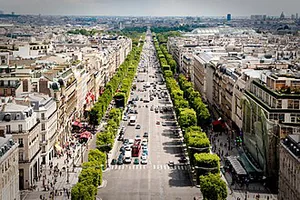
Pop the champagne, straighten your scarf, and take a slow stroll down the Champs-Élysées. It’s a name that conjures up shimmering lights, stylish storefronts, and the triumphant sweep of the Arc de Triomphe at its crown. For many, this isn’t just a street—it’s the beating heart of Paris, a grand stage where the city’s beauty and bravado play out from morning to midnight. Whether you’re sipping coffee at an iconic café, browsing behind glass windows, or simply soaking in the endless rush of life, the avenue feels less like a road and more like a living, breathing masterpiece.
You could call it a catwalk of French culture, but that undersells the pure sensation of standing there. The avenue stretches for nearly two kilometers, lined with horse-chestnut trees, elegant Haussmann buildings, and a constant hum of energy. At dawn, it’s all soft pink light and joggers. By noon, it’s a global crossroads of shoppers and sightseers. Come evening, the bistro terraces glow with warmth, and the Arc de Triomphe lights up like a gold-tipped sentinel. This is Paris at its most theatrical, and there’s no stage quite like it.
But the Champs-Élysées wasn’t always this glittering. Its name means the Elysian Fields—the paradise of Greek mythology. And in a way, it went from a humble stretch of farmland to an earthly paradise of power and spectacle. The story starts in 1640 when Marie de Médicis extended some gardens, but it was landscape architect André Le Nôtre who gave the avenue its identity in the 1660s while designing the Tuileries. He carved out a long, straight line of trees that opened up the view toward the modern-day Arc de Triomphe. Back then, it was just the edge of the city, a wild place of fields and forests where Parisians went to escape.
By the 18th century, the avenue had blossomed. In 1724, the city formally extended it into what we see today, and soon it became the fashionable promenade for aristocrats who rode their carriages from the Louvre to the hill at Chaillot. When Napoleon commissioned the Arc de Triomphe in 1806 to honor his army, he unknowingly cemented the avenue’s eternal glory. Over the decades, Baron Haussmann widened the streets, gas lamps flickered on, and the Champs-Élysées turned into a stage for every major French celebration—from the liberation of Paris in 1944 to fireworks on Bastille Day. The Tour de France crowns its winner here each summer, and the world watches. That’s the story of this boulevard: it’s never just a street, it’s a symbol.
Now, let’s talk about what you actually do when you’re there. First, set aside half a day—maybe an afternoon and evening. The avenue itself is free, open 24/7, and the joy is in the wandering. Start at the shining Arc de Triomphe, standing proudly at the western end. It costs around €13 to climb to the top, but it’s worth every euro. The view from the rooftop is a 360-degree star turn: twelve avenues radiating out like sunbeams, the Eiffel Tower peeking to the side, and the long ribbon of the Champs-Élysées unspooling below you. Try to time your visit for late afternoon, so you catch the daylight, the sunset, and the sparkling lights of Paris as they flicker on after dark.
Back on ground level, walk down the upper half of the avenue. This is the luxury stretch—high-end boutiques, car showrooms, and the famous flagship of Louis Vuitton. Even if you’re not shopping, a wander through the stores is a free admission into the world of French design. But don’t stop there. Midway down, the avenue opens into the glorious Jardin des Champs-Élysées, a lush green respite with fountains, statues, and the lovely Petit Palais across the road. This garden is one of the city’s best-kept secrets for travelers: quiet, shaded corners, charming cafés, and a gentle sense of calm just steps from the chaos. Hidden within it is the Théâtre Marigny and a vintage-style puppet show for kids—a whimsical touch that’s easy to miss.
Speaking of hidden gems, look for the two of the avenue’s grandest buildings—the Grand Palais and the Petit Palais—both built for the 1900 World’s Fair. The Grand Palais often hosts blockbuster art exhibitions, while the Petit Palais is a beautiful museum of fine arts, and it’s free for its permanent collection. That’s a sneaky win for budget-conscious travelers. For a true insider’s moment, duck into the tiny Passage du Lido, a narrow arcade near number 76 that’s tucked between the storefronts. It’s a relic of the 19th century, covered with a glass canopy, and you’ll likely have it all to yourself. Not many visitors even realize it’s there.
When it comes to photo spots, don’t just snap from the middle of the sidewalk. For the classic postcard shot of the avenue, stand on the steps of the Arc de Triomphe or on the terraces of the Jardin des Champs-Élysées. For something less clichéd, position yourself at the top of the avenue looking toward Place de la Concorde at dusk—the Egyptian obelisk is backlit beautifully. And if you’re feeling bold, the famous carousel at the entrance of the gardens makes a playful foreground. The best shots happen in the ‘golden hour’ before sunset, when the stone buildings turn honey-colored and the city lights just start to twinkle.
Your time on the Champs-Élysées isn’t complete without embracing the ritual of café society. Pull up a chair at the iconic Fouquet’s, where the golden lettering has crowned the corner since 1899. It’s pricey, but a coffee there is payment for history. Or, for a local vibe, sidestep into a side street and find a neighborhood café for half the price and double the charm. The avenue is also the place to try a classic French treat—a crêpe from a street vendor, a macaron from Ladurée, or a thin-crusted pizza from the bustling Italian spots that have somehow claimed their slice of the boulevard.
Here’s one more piece of advice: visit both early and late if you can. Join the morning joggers near the Concorde, then come back after nightfall when the avenue glitters like a jewel box. The crowds thin, the neon signs reflect on the wet pavement, and you’ll get that cinematic Paris feeling that movies always promise. Whether it’s your first visit or your fiftieth, the Champs-Élysées somehow feels both familiar and fresh. It’s a triumph of design, a living archive of French history, and a parade ground for daily life—all rolled into one glorious, tree-lined dream. Come for the glamour, stay for the magic, and let the avenue sweep you off your feet. C’est la vie. That’s Paris, right there.
