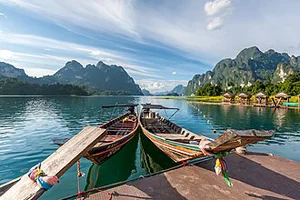
You don’t just visit Khao Sok National Park — you enter another world. Tucked away in southern Thailand, this ancient rainforest feels like something from a dinosaur storybook. Towering limestone karsts punch up through the canopy, their sheer gray faces draped in vines and moss. Beneath them, the jungle hums with life: gibbons calling at dawn, hornbills flapping overhead, and the constant, gentle rush of the Sok River threading through the valley. It’s wild, it’s dramatic, and it leaves you a little breathless.
The park is often compared to Halong Bay for good reason — but flipped on its side. Instead of seascape, you get a flooded valley where those same limestone spires rise from the emerald waters of Cheow Lan Lake. Nowhere else on Earth looks quite like this. And here’s the kicker: Khao Sok shelters one of the oldest rainforests in the world, dating back over 160 million years. That’s older than the Amazon. Spend one day here, and you’ll understand why travelers call it one of Thailand’s greatest adventures — and their best-kept secret.
Khao Sok’s story begins long before it was a protected park. Archaeological finds in the region’s caves suggest humans lived here more than 10,000 years ago, hunting where the jungle now swallows their footprints. Later, during the 18th and 19th centuries, the area was a frontier for tin mining, with boats plying the Khlong Saeng River. But the real transformation came in the 1980s, when the Electricity Generating Authority of Thailand built the Ratchaprapha Dam. In 1987, the dam flooded the lowlands, turning a forested valley into what we now know as Cheow Lan Lake. Some locals say you can still see the tops of old trees beneath the water on clear days — whether that’s true or just a good story, it adds an eerie beauty to the place.
The park itself was officially designated in 1980, though it wasn’t fully shaped until the lake filled in after the dam’s completion. The flooding forced entire communities to relocate, and today’s floating raft houses on the lake are the descendants of that displacement. The Thai government banned commercial logging in 1989, which gave the remaining lowland forest a fighting chance. Because of this protection, Khao Sok is now one of the most biologically rich spots in Southeast Asia — home to tigers, elephants, tapirs, and a flower that smells like rotting meat and blooms only once a year: the giant Rafflesia. You can’t always rely on seeing the big mammals here, but the park’s botanical wonders alone are worth the trip.
So what do you actually do inside Khao Sok? Plenty. The classic move is a lake tour — you’ll zoom across Cheow Lan Lake in a traditional longtail boat, weaving between islands of rock. Many visitors base themselves on one of the floating raft bungalows, where you sleep in a wooden hut and wake up to mist curling over the water. From there, you can paddle a kayak into hidden coves, swim in the cool, clear water, and hike into the jungle along the lake’s edge. The trail to Nam Talu Cave is a favorite: a two-hour scramble through underground chambers that ends with a narrow gap you have to wriggle through. It’s muddy, it’s tight, and it’s unforgettable.
Back on the main side of the park, near the headquarters, the Sok River welcomes you for a lazy inner-tube float. The current is mild, and you drift past overhanging bamboo and fish darting beneath your feet. There are also steeper treks, like the 4-kilometer hike to Sip Et Chan Waterfall, which thunders into a deep swimming hole. And if you’re lucky enough to spot the two-ton Rafflesia keithii in bloom, you’ll want to snap a photo — but don’t get too close. The smell alone will keep you from lingering.
For most people, two or three days in Khao Sok feels right. That gives you time to enjoy a full-day lake trip, a proper jungle hike, and an evening listening to the forest settle into night. If you’re short on time, you can squeeze a lot into a single day: morning boat ride, a short cave visit, lunch on a raft house, and a swim before heading back out by sunset. But honestly, you’ll want more. The longer you stay, the more the park reveals itself — like how the gibbons start their songs at 5:30 a.m., or how the lake turns glassy-still right before dark. It’s worth sticking around for that.
Ticket information is straightforward enough: foreigners pay a small entry fee to the park itself, and you’ll need extra for the longtail boat ride out to the lake. You can buy both at the visitors’ center, right near the entrance. Keep a few baht handy for the local guides who often hang around offering canoe trips and cave walks — they’re worth every coin. Don’t forget your national park pass if you have one, and bring cash because ATMs are scarce once you’re inside.
Now for the hidden gems that most crowds miss. For the best photo of the karsts, forget the midday light. Hire a boat in the late afternoon, when the sun gets low and the limestone walls glow golden against the dark green water. If you’re staying overnight, wake up before sunrise and stand on your raft-house deck — you’ll get that iconic reflection shot with zero people in it. Another under-the-radar spot is the lesser-known trail to Than Sawan Waterfall, which loops from the park HQ and passes a cave entrance that you can peek into. And keep your eyes peeled for the wild orchids that grow along the paths; they’re tiny, but they’ll stop you in your tracks.
And one more thing: the floating raft houses themselves are a hidden gem. They’re not luxurious — you’ll get basic beds, shared bathrooms, and a solar-powered lightbulb — but that’s the charm. You’ll fall asleep to the sound of gentle waves lapping at the bamboo and wake up to birdsong. Meals are simple Thai fare, served family-style on the deck. No Wi-Fi, no distractions, just the jungle around you. That’s the real Khao Sok. You come for the dramatic cliffs and the ancient trees, but you leave remembering the quiet moments — the mist on the water, the roar of a waterfall, the feeling that this small corner of Thailand is still wonderfully wild. Don’t just pass through. Let it sink in.
