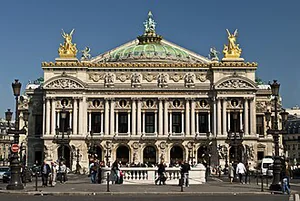
Step through the doors of the Palais Garnier, and you’ll feel like you’ve wandered into a fever dream of gilded grandeur. This is not just an opera house; it’s a palace dedicated to music, spectacle, and unapologetic excess. From the sweeping marble staircase to the seven-ton crystal chandelier, every corner demands a second look. It’s one of the most beloved landmarks in Paris, and it makes an unforgettable first impression.
Known simply as the Palais Garnier, this Beaux-Arts masterpiece sits at the head of the Avenue de l’Opéra. It might be the most famous opera house in the world, thanks in part to Gaston Leroux’s 1910 novel The Phantom of the Opera and the musical it inspired. But long before the masked ghost took center stage, the building was a statement of Second Empire confidence and artistic ambition. It still feels that way today.
The story begins in 1858, when Napoleon III survived an assassination attempt outside the old opera house. He decided Paris needed a grand new home for opera, one with a secure side entrance for royalty. The design competition drew 171 entries, and the winner was a young, relatively unknown architect named Charles Garnier. Construction started in 1861, but it was a rocky road. Workers hit an underground spring and had to spend eight months pumping out water, then more delays came with the Franco-Prussian War and the fall of the empire.
By the time the building finally opened on January 5, 1875, the emperor was long gone, yet Garnier’s vision stood triumphant. The opulent style, now called Beaux-Arts, mixed baroque ornament, renaissance details, and a fearless love of marble, gold leaf, and sculpture. It was instantly controversial and instantly iconic. The architect lived to see his creation become the centerpiece of Parisian cultural life, and it remains one of the finest surviving examples of 19th-century theater design. The Phantom’s legendary underground lake? That’s based on the real water table Garnier had to tame. Imagine that.
Start your visit at the grand staircase. This is the heart of the building, a dramatic cascade of white marble with a wide bottom flight that splits into two, all under a ceiling painted with scenes of music and dance. It was designed for spectacle, so visitors could “see and be seen” during intermission. Climb it slowly. Look up. Go ahead, let your jaw drop. This is where Parisian high society used to parade, and you’ll vaguely feel that history in the air.
Follow the crowd to the Grand Foyer, a gallery of gold mosaics, chandeliers, and painted allegories. It’s often compared to the Hall of Mirrors at Versailles, and for good reason. Two long mirrored galleries stretch the length of the building, with a central salon that practically glows. The acoustics here are generous too, so you’ll hear snippets of conversation in every language bouncing off the gilded walls. Not a bad spot to pause and take it all in.
Inside the auditorium itself, you’ll notice a few surprises. The famous ceiling, a swirl of jazz-age colors by Marc Chagall, was added in 1964, replacing the original. It still sparks debate. The red velvet seats and gold trim feel classic, while the splashy modern ceiling takes a moment to process. You’ll also spot the enormous bronze chandelier, the one made famous in the Phantom’s falling scene. For the best view, head to the upper balconies, where you can look down at the chandelier and across at the Chagall panels from a better angle.
Allow yourself at least an hour and a half to two hours. Tickets usually run around 15 euros for self-guided visits, with guided tours that go behind the scenes for more. Buy in advance if you can, especially on weekends. There’s also an on-site museum and library, the Bibliothèque-Musée de l’Opéra, which holds a treasure trove of ballet artifacts and set designs. It’s a quiet getaway from the crowds, often missed by visitors in a hurry.
Photo spots? The grand staircase from the lower level is the classic shot; come early or late to avoid people. The Grand Foyer mirrors create amazing symmetrical portraits, and the exterior is best photographed from the front or from the side loggia on the upper terrace. But for a real hidden gem, seek out the Rotonde du Glacier. It sits just off the main circulation area and features a painted ceiling by Félix-Joseph Barrias. Most people rush right past it, but the cool, semicircular room holds a hauntingly peaceful mural of a starry sky. Another lesser-known delight is the exterior façade’s honey-colored columns and friezes, which are easier to admire at sunset when the stone glows rose and gold.
No matter how much time you spend, the Palais Garnier rewards slow exploration. Take a seat in the little salon chairs. Trace the gilded curlicues with your eyes. Remember that you’re standing inside a masterpiece that took fifteen years, thousands of workers, and one very stubborn architect to complete. Then step back out onto Place de l’Opéra and join the glittering flow of Paris, carrying the gilded memory with you.
